


High Dynamic Range Camera Portfolio: How 120+ dB HDR Solves Outdoor Imaging Challenges
From smart city surveillance to fleet management, Vadzo Imaging explains how sensor-level High Dynamic Range eliminates detail loss in real outdoor deployments.
FORT WORTH, TX / ACCESS Newswire / May 1, 2026 /Vadzo Imaging, a globally trusted provider of high-performance embedded vision systems, today publishes a definitive technical breakdown of dynamic range in industrial cameras and why 120 dB HDR capability matters in outdoor imaging. For system integrators, OEMs, and vision engineers, dynamic range is not a marketing figure. It determines whether a high dynamic range camera retains usable detail in a scene containing both direct sunlight and deep shadow. Vadzo Imaging builds its camera portfolio on sensors that address this requirement structurally and explains precisely when 120 dB HDR changes the output and when it does not.
What Dynamic Range Means in an Industrial Camera
Dynamic range in an industrial camera is the ratio between the maximum signal a pixel can hold before saturation and the minimum signal it can register above the noise floor. It is expressed in decibels. A camera with a higher dynamic range captures more simultaneous detail across a scene with bright highlights and deep shadows. High dynamic range is not a software filter. It is a sensor-level measurement of how wide a luminance range the imaging sensor can faithfully record in a single exposure.
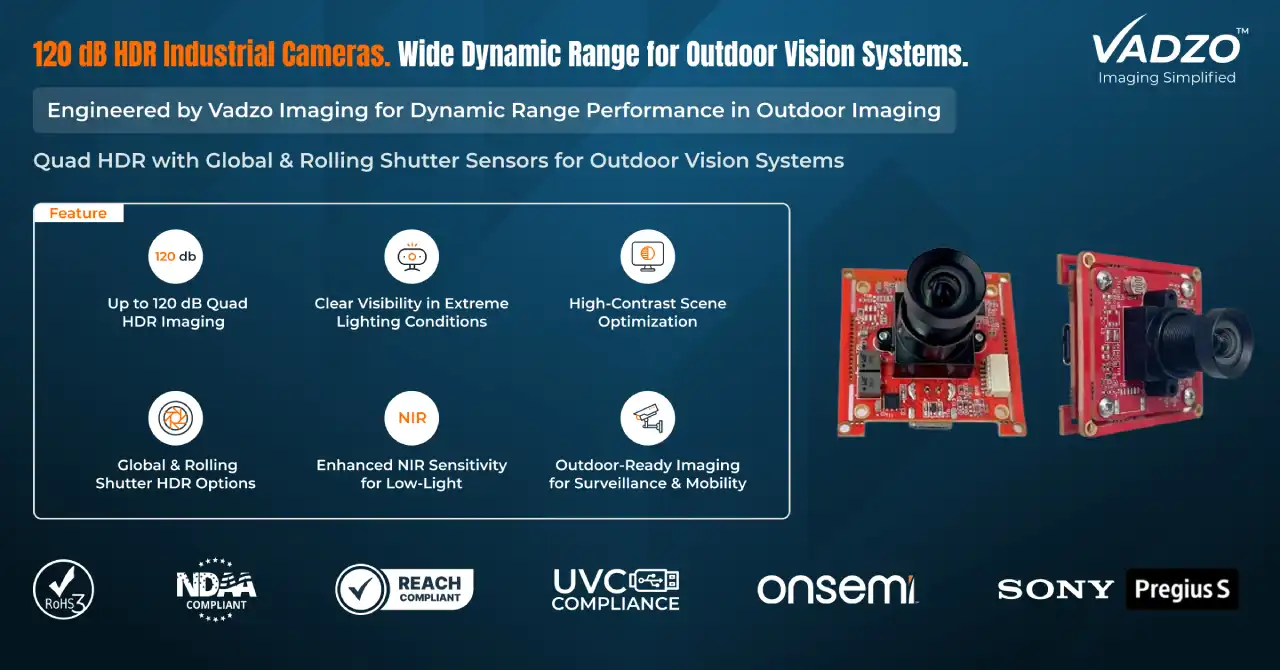
Standard industrial camera sensors typically operate in the 60 to 70 dB range. Outdoor camera deployments encounter scene contrast ratios that exceed this regularly. The AR0821 4K HDR USB Camera from Vadzo Imaging addresses this directly. Built on the Onsemi AR0821 BSI CMOS sensor, the 8MP Rolling Shutter USB Camera delivers high dynamic range capture over USB 3.0. The Onsemi AR0821 8MP USB Camera is deployed in smart city surveillance, outdoor monitoring, and fleet management, where scene contrast exceeds what a standard industrial camera sensor can handle.
Why 120 dB HDR Changes the Output in Outdoor Imaging
At 120 dB HDR, a camera can faithfully image a scene with a luminance ratio of one million to one. This is the contrast range encountered in outdoor camera deployments at the boundary between direct sunlight and shadow. Below 100 dB, detail loss at one end of the scene is unavoidable. At 120 dB HDR, the industrial camera captures both a license plate in deep shadow and a road surface under noon sunlight within the same frame without clipping either. This is the threshold above which a high dynamic range camera stops failing in the specific use case that defines outdoor imaging.
Lens filter control and NIR sensitivity interact with dynamic range at the sensor level. A camera operating at 120 dB HDR with enhanced NIR sensitivity can cover the full outdoor deployment cycle from daylight through dusk to complete darkness under IR illumination without switching sensor modes. The IMX900 Global Shutter Camera from Vadzo Imaging delivers exactly this. The 3MP mono global shutter camera achieves Quad HDR up to 120 dB through hardware-level multi-exposure control.
HDR Modes and Auto-Exposure: How 120 dB HDR is Achieved Without Significant Latency
High dynamic range in an industrial camera can be achieved through multiple methods. Software tone-mapping applies post-processing to a single standard exposure. Multiple exposure HDR fuses two or more frames captured at different integration times. Sensor-level HDR uses pixel-level or hardware-integrated multi-exposure architectures to capture a wide dynamic range within a single frame output cycle. Low-latency camera systems require sensor-level HDR or hardware-accelerated fusion. Software tone-mapping introduces frame latency that is unacceptable in real-time control applications.
The 120 dB HDR capability in the IMX900 sensor-based camera modules from Vadzo Imaging operates through Quad Shutter Control and multi-exposure readout integrated at the pixel level. The IMX900 3MP USB camera and 3MP Quad Shutter Control Camera produce low-latency camera output without software fusion delay. High-contrast imaging in outdoor environments, industrial camera systems at facility perimeters, and outdoor camera networks all operate within the envelope this sensor architecture was designed for.
"Dynamic range is often misunderstood as a specification on paper, but in real deployments, it defines whether an imaging system succeeds or fails. At 120 dB HDR, the camera transitions from losing scene information to reliably capturing both extremes of contrast in a single frame. Our AR0821 and IMX900-based camera portfolio is built around this exact threshold, enabling consistent performance in outdoor and high-contrast environments. " - Alwin Vincent, Product Manager at Vadzo Imaging. "
Engineering Wide Dynamic Range: Vadzo AR0821 & IMX900 Portfolio for Industrial HDR Excellence
Falcon-821CR: Onsemi AR0821 4K HDR USB camera for Smart Cities & Fleet Management
The AR0821 4K HDR USB Camera is designed for outdoor environments where scene contrast exceeds what standard industrial cameras can handle. Using the Onsemi AR0821 BSI CMOS sensor architecture, it captures 8MP 4K HDR output over USB 3.0, handling the transition from noon sunlight to deep shadow without clipping highlights or crushing shadows. As part of the Falcon Series, it delivers UVC-compliant output with LED flicker mitigation, allowing for seamless integration into smart city surveillance, outdoor monitoring, and fleet management camera systems.
Key specs: 8MP (3840×2160) | Onsemi AR0821 BSI CMOS | Rolling Shutter | 1/1.8 " BSI CMOS | USB 3.0 / UVC | 120 dB HDR + LED Flicker Mitigation
Falcon-900MGS: Sony IMX900 Pregius S 3MP Global Shutter for High-Speed Inspection
The IMX900 Global Shutter Camera is built for high-contrast imaging in manufacturing, logistics, and autonomous systems where motion artifacts are unacceptable. Using Sony Pregius S BSI global shutter architecture with Quad Shutter Control, it achieves 120 dB HDR at the hardware level without software fusion latency. As part of the Falcon Series, it delivers low-latency camera output over USB 3.0 with fast auto-exposure, enhanced NIR sensitivity at 850nm and 940nm, and GStreamer pipeline support for edge AI and robotics platforms.
Key specs: 3MP (2048×1536) | Sony IMX900 Pregius S | Global Shutter | 1/2.5 " BSI CMOS | USB 3.0 / UVC | Quad HDR 120 dB + NIR | Fast AE + GStreamer
Applications for Vadzo High Dynamic Range Camera Portfolio Across Industries
Outdoor Surveillance & Smart City Infrastructure: Roadway intersections at noon and at 2 AM under IR illumination represent a contrast range that exceeds what a standard industrial camera handles in a single frame. A 120 dB HDR camera running autoexposure with low-latency camera output on a PoE GigE or USB interface handles this without operator intervention. The AR0821 HDR camera and IMX900 HDR camera portfolio from Vadzo Imaging serves this use case across the Falcon Series USB platform and the Innova Series GigE platform.
Industrial Camera Applications in Manufacturing & Logistics: High-contrast imaging at facility boundaries, loading docks, and outdoor staging areas requires real-time image output without frame latency from software HDR processing. Sensor-level 120 dB HDR eliminates this constraint. High-precision imaging of barcodes and product markings on reflective surfaces under mixed outdoor and artificial illumination requires the camera to hold detail in both specular highlights and matte shadow regions simultaneously.
Agricultural Inspection & Fleet Management Camera Systems: Outdoor camera capability at remote deployment sites where power and connectivity are constrained demands efficient integration. An 8MP rolling shutter USB camera running on a single USB 3.0 cable with auto exposure and high dynamic range output simplifies integration relative to camera modules requiring external power. The AR0821 high dynamic range camera from Vadzo Imaging provides 4K HDR output at 8.3MP over a single USB 3.0 connection with LED flicker mitigation for environments mixing artificial and outdoor illumination.
Frequently Asked Questions (FAQs)
1. If a camera claims 120 dB HDR, is it always delivering that range in real deployments or only under ideal conditions?
This is the correct question. 120 dB HDR as a sensor specification is measured under controlled conditions with optimal ISP tuning, optimal lens, and optimal scene contrast. Real outdoor camera deployments involve lens vignetting, flare, and ISP pipelines that compress the sensor 's raw dynamic range before output. A camera module with a 120 dB HDR sensor that ships with default ISP settings will not achieve 120 dB at the output in every scene. What it will achieve is substantially a wider dynamic range than a 70 dB camera under the same conditions. Vadzo Imaging provides ISP parameter documentation and application engineering support to help engineers determine the threshold for their deployment.
2. Does a 120 dB HDR camera introduce motion artifacts in fast-moving scenes due to multi-exposure fusion?
In software, multi-exposure fusion, yes. When two or more frames captured at different integration times are fused in post-processing, a fast-moving subject produces ghosting artifacts at the fusion boundary. The 3MP Quad Shutter Control Camera from Vadzo Imaging uses sensor-level Quad Shutter Control and global shutter readout. All pixels are exposed and read simultaneously. Motion artifacts from multi-exposure fusion are eliminated at the hardware level. For high-speed industrial camera applications and autonomous vehicle guidance, this architecture distinction is operationally critical.
3. Is a high dynamic range necessary for indoor industrial camera applications or only for outdoor use?
Indoor manufacturing environments with controlled and consistent illumination often do not require 120 dB HDR. A 70 dB industrial camera performs adequately when the lighting system is engineered to maintain uniform scene contrast within that range. The high dynamic range camera requirement emerges when the scene contains simultaneous bright and dark regions that cannot both be resolved within standard dynamic range. This occurs in any indoor environment with windows, open loading bays, vehicle headlights, or weld flash. High-contrast imaging requirements exist in both outdoor and indoor contexts. Vadzo Imaging 's camera portfolio provides a high dynamic range of options across USB and GigE interfaces for both applications.
4. Can auto-exposure on a 120 dB HDR camera handle a scene transition from noon sunlight to underground parking in under one second?
Fast autoexposure is a separate design requirement from a high dynamic range. A camera can have 120 dB HDR capability and still respond slowly to abrupt scene transitions if the auto-exposure algorithm is tuned for gradual illuminance changes. The IMX900 Global Shutter Camera from Vadzo Imaging incorporates fast auto-exposure at the sensor level, not only in firmware. The system uses sensor-assisted fast auto-exposure with optimized firmware control to adjust exposure parameters in real time. For fleet management camera systems on vehicles transitioning between outdoor and covered parking, the combination of 120 dB HDR and sensor-level Fast AE eliminates exposure lag.
5. How does NIR sensitivity interact with a high dynamic range in an outdoor camera operating under mixed solar and IR illumination?
NIR sensitivity and high dynamic range address different parts of the outdoor imaging challenge. NIR sensitivity enables the camera to produce usable output under IR illumination when solar illuminance drops to zero. High dynamic range enables the camera to hold detail when both solar and IR illumination are present simultaneously, a condition that occurs at dusk and dawn. A camera without NIR sensitivity fails at night regardless of its dynamic range specification. A camera without sufficient dynamic range fails at dusk regardless of its NIR sensitivity. The IMX900 3MP USB camera addresses both requirements simultaneously through STARVIS 2 BSI architecture with enhanced NIR sensitivity at 850nm and 940nm and Quad HDR up to 120 dB.
6. What is the risk of deploying a high dynamic range camera module in a vibration-intensive industrial environment?
The primary risk in vibration-intensive industrial camera environments is not sensor damage, but lens shift and connection integrity. The AR0821 and IMX900 camera portfolio from Vadzo Imaging uses M12 S-Mount lens holders that are mechanically robust relative to C-mount or CS-mount alternatives. RJ45 connectors with locking hardware maintain GigE signal integrity in high-vibration industrial automation environments. The camera boards themselves are compact and low-mass, reducing inertial stress at the mounting points. Vadzo Imaging provides OEM customization, including IP-rated enclosure design for deployments where environmental protection and vibration isolation are structural requirements.
Availability
The AR0821 4K HDR USB Camera and IMX900 Global Shutter Camera are available now for OEM evaluation and production deployment. Technical documentation, evaluation kits, datasheets, and SDK downloads are available through the Vadzo Imaging sales team. For volume pricing, OEM customization, and firmware modifications, contact support@vadzoimaging.com or call +1 817-678-2139.
About Vadzo Imaging
Vadzo Imaging develops high-performance embedded vision systems and camera modules for OEMs and system integrators building next-generation intelligent systems. The company delivers imaging platforms across USB, MIPI, GigE, Wi-Fi, and SerDes interfaces, supporting applications in industrial automation, robotics, smart surveillance, smart city infrastructure, and edge AI. Beyond hardware, Vadzo provides end-to-end imaging expertise, including sensor integration, ISP tuning, firmware development, and OEM customization services that accelerate development and deployment at scale. Every product is built on the principle that premium imaging should be accessible, reliable, and instantly deployable. Visit vadzoimaging.com to explore the full camera portfolio.
Media Contact
Alwin Vincent
Vadzo Imaging
Phone: +1 817-678-2139
Email:alwin@vadzoimaging.com
LinkedIn:Vadzo Imaging
YouTube: Vadzo Imaging
X: Vadzo Imaging
SOURCE:Vadzo Imaging
View the original press release on ACCESS Newswire
© 2026 ACCESS Newswire. All Rights Reserved.