



Vadzo Imaging Introduces the Bolt-830MRS Monochrome MIPI Camera with 8MP Rolling Shutter, CSI-2 Interface, Built on Onsemi HyperLux LP AR0830
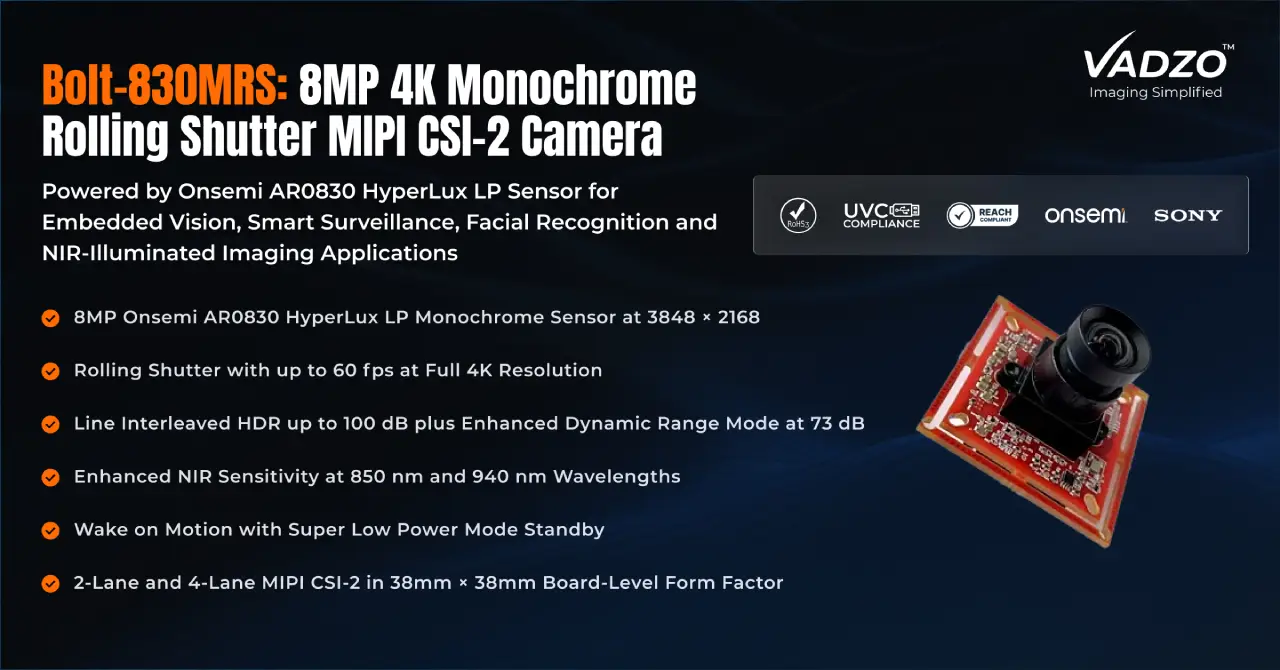
The Bolt-830MRS is an 8MPmonochrome MIPI camera built on the Onsemi AR0830 HyperLux LP sensor, delivering 4K rolling shutter imaging with Line Interleaved HDR up to 100 dB dynamic range. The module combines enhanced NIR response at 850 nm and 940 nm, Wake on Motion standby, and super low power operation in a compact 38mm × 38mm board-level MIPI CSI-2 form factor purpose-built for embedded vision systems where high resolution grayscale capture, low power consumption, and NIR-illuminated imaging are core requirements.
FORT WORTH, TX / ACCESS Newswire / May 18, 2026 /Vadzo Imaging is a provider of embedded vision camera products and today introduces the Bolt-830MRS. The Bolt-830MRS is an 8MP 4K Monochrome Rolling Shutter MIPI CSI-2 camera module built on the Onsemi AR0830 HyperLux LP sensor. With this launch Vadzo delivers anIndustrial Embedded MIPI Camera purpose-built for embedded vision deployments where grayscale clarity, near-infrared sensitivity, and event-driven low-power operation must arrive over a native CSI-2 interface without USB protocol overhead.
Sensor and Camera Overview
The Bolt-830MRS is built on the Onsemi AR0830 HyperLux LP Monochrome sensor a stacked 1/2.9-inch back-side illuminated CMOS image sensor with a 1.4 µm pixel pitch and a maximum resolution of 8MP at 3848 × 2168. The monochrome variant of the AR0830 omits the Bayer color filter array, enabling every pixel to capture full broadband light. This raises the Clear channel responsivity to 17.3 ke⁻/lux-sec, which is significantly higher than the green channel responsivity of the color variant of the same sensor. The result is improved performance in low-light scenes and stronger near-infrared response at 850 nm and 940 nm wavelengths. The AR0830 mono camera supports Line Interleaved HDR mode at up to 100 dB dynamic range, enhanced Dynamic Range mode at 73 dB in 1-exp configuration, Wake on Motion, Super Low Power Mode and context switching across multiple sensor configurations.
On the camera side, the Bolt-830MRS is delivered as a 2-board solution. The camera board houses the AR0830 monochrome sensor, ISP, lens, and lens holder. The adapter board provides the connector interface for either 2-lane or 4-lane MIPI CSI-2 termination. The form factor measures 38mm × 38mm convertible to 32mm × 32mm for space-constrained embedded platforms. The module ships with a standard M12 S-Mount lens holder accepting third-party M12 lenses. The Bolt-830MRS operates from −30°C to 70°C and is ROHS3 and REACH compliant.
Key specs: 8MP (3848 × 2168) | Onsemi AR0830 HyperLux LP 1/2.9 " 1.4 µm | Monochrome | Rolling Shutter | LI-HDR up to 100 dB | eDR Mode at 73 dB | NIR at 850 nm and 940 nm | Wake on Motion | 2-lane and 4-lane MIPI CSI-2 | 4-lane MIPI D-PHY up to 1.5 Gbps/lane | Y8 Output Format | 38mm × 38mm | −30°C to 70°C
Key Capabilities of the Onsemi AR0830 HyperLux LP Monochrome MIPI CSI-2 Camera Module
8MP Monochrome Rolling Shutter Imaging
Rolling shutter sensors capture image data row by row, and the AR0830 mono camera routes the full broadband signal directly to the photodiode without a Bayer filter mosaic in the path. Every pixel collects light across the visible and near-infrared spectrum simultaneously. With a Clear channel responsivity of 17.3 ke⁻/lux-sec the sensor delivers noticeably stronger signal per pixel under the same illumination compared to the color variant of the same sensor. As a high-resolution monochrome camera platform, the AR0830 HyperLux LP supports up to 60 fps at full 4K resolution over a 4-lane MIPI CSI-2 connection and delivers Y8 output for direct ingestion into ISP pipelines and inference frameworks that do not require demosaicing. For engineers working with an 8MP MIPI camera requirement the monochrome variant of the AR0830 extends the same resolution and interface into pure grayscale capture.
Line Interleaved HDR and Enhanced Dynamic Range
The Bolt-830MRS supports Line Interleaved HDR mode where alternating rows of the sensor capture different exposure levels within a single frame, and the results combine to produce a high dynamic range image. This single-frame approach avoids the alignment overhead and motion artefacts associated with multi-frame HDR merging. LI-HDR mode delivers up to 100 dB of dynamic range. Enhanced Dynamic Range mode extends the usable luminance range through analog processing within a single exposure cycle delivering 73 dB in 1-exp configuration. Both modes are appropriate for moving scenes, and embedded vision deployments where lighting conditions vary across the captured frame. For OEM teams already evaluating Vadzo 's 4K HDR MIPI camera options the Bolt-830MRS extends the AR0830 HyperLux LP platform into monochrome capture without changing the HDR architecture that has already been validated on the color variant.
Enhanced NIR Sensitivity at 850 nm and 940 nm
The AR0830 HyperLux LP architecture is engineered for strong response in the near-infrared band specifically at the 850 nm and 940 nm wavelengths used by industrial NIR illumination arrays. Monochrome capture preserves the full NIR signal without color filter absorption losses making the Bolt-830MRS a strong fit for any 4K MIPI monochrome camera deployment where ambient visible light is limited or where structured NIR illumination is the primary scene light. Typical use cases include face capture under controlled IR illumination, vein pattern recognition for biometric authentication, document capture under non-visible light and security applications operating in low-light or night-time environments.
Wake on Motion and Super Low Power Operation
The HyperLux LP designation reflects the AR0830 sensor 's ultra-low power architecture. Typical power consumption is 190 mW at full 8MP capture at 60 fps. The sensor includes a hardware Wake on Motion feature that holds the imager in Super Low Power Mode standby between motion events and resumes full-resolution capture immediately when motion is detected. This eliminates continuous streaming overhead in always-on deployments and extends operating duration for battery-backed or solar-powered embedded vision systems where per-frame power cost determines mission cycle duration. For OEM teams building smart city camera nodes and event-triggered surveillance terminals, the Wake on Motion architecture delivers 4K monochrome capture on demand rather than continuous streaming power draw.
Programmable Sensor Control and Subsampling Modes
The Bolt-830MRS exposes the AR0830 sensor 's programmable controls over the I²C interface including gain, horizontal and vertical blanking, frame rate, exposure time, window size, cropping and image mirror or flip. Monochrome subsampling modes include skipping and summing which let engineers trade resolution for frame rate or signal strength at the sensor level without downstream processing. Various trigger modes are available for multi-sensor synchronization in stereo and structured-light configurations. An on-chip temperature sensor and on-chip lens shading correction simplify thermal compensation and optical calibration during integration. Bit-depth compression (DPCM 10-8) is available for the MIPI interface, and 800 bytes of one-time programmable memory are available for storing shading correction coefficients and module information.
Platform Integration and OEM Customization
The Bolt-830MRS connects natively over 2-lane or 4-lane MIPI CSI-2 to embedded SoC platforms including Raspberry Pi, NVIDIA Jetson Nano, NVIDIA Xavier NX and NXP i.MX8M Plus. Module-level Linux drivers are available out of the box for these platforms eliminating bridge IC overhead and the framing latency that comes with USB 4K module architectures. For edge AI inference, this means deterministic sensor-to-NPU data delivery. For Embedded Vision OEM Camera deployments, this means lower system bill of materials and one fewer driver stack to maintain across kernel updates. Driver porting support for additional SoC platforms including STM and MediaTek is available on request from the Vadzo engineering team.
Vadzo supports full OEM customization through its OEM MIPI Camera Module program including form factor modifications, board redesigns, firmware development, custom feature integration, NIR and visible LED array board design, lens holder modifications, electro-mechanical lens filter control and IP-rated and non-IP-rated enclosure design. Engineering teams can engage with Vadzo from sensor selection through enclosure delivery.
"Monochrome imaging is the right answer for a growing set of embedded vision problems where the value of color information is zero and the cost of color information is sensitivity and bandwidth. NIR-illuminated biometrics, low-light security, document capture and machine-readable code detection do not need a Bayer mosaic. They need every photon. With the Bolt-830MRS we paired the AR0830 HyperLux LP monochrome sensor with native MIPI CSI-2 integration and Wake on Motion so embedded engineers can deliver high resolution grayscale capture and event-driven operation in a single board-level module without the power overhead that continuous-stream architectures impose. " - Alwin Vincent, Product Manager, Vadzo Imaging
Applications
Retail Analytics and In-Store Vision
The Bolt-830MRS supports retail analytics systems including shelf monitoring, queue analysis and people-counting deployments where grayscale capture under mixed indoor lighting is sufficient, and HDR coverage of fluorescent-lit aisles is required. LI-HDR mode preserves detail across illumination boundaries that defeat single-exposure imaging modules.
Smart City Camera Infrastructure
For smart city camera nodes deployed on streetlights, traffic intersections and pedestrian crossings, the camera 's low-power architecture combined with Wake on Motion enables long-duration operation on grid-tied and battery-backed installations. Full 4K monochrome capture supports license plate readability, traffic flow analysis and crowd-level scene analysis without the bandwidth burden of full RGB streams.
Facial Recognition and Access Control Terminals
The AR0830 monochrome sensor 's strong NIR response at 850 nm and 940 nm makes the Bolt-830MRS well suited for facial recognition camera kiosks and access control terminals. IR-illuminated face capture remains consistent regardless of ambient lighting variation across building entrances and interior lobby zones where single-exposure color imaging produces uneven results.
Robotics Camera and AGV Perception
For robotics camera applications, AGV navigation and warehouse automation the rolling shutter capture, NIR sensitivity and grayscale clarity of the Bolt-830MRS support document scanning, barcode reading, OCR and obstacle detection in structured-light environments. The 2-lane and 4-lane MIPI CSI-2 interface connects directly into the SoC ISP pipeline without USB bridging overhead.
Wearable Camera and Head-Mounted Imaging Devices
The compact 32mm × 32mm convertible form factor enables integration into wearable camera enclosures including dental loupes, head-mounted inspection devices, body-worn monitoring camera products and assistive headsets where weight and footprint are primary design constraints.
Edge AI and Embedded Vision Inference
For real-time AI inference on embedded platforms, cropping and subsampling modes reduce bandwidth and processing load at the sensor level. The monochrome output of the Bolt-830MRS feeds directly into grayscale-trained inference models for defect detection, anomaly recognition and machine-readable code interpretation across LED-lit factory floors and outdoor inspection sites.
Security and Surveillance Applications
4K monochrome capture combined with enhanced NIR sensitivity makes the Bolt-830MRS suitable for night-time perimeter monitoring, IR-illuminated covert imaging and battery-backed remote surveillance nodes where Wake on Motion eliminates continuous-stream power draw. The onsemi AR0830 camera platform 's low power consumption makes it a strong fit for solar-powered outdoor deployments where per-event energy cost determines installation cycle duration.
Frequently Asked Questions (FAQs)
What is the best MIPI CSI-2 monochrome camera with NIR sensitivity at 850nm and 940nm for biometric and low-light applications?
Biometric terminals, facial recognition kiosks, and low-light security deployments require a camera that captures clean detail under IR illumination without the sensitivity loss that color filter arrays impose. The Bolt-830MRS delivers 17.3 ke⁻/lux-sec Clear channel responsivity, because every pixel captures full broadband light without a Bayer mosaic in the path. NIR response at 850 nm and 940 nm covers the standard IR illumination wavelengths used in biometric, vein recognition, and night-vision deployments. Y8 monochrome output feeds directly into IR-trained inference models without demosaicing overhead, reducing both pipeline latency and host CPU load.
Which 4K MIPI camera with Wake on Motion is best for battery-powered and solar surveillance deployments?
Always-on 4K streaming drains battery-backed and solar-powered surveillance nodes faster than the energy budget allows, the right camera holds standby between events and resumes full-resolution capture only when motion is detected. The Bolt-830MRS Wake on Motion feature keeps the AR0830 sensor in Super Low Power Mode between motion events and triggers immediate full 4K monochrome capture on detection. At 190 mW for full 8MP capture at 60 fps, the power envelope supports long-duration deployments where per-event energy cost determines installation cycle. For smart city nodes, perimeter monitoring terminals, and remote embedded vision systems, Wake on Motion delivers event-driven 4K capture without continuous-stream power draw.
What is the difference between LI-HDR and eDR mode, and which HDR setting is right for my embedded vision deployment?
Choosing the wrong HDR mode for a deployment produces motion artifacts, dynamic range shortfall, or bandwidth overhead that a correctly selected mode avoids entirely. The Bolt-830MRS LI-HDR mode delivers up to 100 dB dynamic range, which is the right choice for high-contrast scenes such as outdoor surveillance, traffic monitoring, and mixed-light industrial environments where the full dynamic range headroom is needed. Enhanced Dynamic Range mode delivers 73 dB within a single exposure cycle. Both modes suit moving scenes and both are programmable over the I²C interface without a firmware change, allowing integrators to match the HDR mode to the actual lighting conditions of the deployment.
Which 8MP monochrome MIPI CSI-2 camera integrates natively with Jetson, Raspberry Pi, and i.MX without USB bridging overhead?
USB-bridged camera modules introduce framing latency, an additional driver stack, and protocol overhead that MIPI-native embedded platforms do not require, and that edge AI inference pipelines cannot tolerate when deterministic sensor-to-NPU delivery matters. The Bolt-830MRS connects natively over 2-lane or 4-lane MIPI CSI-2 to Raspberry Pi, NVIDIA Jetson Nano, NVIDIA Xavier NX, and NXP i.MX8M Plus with validated module-level Linux drivers out of the box. Direct CSI-2 connection eliminates the USB bridge IC, reduces system BOM, and delivers deterministic sensor-to-NPU data transfer for real-time inference on grayscale models. Driver porting for STM and MediaTek platforms is available on request from the Vadzo engineering team.
Does Vadzo Imaging support OEM customization on the AR0830 HyperLux LP camera platform?
Yes. Vadzo Imaging supports full OEM customization across the AR0830 HyperLux LP camera platform including form factor modifications, board redesigns, firmware development, custom feature integration, NIR and visible LED array board design, lens holder modifications, electro-mechanical lens filter control and IP-rated and non-IP-rated enclosure design. Vadzo engineering engages with OEM teams from sensor selection through enclosure delivery. Reach the Vadzo team at support@vadzoimaging.com or +1 817-678-2139 to discuss requirements.
What other monochrome MIPI camera modules are available in the Vadzo Bolt Series camera portfolio?
Vadzo offers a complete monochrome MIPI camera lineup across resolutions and shutter architectures. For higher resolution applications, the 13MPAR1335 monochrome MIPI camera delivers full 4K and 13MP output. For NIR-focused 5MP applications, the 5MP AR0522 NIR monochrome MIPI camera is purpose-built for low-light and IR illumination. For 2MP global shutter applications the 2MP AR0234 monochrome global shutter MIPI camera eliminates rolling shutter artefacts. For 3MP global shutter capture with Quad HDR, the 3MP IMX900 monochrome global shutter MIPI camera built on the Sony Pregius S sensor extends the portfolio further. Each module in Vadzo 's High-Speed MIPI Camera portfolio targets a specific combination of resolution, shutter architecture, and sensor performance for embedded vision deployments.
5) What output format and resolutions does the Bolt-830MRS deliver?
The Bolt-830MRS delivers image capture and video streaming in Y8 monochrome format with selectable resolutions from VGA through 720p, 1080p and full 4K at 3848 × 2168. Subsampling modes including skipping and summing are programmable over the I²C interface for sensor-level resolution and frame rate trade-offs without host-side downscaling. In LI-HDR and eDR modes, the sensor operates at 30 fps at full 4K resolution. The onsemi AR0830 camera also supports a crop mode at 90 fps and 2MP output at 120 fps through the Bin2 mode.
Availability
The Bolt-830MRS Monochrome MIPI CSI-2 camera module is available for evaluation and production orders. Evaluation kits include the camera board, MIPI adapter board, default 74° DFOV M12 S-Mount lens and platform driver documentation with no minimum order requirement. Contact Vadzo at support@vadzoimaging.com or +1 817-678-2139 to request an evaluation kit or to discuss OEM integration requirements.
About Vadzo Imaging
Vadzo Imaging is a global provider of embedded vision solutions delivering high-performance camera technologies and imaging platforms for applications in robotics, industrial automation, UAVs, edge AI and medical systems. Vadzo products are designed for seamless integration with leading embedded platforms such as NVIDIA Jetson, Raspberry Pi, Qualcomm RB series and NXP i.MX. Vadzo supports customers through hardware customization, firmware development and module-level drivers enabling faster development and deployment of vision-based systems.
Media Contact
Alwin Vincent
Vadzo Imaging
Email: alwin@vadzoimaging.com
LinkedIn: Vadzo Imaging
YouTube: Vadzo Imaging
X: Vadzo Imaging
SOURCE: Vadzo Imaging
View the original press release on ACCESS Newswire
© 2026 ACCESS Newswire. All Rights Reserved.