


Vadzo Imaging Explains Depth Sensing Camera Technologies: Stereo Vision, Structured Light, and Time of Flight for Robotics
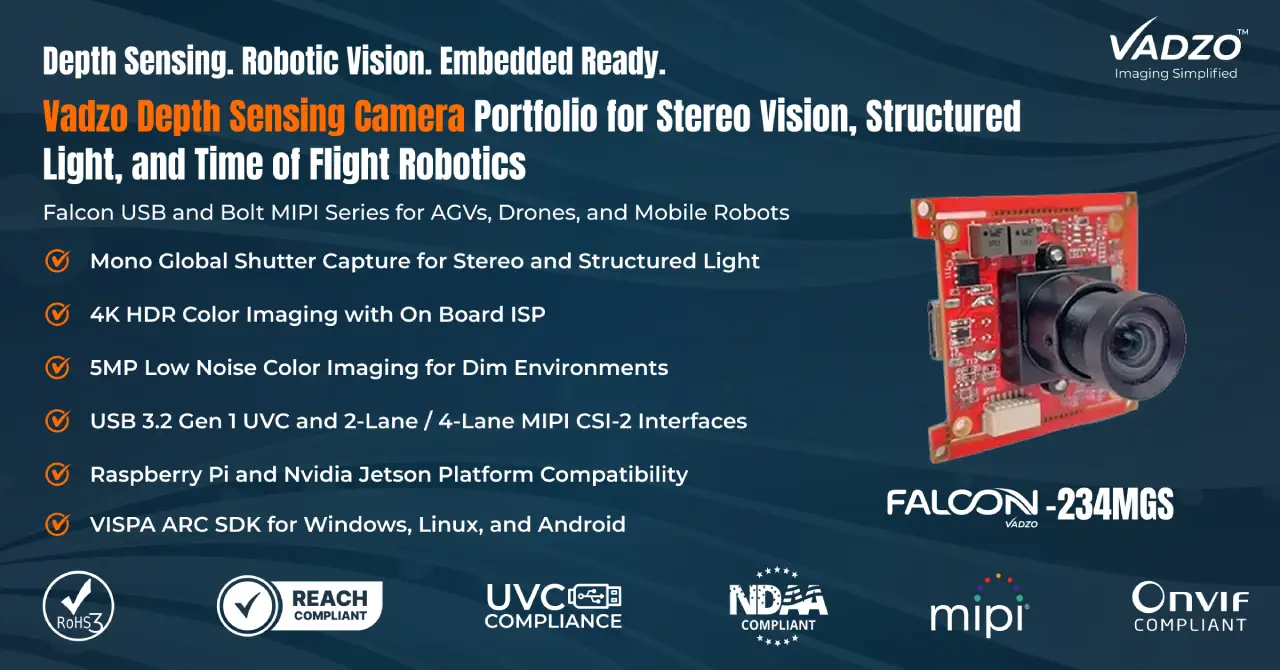
Vadzo depth sensing camera solutions engineered for robotic vision pipelines spanning stereo vision, structured light, and time of flight architectures. The Falcon mono global shutter USB camera portfolio anchored by the AR0234 mono global shutter camera supports stereo and structured light capture, while the Bolt MIPI camera portfolio featuring the AR0821 4K HDR MIPI camera and the AR0521 5MP low noise MIPI camera delivers the high resolution color stream for ToF sensor fusion in dim and dynamic environments. Interface support spans USB 3.2 Gen 1 UVC and 2 lane and 4 lane MIPI CSI-2 connectivity, with the VISPA ARC SDK enabling OEM integration across AGVs, drones, mobile robots, and collaborative robotic platforms.
FORT WORTH, TX / ACCESS Newswire / May 20, 2026 /Vadzo Imaging today published a technical explainer covering the three primary depth-sensing camera technologies used in modern robotics. The explainer outlines how stereo vision, structured light, and time of flight differ in operating principle, range, accuracy, and lighting tolerance, and how each technology maps to specific robotic vision workloads. Alongside the explainer, Vadzo highlights its robotic vision camera portfolio that integrates into these depth pipelines across USB and MIPI interfaces.
Modern robots rely on accurate three-dimensional scene understanding to navigate environments, detect obstacles, manipulate objects, and operate around humans. Each depth modality carries distinct tradeoffs. Selecting the correct 3D depth sensing camera approach is a critical design decision for embedded vision engineers and OEM developers building autonomous platforms, AGVs, drones, and collaborative robots.
The Falcon series and Bolt series from Vadzo provide the front-end imaging components used inside these depth architectures. Mono global shutter modules anchor stereo vision and structured light pipelines. HDR and low-light color modules deliver the high-resolution RGB stream that complements depth data in sensor fusion-based spatial vision camera systems for robotics.
Stereo Vision: Passive Depth Through Binocular Geometry
Stereo vision is a passive depth-sensing method that uses two synchronized camera modules separated by a fixed baseline. The system captures the same scene from two viewpoints simultaneously. By identifying matching features between the left and right images, the system computes pixel disparity and applies triangulation using the known baseline and intrinsics to derive depth for every matched point. Because the method does not emit any signal, it is robust in outdoor sunlight and does not interfere with other sensors operating nearby.
Two technical requirements dominate stereo system design. The first is global shutter capture. Rolling shutter sensors introduce inter-row time offsets that distort fast-moving objects and break disparity estimation on dynamic scenes. Global shutter sensors expose every pixel simultaneously, which preserves geometric integrity for stereo matching. The second is monochrome capture. Mono sensors deliver a higher signal-to-noise ratio per pixel than Bayer color sensors at the same resolution, which directly improves feature matching, edge contrast, and disparity confidence in textured and low-texture regions.
Vadzo Imaging Stereo Vision Camera Options
The Falcon-234MGS is a 1080p monochrome global shutter USB camera built on the Onsemi AR0234 CMOS sensor with a 1/2.6 inch optical format and a 3.0 µm pixel size. The module delivers a 2MP maximum resolution of 1920 x 1200 with video streaming up to 1080p at 60fps, 720p at 60fps, and VGA at 90fps. It uses a USB 3.0 Gen 1 Type C interface that is backward compatible with USB 2.0 and is UVC compliant for plug-and-play deployment on Windows and Linux. The compact 38mm x 38mm form factor convertible to 32mm x 32mm with an S Mount M12 lens holder and a 74 DFOV lens makes it a strong fit for paired stereo rigs on robotic platforms. The wide operating temperature range of negative 40 degrees C to 85 degrees C supports both indoor and outdoor robotic deployments.
For embedded designs that bypass USB host overhead, the Bolt-234MGS provides the same AR0234 mono global shutter imaging on a monochrome global shutter MIPI camera interface. The module supports both 2 Lane MIPI CSI-2 and 4 Lane MIPI CSI-2 termination through Vadzo 's adapter board. It integrates with Raspberry Pi, Nvidia Jetson Nano, and Nvidia Jetson XavierNX platforms, commonly used as compute payloads in robotic stereo rigs. Like its USB counterpart, it delivers 2MP at 1920 x 1200 with the AR0234 1/2.6-inch sensor at 3.0 µm pixel size, the 74 DFOV S Mount optics, and the negative 40 degrees C to 85 degrees C operating range. As a global shutter MIPI camera in a 38mm x 38mm board-level form factor, it is designed for OEMs building their own compute platforms onto AGVs and autonomous mobile robots.
Structured Light: Active Depth Through Projected Patterns
Structured light is an active depth-sensing technique. A projector emits a known optical pattern onto the scene. The pattern is most commonly a coded stripe sequence, a pseudo-random dot pattern, or a speckle pattern. A camera positioned at a known offset from the projector observes how the pattern deforms when it falls on three-dimensional surfaces. The system computes depth by triangulating the deformed pattern against the original known pattern using the projector to camera baseline.
Near infrared wavelengths around 850nm or 940nm are typically used so that the pattern is invisible to humans and does not contaminate visible imaging streams running on the same robot. Two characteristics define a good, structured light capture camera. First, the sensor must be monochrome and sensitive in the near infrared band so that the projected pattern is recorded with high contrast against the scene background. Second, the sensor must use a global shutter that exposes every pixel simultaneously; the projected pattern is sheared across rolling shutter rows during motion or during high-speed pattern sequencing.
Structured light works well in indoor controlled lighting and delivers high accuracy at short to medium range, which makes it a natural fit for bin picking, pick and place arms, 3D scanning, and item dimensioning on warehouse robots. Performance degrades under direct sunlight where ambient infrared swamps the projected pattern.
Vadzo Imaging Structured Light Camera Options
Vadzo 's monochrome global shutter platforms are well-suited for the capture side of structured light pipelines. The AR0234-based Falcon-234MGS, as a global shutter USB camera, and the Bolt-234MGS, as a MIPI monochrome camera, deliver the simultaneous pixel exposure required to record undistorted projected patterns. Both modules share the same Onsemi AR0234 sensor, 2MP resolution at 1920 x 1200, 3.0 µm pixels, and 74 DFOV optics, which makes them interchangeable between USB and MIPI structured light prototypes.
For OEMs building custom structured light heads, Vadzo also offers integration services that include design and integration of NIR and color LED array boards, lens holder modifications with electromechanical lens filter control, and enclosure design for IP-rated and non-IP-rated structured light units. This allows robotic platform builders to consolidate the projector, the NIR-sensitive camera, and the synchronization electronics into a single qualified module.
Time of Flight: Direct Depth Measurement by Light Travel Time
Time of flight, or ToF, is an active depth sensing method that measures the round-trip travel time of an emitted light pulse to derive distance. A modulated light source, typically a vertical cavity surface-emitting laser at 850nm or 940nm, illuminates the scene. A dedicated ToF sensor measures either the direct arrival time of the returning photons in direct ToF or the phase shift of the modulated wave in indirect ToF. Distance is computed for each pixel from the timing or phase data, which produces a per-pixel depth map at the sensor frame rate.
ToF systems offer compact form factors, low computational load on the host processor, and operate at longer ranges than structured light. They are commonly used for collision avoidance on AGVs, free space detection on mobile robots, gesture recognition on collaborative robots, and people detection on service robots. ToF data is typically fused with a high-resolution color image stream from a companion 2D camera. This sensor fusion approach pairs the dense depth map from the time of flight camera with the rich texture, resolution, and dynamic range of a high-quality color camera to enable semantic scene understanding and object recognition that depth alone cannot deliver.
Vadzo Imaging Camera Options for ToF Sensor Fusion Pipelines
The Bolt-821CRS is a 4K HDR MIPI module built on the Onsemi AR0821 CMOS sensor with a 1/1.7-inch optical format and a 2.1 µm pixel size. It delivers an 8MP maximum resolution of 3848 x 2168 with video streaming up to 4K, 1080p, and 720p, coupled with ISP support through the host SoC pipeline for Auto Exposure, Auto White Balance, Auto Gain, and HDR processing. As a 4K HDR MIPI Camera, it acts as the high-resolution color channel in RGB plus depth robotic pipelines, where it provides the textured imagery that overlays onto the ToF depth map. The module supports both 2 Lane and 4 Lane MIPI CSI-2 connections to Raspberry Pi, Nvidia Jetson Nano, and Nvidia Jetson XavierNX, and ships in the same 38mm x 38mm form factor with a 74 DFOV S Mount lens. The Bolt-821CRS also offers good NIR sensitivity, which extends its usefulness into robotic scenes lit by NIR illuminators.
The Bolt-521CRS is a 5MP low noise MIPI camera built on the Onsemi AR0521 CMOS sensor with a 1/2.5-inch optical format and a 2.2 µm pixel size. It delivers a 5MP maximum resolution of 2592 x 1944 with video streaming up to 1080p, 720p, and VGA. As a 5MP MIPI camera coupled with a high-performance ISP, it delivers clean color imaging in dim warehouse aisles, in twilight outdoor robotics, and in indoor service robot environments where the ambient light is well below daylight levels. The Bolt-521CRS is supplied in the same 38mm x 38mm form factor and uses the 2 Lane and 4 Lane MIPI CSI-2 interfaces for direct integration with Raspberry Pi and Nvidia Jetson-based ToF sensor fusion stacks.
For robotic platforms that require a custom ToF plus RGB head, Vadzo offers design and integration of advanced sensors, including ToF, mmWave Radar, and IMU as part of its camera customization service. This allows OEMs to consolidate a dedicated ToF Camera depth sensor with a Bolt series color module or Falcon series color camera.
Software Platform and Integration
All Falcon USB modules in the Vadzo depth sensing portfolio are supported by the VISPA ARC SDK. The SDK provides camera control, video streaming, and hardware management for Vadzo USB and MIPI modules on Windows, Linux, and Android. It supports Region of Interest configuration, image flip, SMART GPIO control, autofocus where applicable, still capture, and secure firmware updates. The platform consistency across the AR0234 monochrome camera, AR0821 camera, and AR0521 camera modules lets robotic OEMs share calibration, sync, and image control routines across stereo, structured light, and ToF heads. The MIPI modules are validated with Raspberry Pi and selected Nvidia SOM platforms, and driver porting is available for NXP IMX, STM, and MediaTek hosts on request.
"Robotic vision is no longer a single sensor problem. The decision between stereo, structured light, and time of flight depends on range, lighting, motion, and downstream perception load. With the Falcon mono global shutter family for stereo and structured light capture and the Bolt HDR and low noise color family for ToF sensor fusion, our objective is to give embedded vision engineers a consistent camera platform and SDK they can build any of the three depth pipelines on without changing the rest of their stack. " - Alwin Vincent, Product Manager, Vadzo Imaging.
Robotic Vision Applications
Autonomous Mobile Robots and AGVs: Obstacle avoidance, free space detection, and lane following using stereo or ToF depth combined with mono global shutter feature tracking on the navigation stack.
Warehouse Robotics and Bin Picking: Item dimensioning, 3D scanning, and pick and place using structured light for short range high accuracy depth on stationary or slow-moving arms.
Drones and UAVs: Sense and avoid, terrain following, and visual odometry using stereo vision with the Falcon and Bolt mono global shutter modules as the navigation eyes of the platform.
Collaborative Robots and Safety: Human worker detection, distance monitoring, and gesture interpretation using ToF depth fused with a high-resolution color stream for semantic understanding.
Mobile Service Robots: Indoor mapping, people following, and object recognition using ToF for free space and a low noise color companion for low light scene parsing in homes, hotels, and hospitals.
Smart Parking and Vehicle Monitoring: Vehicle counting, occupancy mapping, and barrier control using monochrome global shutter capture for stable disparity under variable lighting.
Edge AI Robotics: On device perception running on Nvidia Jetson and Raspberry Pi class compute with the MIPI Falcon and Bolt modules delivering the input stream for stereo, structured light, or ToF fusion inference.
Frequently Asked Questions (FAQs)
1) What is the best camera solution for stereo vision depth sensing in robotics?
For stereo vision depth pipelines, pairing two identical AR0234-based modules is the most reliable approach. Vadzo Imaging offers this configuration through its Falcon-234MGS for USB 3.0 host deployments and the Bolt-234MGS for embedded MIPI designs. Both are built on the Onsemi AR0234 mono global shutter sensor at 2MP resolution and can be deployed in matched stereo camera configurations for disparity-based depth estimation, which is exactly what robotic navigation, AGV imaging, and drone applications need for clean disparity maps. Vadzo 's stereo vision camera portfolio makes it straightforward to source a matched pair from a single vendor without worrying about sensor-to-sensor variation.
2) Why does global shutter matter for stereo vision and structured light robotic systems?
Global shutter exposes every pixel simultaneously. In a stereo rig that means both the left and right frames share the same moment in time, so the geometric relationship between them stays intact even when the robot or the scene is moving. Rolling shutter exposes rows one after another, which bends straight edges on moving subjects and shears projected light patterns, making depth calculations unreliable. Any robotic platform that moves or operates in a dynamic environment needs global shutter capture for consistent and accurate depth output.
3) What camera products does Vadzo offer for structured light 3D scanning in industrial robotics?
Vadzo 's mono global shutter modules are a natural fit for structured light heads because they capture projected NIR patterns with simultaneous pixel exposure across the full frame. Vadzo goes further than just the sensor module, though. For OEMs building an integrated structured light product, the team can add NIR LED array boards, lens filters, and custom enclosure designs around the same AR0234-based platform. That means the same structured light camera core can be reused and repackaged across multiple product lines rather than redesigned from scratch each time.
4) Can a high-resolution color module be fused with a ToF depth sensor in a robotic perception stack?
Yes, and Vadzo 's Bolt series is designed for exactly this kind of RGB plus depth pipeline. The Bolt-821CRS delivers 4K HDR imaging at 3848 x 2168 with on-board ISP and solid NIR sensitivity, while the Bolt-521CRS provides 5MP imaging at 2592 x 1944 using the AR0521 low noise sensor, which handles dim environments well. Either module pairs with a dedicated ToF depth sensor to produce an RGB plus D feed that robotic perception software can use for object classification and semantic scene understanding. Vadzo 's full 3D vision camera portfolio covers this use case from the color channel through to custom integration support.
5) Which depth-sensing technology is best suited to outdoor mobile robots?
Stereo vision is generally the preferred choice for outdoor platforms because it is passive. It does not depend on projected light, so ambient sunlight can overpower. Structured light works well in controlled indoor settings but struggles outside for the same reason. Time of flight can operate in both environments, though it typically needs optical filtering and modulation tuning to suppress ambient infrared in bright conditions. On outdoor mobile robots, the most capable setups combine stereo or ToF depth sensing with a high-resolution color companion module to give the perception stack both geometry and appearance data at the same time.
Availability
Vadzo Imaging 's depth sensing camera platforms covering stereo vision, structured light capture, and ToF sensor fusion are available for evaluation, prototyping, and production deployment. Robotic OEMs, system integrators, and embedded vision engineers can access technical documentation, evaluation units, and dedicated development support directly from Vadzo. Global customers can purchase modules through Vadzo 's official channels with shipping to key robotics markets, including the US, UK, Canada, Europe, Japan, South Korea, and worldwide. Vadzo also provides volume order support and custom integration services for stereo rigs, structured light heads, and ToF plus RGB fused assemblies.
About Vadzo Imaging
Vadzo Imaging is a provider of high-performance embedded vision camera solutions for robotics, industrial automation, medical, and embedded applications. The company specializes in CMOS sensor integration, ISP tuning, and versatile interface solutions across USB, MIPI CSI-2, GigE, and SerDes platforms. Vadzo 's product families include the Falcon USB camera series and the Bolt MIPI camera series, both supported by the VISPA ARC SDK for Windows, Linux, and Android. The portfolio covers global shutter, monochrome, HDR, low noise, low light, and NIR sensitive modules suited for stereo vision, structured light, and time of flight depth pipelines on AGVs, drones, mobile robots, and collaborative robotic platforms.
Media Contact
Alwin Vincent
Vadzo Imaging
Email:alwin@vadzoimaging.com
LinkedIn:Vadzo Imaging
YouTube:Vadzo Imaging
X:Vadzo Imaging
SOURCE: Vadzo Imaging
View the original press release on ACCESS Newswire
© 2026 ACCESS Newswire. All Rights Reserved.