



Vadzo Imaging Introduces Falcon-830CRS: AR0830 HDR USB Camera with Wake-on-Motion for Edge AI and Embedded Vision
The Falcon-830CRS is an 8MP AR0830 HDR USB Camera integrating the onsemi AR0830 1/2.9-inch BSI CMOS sensor with 100 dB LI-HDR, eDR, Wake-on-Motion, and enhanced NIR sensitivity at 850 nm and 940 nm, delivering full Vispa ARC SDK compatibility for OEM embedded vision integration across retail analytics, smart access, biometrics, video conferencing, robotics vision, and edge AI deployments.
FORT WORTH, TX / ACCESS Newswire / June 10, 2026 /Vadzo Imaging, a provider of embedded vision camera solutions, today announces the launch of the Falcon-830CRS, an AR0830 HDR USB Camera integrating the onsemi AR0830 8MP BSI CMOS sensor with on-chip LI-HDR, eDR, Wake-on-Motion, and 850 nm/940 nm NIR response in a UVC-compliant USB form factor. Positioned within Vadzo 's USB camera series for OEM product developers and embedded system architects, the Falcon-830CRS delivers 4K HDR USB Camera performance at 30fps in LI-HDR mode with 100 dB dynamic range and 60fps full-resolution linear capture at 3840×2160, with Vispa ARC SDK support for NVIDIA Jetson, Raspberry Pi, and NXP i.MX. The Falcon-830CRS HDR USB Camera directly resolves the constraints OEM teams face: standard sensors saturate under bright sources, lose shadow detail, or draw continuous power when the scene holds no actionable content.
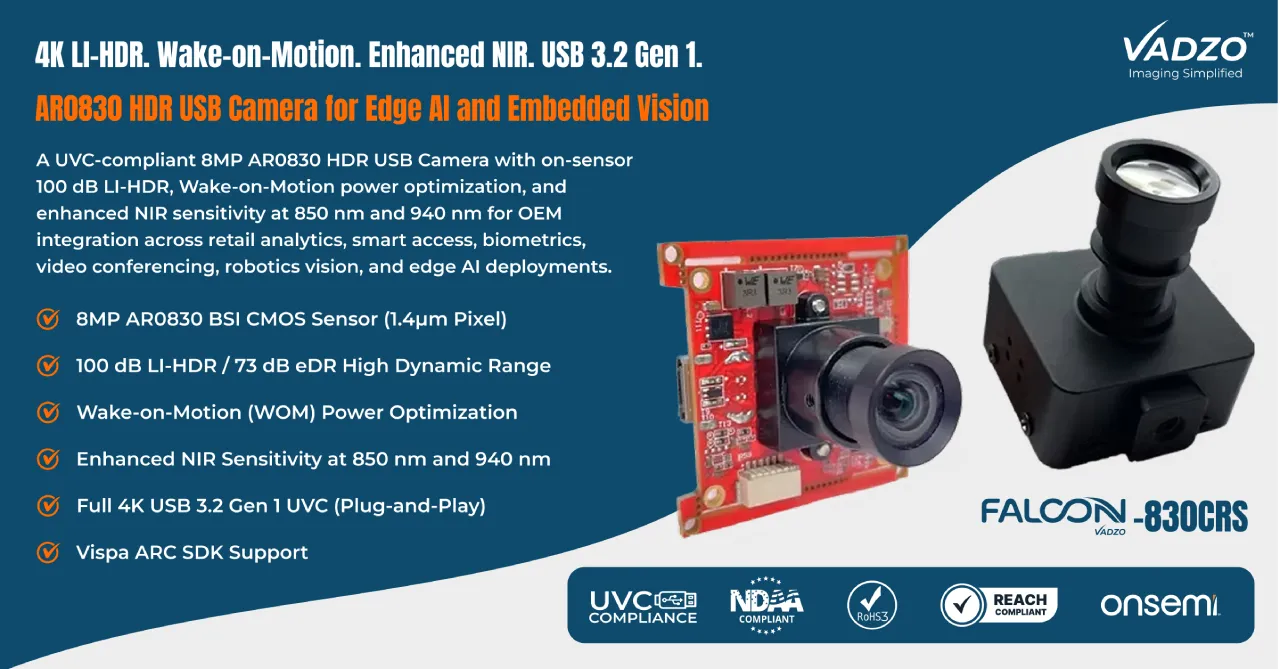
Sensor and Camera Overview
High-contrast lighting, NIR illumination requirements, and always-on power budgets are three constraints that define embedded vision product viability at production scale. Retail entrance monitoring, access control terminals, endpoint video products, and edge AI inference nodes all share these constraints, and standard linear 4K camera modules resolve none of them at the sensor level. The Falcon-830CRS AR0830 HDR USB Camera addresses all three through the onsemi AR0830 1/2.9-inch stacked BSI CMOS sensor with a 1.4 μm pixel pitch, a 3840×2160 active-pixel array, and a 39.9 dB peak SNR.
The Onsemi AR0830 Camera runs on Electronic Rolling Shutter with Global Reset Release mode support, with both 10-bit and 12-bit output available. In 10-bit linear mode, the AR0830 USB Camera delivers 60fps at full 3840×2160 resolution. LI-HDR Imaging mode achieves 30fps with 100 dB dynamic range through line-interleaved T1/T2 exposure pairs for downstream ISP HDR processing. eDR Imaging mode delivers 73 dB single-exposure dynamic range at 30fps in both 10-bit and 12-bit output. The AR0830 Color USB Camera is available in RGB Bayer, RGB-IR, and monochrome color filter array variants. Enhanced NIR Sensitivity at 850 nm and 940 nm covers standard NIR LED illumination bands for day/night access control and biometric terminal designs. WOM streaming at 960×540 at 1fps holds the sensor in a binned monitoring state, triggering full-resolution output only when pixel-level motion exceeds the programmed threshold.
This AR0830 HDR USB Camera connects via a UVC-compliant USB interface and enumerates natively on Windows, Linux, and Android without proprietary driver installation. The 4-lane MIPI D-PHY interface runs at up to 1.5 Gbps per lane with DPCM 10-to-8 bit-depth compression available for bandwidth-constrained hosts. Power consumption is 190 mW at 8MP 60fps, dropping substantially in Super Low Power and WOM modes.
Key specs:8MP 3840×2160 | onsemi AR0830 | 1/2.9 " | Pixel Size 1.4 µm x 1.4 µm | Color | Rolling Shutter | S Mount (M12 Standard) | −30°C to 70°C | Dimension 38mm (L) x 38mm (B) convertible to 32mm (L) x 32mm (B)
Key Capabilities of Falcon-830CRS:4K AR0830 HDR USB Camera
LI-HDR and eDR: 100 dB Dynamic Range at 4K Resolution:Retail aisle monitoring, access control vestibules, and warehouse inspection environments combine overlit zones and deep shadows within a single frame. A linear sensor either clips bright regions or underexposes shadows, and neither output serves AI inference or face detection models reliably. The Falcon-830CRS AR0830 HDR USB Camera eliminates this through two on-sensor HDR operating modes. LI-HDR Imaging mode uses line-interleaved T1/T2 readout at 30fps, generating spatially aligned exposure pairs across the full 3840×2160 frame and delivering a 100 dB High Dynamic Range Imaging data stream to the downstream ISP for tone mapping and HDR reconstruction. For deployments where single-exposure capture simplifies the ISP pipeline, eDR Imaging mode delivers 73 dB dynamic range at 30fps in 10-bit or 12-bit output, exceeding standard linear sensors without multi-exposure blending. Both modes operate at full 4K resolution, making the Falcon-830CRS a capable HDR Imaging platform for outdoor-facing kiosks, biometric terminals, and retail entrance monitoring with three or more stops of ambient variation.
Wake-on-Motion and Low Power Imaging:Always-on embedded vision systems in building access, retail monitoring, and edge AI kiosk environments run for extended hours, creating a power budget constraint that continuous full-resolution streaming alone cannot satisfy. The AR0830 HDR USB Camera addresses this directly through the Wake-on-Motion (WOM) architecture. In WOM mode, the onsemi AR0830 sensor operates at 960×540 binned resolution at 1fps, continuously evaluating pixel-level motion against a programmed threshold while drawing minimal power. When motion exceeds the configured value, the sensor transitions to full 8MP streaming immediately, without host-side intervention or OS scheduling involvement. This Low Power Imaging architecture eliminates external PIR sensors from the OEM BOM, reducing design complexity for battery-assisted and power-over-USB embedded vision products. Super Low Power Mode extends this further, providing continuous Low Light Imaging monitoring at 1fps for remote deployments where power budget is the primary design constraint.
Enhanced NIR Sensitivity for Day/Night and Biometric Imaging:Standard RGB sensors lose NIR response beyond 700 nm, forcing OEM teams to either accept visible-light-only operation or add a dedicated NIR sensor to the design. The Falcon-830CRS AR0830 HDR USB Camera in RGB-IR variant eliminates this with 850 nm/940 nm NIR sensitivity from a single onsemi AR0830 sensor. This spectral range addresses both common NIR LED illuminator bands used in face authentication, iris recognition, and liveness detection for facial recognition and access control deployments. The RGB-IR color filter array delivers simultaneous visible color and this near-infrared sensitivity in a single 8MP sensor without optical filter switching or dual-sensor hardware, reducing BOM cost and board footprint for OEM access control and analytics products operating in both daylit and NIR-illuminated conditions. Vadzo 's engineering team supports color filter array variant selection for OEM product teams integrating the Falcon-830CRS into biometric, access control, and analytics products.
Plug-and-Play Integration with Vispa ARC SDK
The Falcon-830CRS 8MP AR0830 USB Camera is fully UVC compliant, enumerating as a standard video device on Windows, Linux, and Android without proprietary driver development. Standard UVC controls, including exposure, gain, brightness, contrast, saturation, sharpness, gamma, and white balance, are immediately accessible through any UVC-capable host application, covering integration on NVIDIA Jetson, Raspberry Pi, and NXP i.MX from the first connection without SDK dependency.
For OEM product teams requiring control beyond the UVC baseline, the Vispa ARC SDK delivers full programmatic access to the extended feature set of this AR0830 HDR USB Camera: manual and automatic exposure and gain configuration, ROI-based auto-exposure, LI-HDR and eDR mode switching, WOM threshold programming, anti-flicker (50Hz/60Hz), image flip, JPEG compression adjustment, and firmware update management. Vispa ARC SDK APIs are available in C, C++, C#, and Python for Windows, Linux, and Android, enabling production-grade OEM integration from prototype through volume production.
Applications
Retail Analytics, Shelf Monitoring, and Customer Analytics:Retail embedded vision systems operate in environments where high-intensity overhead fixtures, natural light from storefront windows, and shadowed shelving zones coexist in a single camera field of view. A linear sensor either clips highlights near the entrance or loses product detail in shadow aisles, making shelf monitoring and shopper behavior analytics unreliable across a full store operating day. The Falcon-830CRS AR0830 HDR USB Camera addresses this through LI-HDR mode, delivering 100 dB dynamic range at 3840×2160 that resolves both product label detail in shadow zones and face detection data near high-brightness entrance areas simultaneously. WOM holds the sensor in low-power monitoring during idle periods and triggers full-resolution streaming when customer presence is detected. For shelf monitoring, Object Detection, image recognition, and customer analytics pipelines on NVIDIA Jetson or Raspberry Pi edge compute, the Falcon-830CRS delivers 4K HDR USB Camera quality with UVC plug-and-play integration and Vispa ARC SDK control.
Smart Access and Biometrics:Access control vestibules, building entry points, and biometric enrollment kiosks sit at the intersection of three hard imaging requirements: outdoor-facing illumination variation spanning three or more stops, NIR-based biometric capture for face authentication and iris recognition, and low-power operation between access events. Standard sensors address at most one of these. The Falcon-830CRS AR0830 HDR USB Camera in RGB-IR variant handles all three from a single onsemi AR0830 sensor. The 850 nm and 940 nm spectral response supports standard NIR LED illuminator bands used in Smart Access and Biometrics systems. LI-HDR mode resolves the backlit-subject problem at outdoor entry points. WOM triggers full-resolution imaging when a person enters the sensor field and returns to low-power monitoring between events, giving OEM teams a single-sensor 8MP USB Camera covering both color and NIR biometric modalities without additional optics or hardware.
Video Conferencing:A conference room or video endpoint camera design faces a fundamental scene constraint: window-side participants create extreme foreground-background contrast that standard sensors cannot capture in a single linear exposure, producing silhouetted subjects that defeat AI-driven background segmentation, face detection, and speaker tracking on the host compute platform. The Falcon-830CRS AR0830 HDR USB Camera resolves this through LI-HDR Imaging mode, generating a properly exposed 3840×2160 frame at 30fps that captures both window-lit backgrounds and shadow-facing participants in a single pass, giving the inference model accurate face regions to process. The UVC-compliant USB interface enumerates immediately on Windows, Linux, and Android without drivers, meeting the plug-and-play requirements of Video Conferencing endpoint OEMs where enterprise IT organizations prohibit proprietary driver installation on managed enterprise endpoints. Vispa ARC SDK provides full ISP control for room-specific exposure targeting and HDR mode management in endpoint products.
Robotics Vision and Autonomous Systems:Mobile robots, inspection drones, and Autonomous Systems face illumination transitions that single-exposure sensors cannot track: moving from a warehouse interior into a sunlit loading dock requires adapting from 500 lux to 50,000 lux without frame drops or manual ISP reconfiguration. The Falcon-830CRS AR0830 HDR USB Camera handles these transitions through on-sensor LI-HDR, maintaining 100 dB dynamic range at 30fps during the illumination change without host-side control. For Robotics Vision applications where full 4K resolution exceeds inference pipeline bandwidth, the AR0830 supports binning at 1920×1080 at 120fps and 960×540 with proportionally reduced data rates. WOM reduces sensor power draw during idle docking periods, and the UVC-compliant interface integrates directly into ROS and custom navigation stack drivers on embedded Linux hosts. The Vispa ARC SDK provides programmatic access to all AR0830 sensor modes for teams scheduling HDR mode transitions within the robot 's state machine.
Edge AI: Object Detection and Image Classification:Edge AI inference systems running Object Detection and Image Classification workloads on NVIDIA Jetson or similar embedded SoCs require camera streams that represent the scene accurately across all ambient conditions the deployment encounters. A frame captured in linear mode under high-contrast lighting produces overexposed regions, generating false detections, clips targets near highlight boundaries, and reducing classification confidence scores in underexposed zones. The Falcon-830CRS 4K AR0830 HDR USB Camera resolves this at the sensor level, delivering properly exposed 4K HDR frames through LI-HDR or eDR mode that give AI inference models scene-accurate input regardless of ambient light conditions. For inference pipelines where frame rate matters more than resolution, the AR0830 HDR USB Camera supports 120fps at 1920×1080 in binned mode for latency-sensitive real-time detection workloads. WOM eliminates streaming overhead during idle periods, preserving SoC compute cycles for inference. Vadzo 's HDR USB Camera portfolio spans deployments from retail edge kiosks to industrial inspection nodes.
"OEM teams deploying edge AI vision in retail, access control, and robotics environments need a sensor that performs across the full range of conditions the deployment will see from day one: variable lighting, NIR illumination requirements, and power budgets that full-resolution streaming alone cannot satisfy. The Falcon-830CRS is the AR0830 HDR USB Camera Vadzo built to solve all three. A 100 dB LI-HDR sensor with Wake-on-Motion and enhanced NIR response, delivered through a USB interface that any embedded Linux platform supports natively, with Vispa ARC SDK giving OEM teams complete control from prototype to production. "- Alwin Vincent, Product Manager, Vadzo Imaging
Frequently Asked Questions
1) What dynamic range does an 8MP AR0830 USB camera achieve in LI-HDR mode, and why does it matter for retail and access control deployments?
Vadzo 's Falcon-830CRS is an 8MP AR0830 HDR USB Camera that achieves 100 dB dynamic range in LI-HDR mode, compared to approximately 60 to 70 dB for a standard linear 4K sensor. In retail and access control environments where overhead lighting fixtures, sunlit entrances, and shadowed shelf or vestibule zones coexist in a single field of view, this gap determines whether the camera delivers a usable frame or an overexposed one. The AR0830 's line-interleaved T1/T2 readout generates spatially aligned exposure pairs at 30fps across the full 3840×2160 frame, giving the downstream ISP a 100 dB data stream for tone mapping without spatial misalignment artifacts. For Object Detection, face detection, product label verification, and customer analytics pipelines on NVIDIA Jetson or Raspberry Pi edge compute, this LI-HDR frame delivers scene-accurate input that standard linear sensors cannot produce under the same ambient conditions.
2) How does Wake-on-Motion reduce power in always-on embedded vision deployments without requiring an external PIR sensor?
Wake-on-Motion in Vadzo 's Falcon-830CRS 8MP AR0830 HDR USB Camera is an on-sensor hardware function in the onsemi AR0830 that operates without an external PIR sensor, host-side processing thread, or OS scheduler involvement. In WOM mode, the sensor runs at 960×540 binned resolution at 1fps, comparing each captured frame against the programmed motion detection threshold while drawing a fraction of full-resolution streaming power. When pixel-level change exceeds the threshold, the sensor transitions to full 8MP output automatically, without a host-side trigger. For retail monitoring kiosks, access control terminals, and building management systems where the camera must remain active across extended hours but only needs full-resolution output during occupancy events, this eliminates continuous streaming overhead. Vadzo 's Vispa ARC SDK lets OEM engineers program the motion detection threshold through C, C++, C#, or Python APIs without firmware modifications.
3) Can a single 8MP RGB-IR USB camera handle both visible face imaging and NIR-based liveness detection without a second sensor?
Yes, and this is one of the most practical advantages Vadzo 's Falcon-830CRS AR0830 HDR USB Camera offers OEM teams building biometric and access control products. The onsemi AR0830 in RGB-IR variant integrates an RGB-IR color filter array delivering simultaneous visible color sensitivity and 850 nm/940 nm near-infrared response from a single 8MP sensor. This spectral coverage addresses both common NIR LED illuminator bands used in commercial face authentication, iris recognition, and liveness detection for facial biometric and access control applications. OEM teams get visible color output for daytime imaging and NIR-sensitive output for IR-illuminated biometric capture from one sensor footprint, eliminating a separate NIR camera module, optical filter switching, or dual-sensor PCB design. Combined with the LI-HDR mode 's 100 dB dynamic range, the Falcon-830CRS handles backlit-subject scenarios at entry points where standard RGB sensors produce silhouetted images.
4) What embedded Linux platforms does the AR0830 HDR USB camera support natively, and does it need custom kernel driver development?
Vadzo 's Falcon-830CRS AR0830 HDR USB Camera is fully UVC compliant, enumerating as a standard video device on Windows, Linux, and Android immediately on connection with no custom kernel module, proprietary driver package, or platform-specific library required. On NVIDIA Jetson, Raspberry Pi, and NXP i.MX platforms, the camera streams through any UVC-compatible application from the first connection. For production OEM deployments requiring full sensor mode control, Vadzo 's Vispa ARC SDK provides programmatic access to LI-HDR and eDR mode switching, WOM threshold configuration, ROI-based auto-exposure, anti-flicker, JPEG compression, and firmware update management through C, C++, C#, and Python APIs. The SDK supports ROS-compatible camera pipelines for robot and Autonomous Systems integration on embedded Linux hosts. The camera also maintains USB 2.0 backward compatibility across existing embedded platform generations.
5) Can an 8MP AR0830 HDR USB camera operate beyond 30fps in binned modes for latency-sensitive edge AI inference pipelines?
Yes. Vadzo 's Falcon-830CRS AR0830 HDR USB Camera supports multiple operating modes beyond full 4K that directly address edge AI inference pipeline bandwidth and latency requirements. At 1920×1080 in binned mode, the AR0830 delivers 120fps, doubling the frame throughput available at full 4K resolution for latency-sensitive Image Classification and real-time inference workloads. The Max Frame Rate crop mode reaches 90fps at 1650×1650 for square-format inference inputs. At 960×540, the sensor operates at 1fps for WOM monitoring, keeping power draw minimal between inference events. All modes are accessible through standard UVC controls or through Vadzo 's Vispa ARC SDK via C, C++, C#, and Python APIs for embedded Linux platforms, giving OEM teams precise control over resolution, frame rate, and HDR mode scheduling.
Availability
The Falcon-830CRS AR0830 HDR USB Camera is now available for evaluation and production orders. Evaluation kits include the camera, M12 S-Mount optics assembly, USB cable, and Vispa ARC SDK documentation with no minimum order requirement. For the complete Vadzo HDR USB Camera portfolio and additional HDR USB Camera options across resolution and interface variants, visit https://www.vadzoimaging.com/, or Contact Vadzo at support@vadzoimaging.com to request an evaluation kit or discuss OEM customization requirements.
About Vadzo Imaging
Vadzo Imaging is a Fort Worth, TX-based provider of embedded vision solutions, delivering high-performance camera technologies across its USB camera series, MIPI, GigE, Wi-Fi, and SerDes interface platforms for applications in robotics, industrial automation, UAVs, edge AI, retail analytics, and access control systems. Its camera portfolio integrates with leading embedded platforms, including NVIDIA Jetson, Raspberry Pi, Qualcomm RB series, and NXP i.MX. Vadzo supports customers through hardware customization, firmware development, and the Vispa ARC SDK for USB camera products, enabling faster deployment of vision-based embedded systems. For more information, visit https://www.vadzoimaging.com.
Media Contact
Alwin Vincent
Vadzo Imaging
Email: alwin@vadzoimaging.com
LinkedIn: Vadzo Imaging
YouTube: Vadzo Imaging
X: Vadzo Imaging
SOURCE: Vadzo Imaging
View the original press release on ACCESS Newswire
© 2026 ACCESS Newswire. All Rights Reserved.