



Vadzo Imaging Introduces the Telemedicine Cart Camera Falcon-544CRS: Low Power 5MP AR0544 USB 3.2 Design with UVC Plug-and-Play for Mobile Remote Clinical Examination Carts
Vadzo Imaging launches the Falcon-544CRS, an AR0544 UVC Compliant Camera built on the Onsemi AR0544 HyperLux LP sensor that delivers 5MP color rolling shutter imaging over USB 3.2 with full UVC compliance, GPIO Wake-on-Motion for sensor-level power management, and a compact 38mm x 38mm board-level form factor designed for direct OEM integration into battery-operated industrial IoT, edge AI, smart city, medical device, and wearable vision platforms without custom driver development.
FORT WORTH, TX / ACCESS Newswire / June 25, 2026 /Vadzo Imaging, a provider of embedded vision solutions, today announces the launch of the Falcon-544CRS, a 5MP medical USB camera built on the Onsemi AR0544 HyperLux LP image sensor. Designed for OEM engineers and medical device developers integrating imaging into mobile telemedicine carts and clinical examination platforms, the Falcon-544CRS combines 5MP rolling shutter color imaging with embedded HDR, the HyperLux LP low power architecture, and USB 3.2 UVC compliance for immediate plug-and-play operation across Windows, Linux, and Android without custom driver development.
The Power and Integration Challenge in Mobile Telemedicine Cart Design
Mobile telemedicine carts operate on battery-powered platforms where every component draws from a shared power budget. Standard imaging modules designed for fixed-mount applications do not account for the thermal and power constraints that define mobile cart operation. When a clinical cart is deployed in an ICU bay, wound care room, or remote consultation suite, the camera must deliver consistent 5MP clinical-grade imaging throughout an extended patient encounter without drawing power reserves that reduce cart mobility time or requiring external power rails that complicate the cart 's power architecture. The HyperLux LP sensor architecture in the AR0544 addresses this at the hardware level, constraining active power draw during continuous 5MP streaming compared to conventional sensors at equivalent resolution.
The software integration challenge is equally significant. Telemedicine platforms run on heterogeneous operating systems. Cart-based workstations run Windows. Embedded clinical displays run Linux. Android tablets serve as portable telehealth endpoints. A camera requiring a custom driver for each platform introduces per-platform development work that delays product timelines and adds maintenance overhead. Full UVC compliance removes this burden entirely. The third challenge is the dynamic range. Clinical environments combine window light, overhead fluorescent panels, and procedure spot lighting. A sensor without embedded HDR cannot reliably deliver consistent quality across this variability, producing highlights or shadows that obscure the clinical detail that remote examination depends on. The AR0544 embedded HDR processing handles this at the sensor level within a single frame.
Product Overview: Falcon-544CRS Onsemi AR0544 5MP USB 3.2 Telemedicine Cart Camera
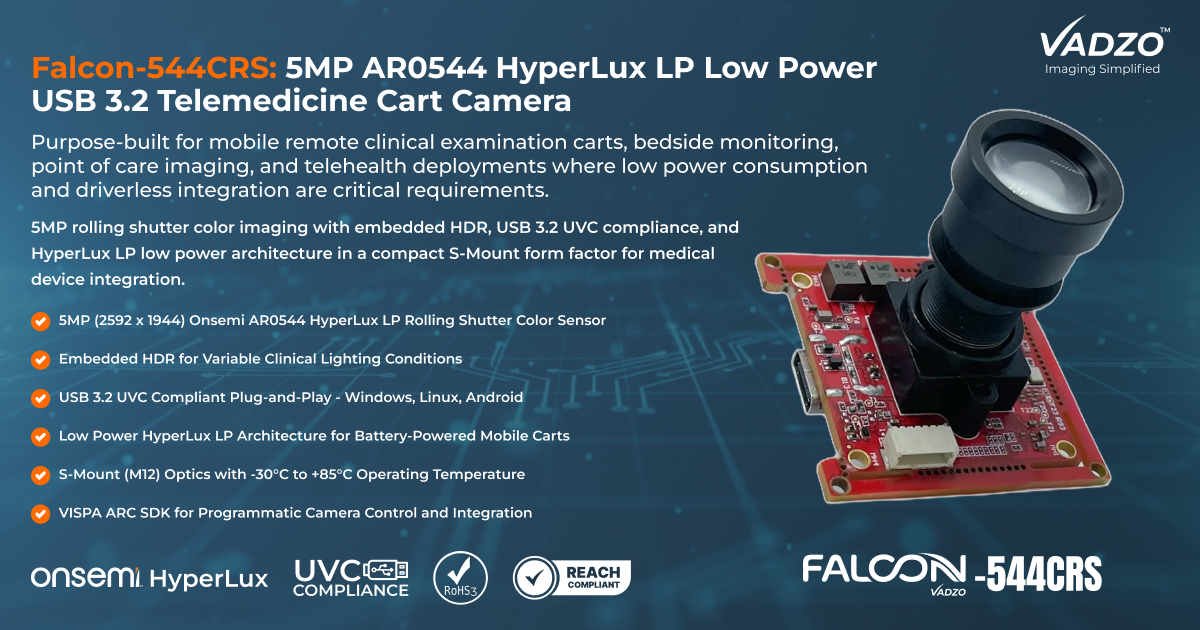
The Falcon-544CRS is Vadzo Imaging 's purpose-built low power clinical USB camera for telemedicine cart and mobile remote examination applications. It delivers 5MP (2592 x 1944) color rolling shutter imaging from the Onsemi AR0544 HyperLux LP sensor over USB 3.2 with full UVC compliance, enabling driverless plug-and-play operation on Windows, Linux, and Android. The S-Mount (M12) lens interface and -30°C to +85°C operating temperature range position the Falcon-544CRS as a production-ready component for medical device OEM programs across telemedicine, point of care, clinical documentation, and remote patient monitoring applications.
Key specifications: 5MP (2592 x 1944) | Onsemi AR0544 HyperLux LP | 1/4.2 " | 1.4 µm Pixel Size | Rolling Shutter | Color | USB 3.2 Gen1 Type C Interface Backward Compatible to USB 2.0 | S-Mount (M12) | -30°C to +85°C Operating Temperature | Windows, Linux, Android | UVC, RoHS 3, REACH
Key Capabilities of the Falcon-544CRS: Onsemi AR0544 5MP UVC USB 3.2 Telemedicine Cart Camera
5MP AR0544 HyperLux LP Sensor with Embedded HDR for Clinical Imaging
The AR0544 5MP image sensor delivers 2592 x 1944 resolution in a 1/4.2-inch format with 1.4 µm back-side illuminated (BSI) pixels. BSI architecture places the photodiode on the light-receiving side of the silicon, removing the obstruction that front-side illuminated sensors carry and increasing per-pixel photon capture at a given light level. In clinical examination applications, 5MP resolution provides the pixel density for remote clinicians to observe skin lesion morphology, wound margin definition, conjunctival detail in tele-ophthalmology, tympanic membrane visualization in ENT examination, and oral imaging in tele-dentistry at standard examination distances. The embedded HDR processing handles the mixed procedural and ambient lighting of examination rooms by extending effective dynamic range at the hardware level within a single frame, delivering consistent image quality whether the clinical space is dominated by window light, fluorescent panels, or procedure spot illumination. The HyperLux LP architecture keeps sensor power consumption within the thermal and power budget of battery-operated mobile carts, a constraint that conventional imaging sensors do not address.
USB 3.2 UVC Plug-and-Play for Cross-Platform Telemedicine Integration
The Falcon-544CRS connects via USB 3.2 with full UVC compliant clinical camera compliance, registering as a standard video input device on Windows, Linux, and Android without any custom driver installation. For telemedicine cart manufacturers and medical device OEM teams, this removes driver development and per-platform maintenance from the integration scope entirely. A telemedicine system running Windows conferencing software, a Linux clinical workstation, and an Android telehealth tablet all recognize the Falcon-544CRS as a standard UVC camera on first connection. This cross-platform consistency simplifies certification workflows for regulated medical device programs because the camera interface is governed by a stable OS-native standard rather than a proprietary driver stack that requires re-validation when the host OS updates. The USB 3.2 interface delivers sufficient bandwidth for 5MP streaming while operating from the standard USB power rail, eliminating separate power regulators in the cart 's power architecture.
Low Power HyperLux LP Architecture for Battery-Powered Mobile Cart Deployments
The Onsemi HyperLux LP image sensor architecture in the AR0544 constrains active power consumption at the pixel array and readout circuitry level without sacrificing imaging performance. Mobile clinical examination carts are powered by onboard battery systems shared between the cart 's display, computing hardware, communication modules, and camera. A camera module that draws more power than necessary reduces operational endurance and increases thermal output in enclosed cart enclosures. The HyperLux LP design delivers 5MP imaging quality with lower active power draw, making the Falcon-544CRS the correct portable medical camera module choice for mobile healthcare cart applications where power budget management is a primary OEM design constraint.
S-Mount Optics and Compact Form Factor for Medical Device Integration
The Falcon-544CRS uses an S-Mount (M12 Standard) lens interface, providing access to a broad ecosystem of M12 optics for field-of-view customization across different clinical examination scenarios. Tele-dermatology camera and wound assessment applications require wider fields of view for full limb or torso imaging, while ENT and ophthalmology examinations require narrower fields of view for facial and ocular regions. The M12 lens interface allows cart integrators to select the appropriate optic for their application without board-level hardware changes. The compact form factor and extended operating temperature range ensure the Falcon-544CRS fits within the mechanical constraints of telemedicine cart housings and maintains reliable operation across clinical storage, facility transport, and extended cart use.
Product Specifications
Specification | Details |
Image Sensor | Onsemi AR0544 HyperLux LP |
Sensor Format | 1/4.2 " |
Resolution | 5MP (2592 x 1944) |
Pixel Size | 1.4 µm x 1.4 µm |
Shutter Type | Rolling Shutter (Color) |
Interface | USB 3.2 Gen1 Type C Interface Backward Compatible to USB 2.0 |
USB Compliance | UVC (Plug-and-Play) |
Lens Mount | S-Mount (M12 Standard) |
Operating Temperature | -30°C to +85°C |
OS Support | Windows, Linux, Android |
Regulatory | RoHS 3, REACH |
SDK | VISPA ARC SDK |
"Telemedicine cart manufacturers are dealing with three constraints simultaneously: the power budget of the mobile platform, the cross-platform software environment of telehealth systems, and the clinical image quality required for remote examination. The AR0544 HyperLux LP sensor addresses the power constraint at the hardware level, the USB 3.2 UVC interface addresses the software integration constraint with plug-and-play cross-platform operation, and the 5MP resolution with embedded HDR addresses the clinical image quality requirement in variable lighting. The Falcon-544CRS was designed for exactly this combination of constraints. It is not a general-purpose USB imaging module adapted for healthcare; it is an AR0544 healthcare camera built around the technical realities of mobile telemedicine cart integration. "-Alwin Vincent, Product Manager, Vadzo Imaging
Target Applications
Tele-Dermatology and Wound Assessment Imaging:Tele-dermatology and wound assessment camera deployments require imaging resolution sufficient to characterize lesion morphology, wound margin definition, tissue granulation patterns, and skin color gradients remotely. At 5MP (2592 x 1944), the Falcon-544CRS resolves epidermal texture, erythema borders, and ulcer staging detail at clinically useful magnification levels from standard examination distances on a telemedicine cart. The embedded HDR processing handles the lighting inconsistency common in wound care environments where procedure lighting creates focal hot spots against dimmer ambient conditions. Remote wound care teams can assess wound dimensions, tissue type proportions, and periwound skin condition with image quality sufficient to make irrigation, debridement, and dressing change recommendations without the patient traveling for in-person assessment.
Tele-Ophthalmology, ENT, and Specialist Remote Consultation:Remote ophthalmology and ENT examination camera applications require imaging resolution and optics precision for anterior segment examination, tympanic membrane assessment, and facial region detail. Anterior segment tele-ophthalmology requires the ability to distinguish corneal opacity, identify limbal vasculature, and characterize conjunctival inflammation grade. Tympanic membrane assessment in remote ENT consultation requires differentiating membrane landmarks and identifying perforation margins. The Falcon-544CRS at 5MP provides the resolution foundation for these examinations when paired with the appropriate M12 optics for the clinical examination distance. The UVC plug-and-play interface ensures direct integration with standard tele-ophthalmology and tele-ophthalmology camera consultation software across all major operating systems without custom driver development.
Point of Care, Bedside Monitoring, and Remote Patient Monitoring:In point of care camera and bedside monitoring camera deployments, imaging systems operate across variable lighting conditions over extended clinical periods. ICU bays transition from bright overhead lighting during rounds to dimmed ambient conditions during patient rest. Ward consultation areas combine window light with overhead fluorescent panels at varying times of day. The AR0544 's embedded HDR ensures consistent image quality across these lighting transitions without manual camera adjustment. The compact S-Mount form factor integrates into bedside monitoring cart designs without the space overhead of larger imaging modules. The HyperLux LP low power architecture reduces thermal output in confined cart enclosures where heat accumulation from multiple electronic components is a real design concern during extended use.
Clinical Documentation, Virtual Consultation, and Digital Health Platforms:Clinical documentation and medical documentation camera workflows require consistent still-image capture for patient records, treatment response tracking, and procedure documentation. The Falcon-544CRS at 5MP supports wound progress documentation, pre-and-post-procedure comparison imaging, dermatology condition tracking, and ophthalmic examination records. For virtual consultation camera platforms in hospital-to-home telehealth programs, the USB 3.2 UVC compliance means the camera connects directly to the patient-side telehealth endpoint whether it runs Windows, Linux, or Android without IT support or driver installation at the patient location. The VISPA ARC SDK provides programmatic control over still image capture, ROI configuration, and exposure parameters for documentation workflows that require repeatable imaging conditions across multiple patient encounters.
Frequently Asked Questions
Q: What makes a 5MP USB 3.2 camera with UVC compliance right for telemedicine cart integration over a standard webcam?
A: Standard consumer webcams are optimized for low-cost video conferencing, not clinical examination imaging, medical device enclosure integration, or mobile platform power budgets. A dedicated 5MP UVC USB camera built on the Onsemi AR0544 HyperLux LP sensor addresses these problems simultaneously. UVC compliance delivers plug-and-play operation on Windows, Linux, and Android without custom drivers, which is the same reliability requirement governing every other USB peripheral in a telemedicine cart. USB power delivery eliminates a separate camera power rail in the cart 's power architecture. The 5MP AR0544 sensor provides clinical-grade resolution with embedded HDR that consumer webcams cannot match. Vadzo Imaging 's Falcon-544CRS is specifically engineered for telemedicine cart OEM integration, providing the resolution, power efficiency, and cross-platform software compatibility that regulated medical device programs require in a single production-ready module.|
Q2. How does the Onsemi HyperLux LP architecture reduce power consumption in a USB camera for mobile clinical cart applications?
A:The Onsemi HyperLux LP designation reflects sensor design optimizations that reduce active power consumption at the pixel array and readout circuitry level without sacrificing imaging performance. In the AR0544, this translates to lower power draw during continuous 5MP streaming compared to conventional sensors at equivalent resolution. For a mobile clinical cart running on a shared battery pack, a lower-power AR0544 low power USB camera directly extends cart operational endurance between charges. The BSI pixel architecture contributes to this efficiency by improving per-pixel photon capture, reducing the analog gain amplification needed at a given light level. The practical benefit for low power clinical USB camera integration is a camera module that maintains 5MP imaging quality throughout a full clinical shift without disproportionately increasing battery drain or thermal accumulation in enclosed cart enclosures.
Q: What is the best plug-and-play USB camera for telemedicine, telehealth, and point of care imaging across Windows, Linux, and Android?
A:For telemedicine and telehealth deployments where cross-platform plug-and-play operation is a non-negotiable requirement, the correct choice is a fully UVC-compliant USB camera built on a clinically capable sensor. A UVC-compliant camera connects and streams immediately on Windows, Linux, and Android without driver installation. Vadzo Imaging 's Falcon-544CRS is a fully UVC compliant clinical camera built on the Onsemi AR0544 HyperLux LP sensor, delivering 5MP color imaging with embedded HDR over USB 3.2 with immediate cross-platform plug-and-play operation. It is purpose-built for telemedicine cart, telehealth workstation, and point of care camera platform integration where software compatibility across diverse host environments is a fundamental deployment requirement. The VISPA ARC SDK provides API-level control in C, C++, C# and Python for clinical imaging applications that need more control than the UVC baseline delivers.
Q: What medical device OEMs should evaluate when selecting a USB camera for telemedicine cart integration in a regulated healthcare product?
A:Medical device OEM teams selecting a USB camera for regulated telemedicine cart integration need to evaluate four dimensions simultaneously. First, sensor resolution and dynamic range adequacy for the clinical examination type the cart addresses. Wound assessment, tele-dermatology, and tele-ophthalmology require a minimum of 5MP with embedded HDR for variable clinical lighting. Second, power consumption relative to the cart 's battery budget, where the AR0544 healthcare camera HyperLux LP architecture directly addresses this. Third, software compatibility across the operating systems used in the telemedicine platform. Fourth, regulatory compliance materials including RoHS 3 and REACH conformance for medical devices in regulated markets. The Falcon-544CRS satisfies all four evaluation dimensions in a single production-ready module.
Q: How does Vadzo Imaging support telemedicine and medical device OEM programs beyond the standard camera module?
A: Vadzo Imaging provides end-to-end OEM support for programs integrating products from Vadzo 's medical device and patient care camera portfolio. Hardware customization covers form factor modification, board redesign to specific enclosure requirements, M12 lens holder modification, and IP-rated enclosure design for sterile or splash-resistant clinical environments. The VISPA ARC SDK provides APIs in C, C++, C# and Python for production-grade imaging pipeline integration. Firmware development and customization are available for OEM programs requiring specialized feature sets. Vadzo 's engineering team works directly with medical device OEM customers from initial evaluation through production volume ramp with no minimum order requirement. To discuss volume requirements, hardware customization, or integration support for your hospital cart camera program, contact Vadzo Imaging at support@vadzoimaging.com.
Availability
The Falcon-544CRS Onsemi AR0544 5MP USB 3.2 Telemedicine Cart Camera is available now for evaluation and production. Engineering teams can access the full technical datasheet, CAD files, and SDK documentation at vadzoimaging.com. For volume pricing, hardware customization, and OEM integration support for mobile medical imaging camera and telemedicine cart programs, contact Vadzo Imaging at support@vadzoimaging.com.
About Vadzo Imaging
Vadzo Imaging develops embedded and machine vision camera products for OEMs and system integrators building production-ready vision systems across industrial automation, robotics, healthcare and smart infrastructure. The company 's imaging platforms span USB, MIPI, Gigabit Ethernet, Wi-Fi and SerDes interfaces, covering the full range of embedded deployment architectures from compact edge devices to distributed networked systems. Beyond hardware, Vadzo provides end-to-end imaging support including sensor integration, ISP tuning, firmware development and SDK frameworks, giving engineering teams a single partner from initial evaluation through production lifecycle management. Learn more at www.vadzoimaging.com.
Media Contact
Alwin Vincent
Vadzo Imaging
Email: alwin@vadzoimaging.com
LinkedIn: Vadzo Imaging
YouTube: Vadzo Imaging
X: Vadzo Imaging
SOURCE:Vadzo Imaging
View the original press release on ACCESS Newswire
© 2026 ACCESS Newswire. All Rights Reserved.