



Vadzo Imaging Positions the Bolt-1335CRO AR1335 OIS MIPI Camera as the Ideal Camera for UAV and Drones
Vadzo 's Bolt-1335CRO is a 13MPAR1335 OIS MIPI Camera built on the onsemi AR1335 sensor delivering optical image stabilization and voice coil motor autofocus in a rolling shutter MIPI CSI-2 module for embedded AI, robotics, UAV, drone and aerial inspection platforms where vibration resistant capture and low latency MIPI delivery are simultaneous design requirements. As a compact AR1335 4K MIPI Camera, it brings lens level stabilization and continuous focus tracking to board level embedded deployments across Vadzo 's Bolt MIPI CSI-2 camera series without USB or network overhead.
FORT WORTH, TX / ACCESS Newswire / July 14, 2026 /Vadzo Imaging, a provider of embedded vision camera products, today announces the Bolt-1335CRO, an AR1335 4K MIPI Camera purpose-built for OEM engineering teams who need stabilized, continuously focused imaging in a compact board-level MIPI form factor for aerial and UAV platforms. As a 13MP rolling shutter MIPI camera delivering 4208x3120 full resolution output with 1.1 µm x 1.1 µm pixel pitch and 2-lane / 4-lane MIPI CSI-2 integration, the Bolt-1335CRO connects directly to embedded flight computers and edge AI SoCs without USB or network overhead.
Sensor and Camera Overview
Aerial platforms put two conflicting demands on an onboard camera at once. Rotor wash and airframe flex introduce continuous vibration into every frame. At the same time, the subject on the ground or in frame keeps changing distance as altitude and flight speed shift. Most embedded MIPI camera modules solve one problem or the other. The Bolt-1335CRO solves both from the same sensor platform.
The Bolt-1335CRO MIPI CSI-2 Camera is built on the onsemi AR1335, a 1/3.2 inch BSI CMOS sensor with 1.1 µm x 1.1 µm pixel size and a native resolution of 13MP (4208x3120). As a Bolt MIPI CSI-2 camera series member, the Bolt-1335CRO shares its sensor platform with other onsemi AR1335-based Bolt modules Vadzo produces for MIPI integrators, differentiated here by onboard optical image stabilization and voice coil motor autofocus. The AR1335 's back-illuminated architecture improves photon collection at the pixel level, maintaining usable image quality in the lower light conditions common during early morning and late afternoon UAV missions.
As an onsemi AR1335 MIPI Camera, the Bolt-1335CRO outputs through 2-lane or 4-lane MIPI CSI-2, depending on platform bandwidth requirements, connecting directly to embedded vision processors and flight computers that already expect a MIPI camera module input rather than a USB or Gigabit Ethernet interface. This matters for UAV camera module design because payload weight, connector count, and cable routing all compete for limited space inside a drone airframe. A native 4K MIPI CSI-2 Camera link removes an extra interface conversion stage that would otherwise add weight and latency to the imaging path.
Optical image stabilization on the Bolt-1335CRO works at the lens assembly level. It physically shifts lens elements to counteract vibration and motion before the frame reaches the AR1335 sensor rather than correcting it afterward in software. For a rolling shutter sensor such as the AR1335, this distinction carries real weight during flight. Rolling shutter architectures expose the frame line by line. Uncorrected vibration during exposure then appears as skew, wobble, or jello-type distortion across a single frame rather than as simple motion blur. By stabilizing the optical path directly, the Bolt-1335CRO reduces this rolling shutter artifact at the point of capture. This is a meaningful engineering distinction for any AR1335 4K Color Camera intended for vibration-heavy platforms such as multirotor drones and fixed-wing UAVs operating in gusty conditions.
Autofocus on the Bolt-1335CRO runs through a voice coil motor actuator. This makes it a VCM Autofocus Camera at the lens level rather than a fixed focus design. Vadzo 's engineering notes on autofocus sensor camera technology cover how voice coil motor actuators drive focus response time and repeatability in embedded modules. That same actuator class underpins the AR1335 Autofocus MIPI Camera behavior on the Bolt-1335CRO, holding focus on a target while the OIS path independently corrects the frame for vibration.
Key specs: 13MP (4208x3120) | onsemi AR1335 CMOS Sensor | 1/3.2 " | 1.1 µm x 1.1 µm Pixel Size | Rolling Shutter | 2 lane and 4 lane MIPI CSI-2 | Optical Image Stabilization | Standard DR | VCM Based Autofocus with Focus Range of 100 mm to Infinity | -30°C to 70°C Operating Temperature
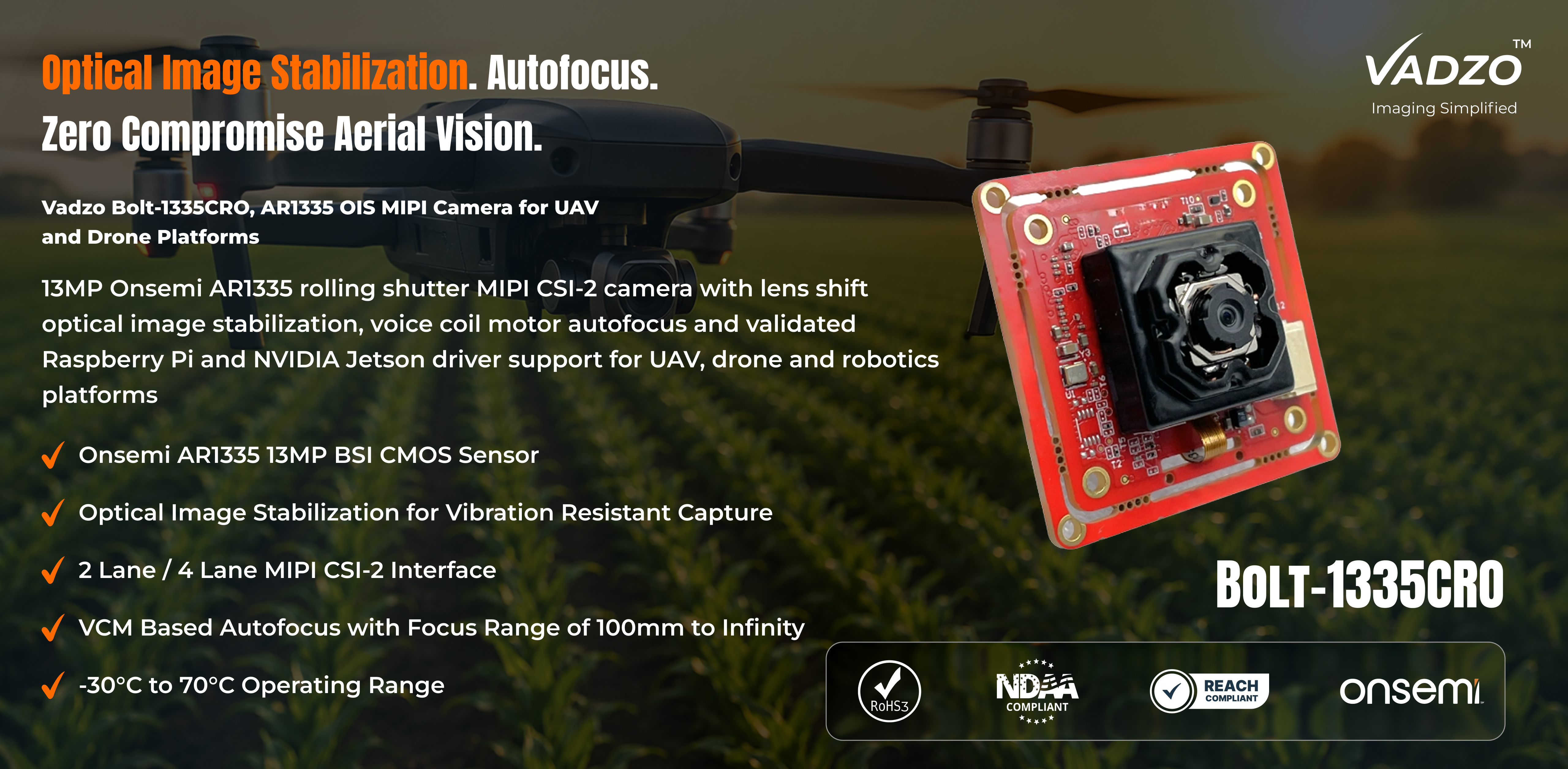
Key Capabilities of the Bolt-1335CRO: AR1335 OIS MIPI Camera for UAV and Drones
Rolling Shutter BSI Sensor for High Resolution Aerial Capture:The onsemi AR1335 at the core of the Bolt-1335CRO is a 13MP BSI CMOS sensor built for OEM drone manufacturers who need a compact camera UAV designers can drop directly into a flight controller stack without redesigning the payload bay. Because the sensor supports both 13MP still capture and 4K video output, the same AR1335 4K Camera hardware serves aerial mapping missions that need high-resolution still frames and live video transmission links that need lower latency 4K streams. This gives UAV integrators a single-camera UAV platform rather than separate modules for mapping and live view. As an AR1335 Rolling Shutter MIPI Camera, the module resolves fine terrain and structural detail at typical mapping and inspection altitudes while keeping bandwidth requirements inside what a 2-lane or 4-lane MIPI CSI-2 link can deliver.
Optical Image Stabilization for Vibration-Resistant Flight Video:Most embedded camera modules force integrators to choose between optical image stabilization and autofocus, treating the two as separate feature sets that live in different product lines. The Bolt-1335CRO is built as an Optical Image Stabilization Camera in its own right. The same AR1335 13MP OIS Camera platform holds a stable frame while correcting for the vibration and micro movement generated by rotor wash and airframe flex. The onboard OIS correction range is tuned for typical multirotor and fixed wing vibration profiles rather than the wider swing range a handheld cinema rig might need. This keeps the actuator compact enough to fit inside a MIPI camera module footprint instead of a separate lens barrel assembly. For drone integrators evaluating a Drone Gimbal Camera against a fixed mount alternative, a 13MP OIS Camera built directly into the module functions as a gimbal-stabilized camera module in its own right, giving integrators the option to pair the Bolt-1335CRO with a lighter one or two-axis gimbal or, in some fixed-wing and inspection platforms, remove the mechanical gimbal from the design entirely.
Voice Coil Motor Autofocus for Continuous Focus Tracking in Flight:The Bolt-1335CRO is also an OIS Autofocus Camera, holding both focus and frame stability as altitude, distance to target, and flight speed change throughout a mission. This makes it a 13MP Autofocus MIPI Camera and, combined with the 4K video path, a 13MP 4K Autofocus Camera that covers both mapping resolution and live tracking requirements from one platform. Integrators who need both interface standard compliance and continuous focus tracking can qualify the Bolt-1335CRO as an AR1335 MIPI CSI-2 Autofocus Camera and a 4K Autofocus MIPI Camera on that basis alone, without adding a second lens module for near and far focus ranges.
2 Lane / 4 Lane MIPI CSI-2 for Low Latency Flight Computer Integration:The Bolt-1335CRO connects via 2 lane or 4 lane MIPI CSI-2 directly to the host SoC ISP, delivering frame data with deterministic, low latency timing and without the USB enumeration overhead, host driver layer, or network stack that characterize alternative interface architectures. As an AR1335 MIPI CSI-2 Camera and a drone camera interface built for direct SoC connection, the Bolt-1335CRO fits within the bandwidth budget of 2 lane implementations for weight and power-constrained platforms. The 4 lane option supports full 13MP and 4K throughput, where flight computer bandwidth allows. Compatible with common embedded vision processing platforms used across drone companion computer designs, including Raspberry Pi 5 MIPI CSI-2 streaming pipelines and NVIDIA Jetson class processors.
Compact Board Level Form Factor for UAV Payload Integration:The Bolt-1335CRO is designed as a board-level embedded vision camera, integrating directly into OEM PCB layouts without mechanical redesign. The compact module footprint integrates a VCM-based autofocus lens with a 100 mm to infinity focus range directly into the design, giving OEM teams a ready-to-fly optical path across UAV Camera Module, Drone Camera Module, and UAV Payload Camera deployments without a separate lens qualification step. Operating across -30°C to 70°C, the Bolt-1335CRO is suited to both controlled indoor test flights and outdoor field deployments, including aerial mapping, agricultural monitoring, and infrastructure inspection missions.
Product Specifications
Specification | Value |
Sensor | onsemi AR1335 CMOS Sensor |
Sensor Format | 1/3.2 " |
Max Resolution | 13MP (4208 x 3120) |
Pixel Size | 1.1 µm x 1.1 µm |
Shutter Type | Rolling Shutter |
Dynamic Range | Standard DR |
Interface | 2 lane / 4 lane MIPI CSI-2 |
Stabilization | Optical Image Stabilization |
Autofocus | Voice Coil Motor (VCM) |
Optics | VCM Based Autofocus with Focus Range of 100 mm to Infinity |
Operating Temperature | -30°C to 70°C |
Platform Support | Raspberry Pi 4, Raspberry Pi 5, NVIDIA Jetson Orin NX, Jetson Orin Nano, Jetson Orin AGX, Jetson Xavier NX, NXP i.MX8M Plus |
"Drone platforms are one of the toughest environments we design for because the camera has to hold both focus and a stable frame while the whole airframe is moving under it, " said Alwin Vincent, Product Manager at Vadzo Imaging. "Building optical image stabilization and autofocus into the same AR1335 MIPI Camera module lets our UAV customers cut weight out of the gimbal assembly without giving up image quality. That is exactly the trade-off drone integrators keep asking us to solve. " - Alwin Vincent, Product Manager, Vadzo Imaging.
Target Applications
The Bolt-1335CRO 's combination of optical stabilization, autofocus, and MIPI CSI-2 output addresses the following aerial and UAV application segments.
Aerial Survey and Mapping:Aerial survey and mapping missions depend on a UAV Mapping Camera that can hold geometric accuracy across an entire flight line. Even small frame-to-frame instability compounds into stitching and orthomosaic errors across hundreds of overlapping images. As an Aerial Survey Camera, the Bolt-1335CRO uses its onboard optical image stabilization to keep each captured frame closer to true nadir orientation. This reduces the correction burden placed on photogrammetry software downstream. Operating as a UAV Payload Camera on fixed wing and multirotor mapping platforms, the module 's 13MP AR1335 sensor gives survey teams enough resolution to identify ground control points and fine terrain detail at typical mapping altitudes. The 4K video mode supports live preview and flight path verification during the mission itself. For agencies and survey firms managing large area capture programs, an AR1335 4K Image Sensor platform built on the onsemi AR1335 Image Sensor that stabilizes optically rather than relying entirely on post-processing software correction, shortens the time spent cleaning up stitched map data before it reaches a client or regulatory body. Because the Bolt-1335CRO functions as a native MIPI CSI-2 UAV Camera Module, mapping platform integrators can pair it directly with onboard flight computers running photogrammetry capture software, timestamping each frame against GPS position data without an intermediate camera interface board.
Drone-Based Infrastructure Inspection:Utility, pipeline, wind turbine, and cell tower inspection programs rely on a Drone Inspection Camera that can capture stable close-range detail while the aircraft holds position in variable wind. As a Drone Vision Camera built around optical image stabilization, the Bolt-1335CRO reduces the frame-to-frame jitter that otherwise makes it difficult for inspectors reviewing footage to spot hairline cracks, corrosion points, or loose hardware on structural inspection targets. The Bolt-1335CRO 's AR1335 OIS Camera design addresses this directly at the optical level rather than depending on gimbal mechanics alone to hold the frame steady. Inspection platforms built around this camera UAV design also benefit from the module 's native MIPI CSI-2 output when integrating with the automation and robotics vision processing stacks that many inspection drone manufacturers already use for automated defect flagging and image classification.
Precision Agriculture and Crop Monitoring:Precision agriculture programs depend on a Precision Agriculture Drone Camera capable of consistent, aligned imagery across repeated flights over the same field. The Bolt-1335CRO 's optical image stabilization keeps the AR1335 sensor 's field of view consistent frame to frame, even as wind gusts move a lightweight agricultural drone off its planned flight line. This matters directly for vegetation index calculations that depend on stable pixel to ground correspondence. As an AR1335 4K Color Camera, the module also gives agronomists enough resolution to distinguish individual plant rows and canopy gaps at typical crop scouting altitudes. For agricultural drone manufacturers standardizing on a single UAV camera module across their product line rather than swapping camera hardware between mapping and scouting configurations, the Bolt-1335CRO 's combination of 13MP still capture and 4K video mode covers both use cases from one AR1335 MIPI CSI-2 Camera platform.
UAV Surveillance and Security:Perimeter security, border monitoring, and public safety UAV programs need a UAV Surveillance Camera that keeps a target legible even during hover and slow orbit maneuvers where rotor vibration is highest relative to airspeed. The Bolt-1335CRO 's OIS Autofocus Camera design holds continuous focus on a subject or vehicle at range while the optical stabilization path keeps that subject visually stable inside the frame. This matters for license plate legibility and facial identification tasks that automated analytics software depends on downstream. As municipalities expand aerial coverage as part of broader smart city aerial monitoring deployments alongside ground-based fixed camera infrastructure, a drone platform built on a consistent MIPI camera module lets integrators reuse the same video pipeline and analytics software stack across both aerial and fixed installation points.
Gimbal Integrated and Gimbal Free Payload Design:Payload engineers integrating a Drone Gimbal Camera into a new airframe face a persistent trade-off between gimbal complexity and image stability. A full three-axis gimbal delivers the smoothest footage but adds weight, power draw, and mechanical failure points that cut into flight time and payload budget. Functioning as a Gimbal Stabilized Camera Module on its own, the onboard optical image stabilization on this AR1335 MIPI Camera reduces how much mechanical correction a gimbal needs to provide, opening the door to lighter one or two-axis designs. For manufacturers building a full UAV photography equipment lineup across mapping, inspection, and cinematography-focused platforms, standardizing on the Bolt-1335CRO as a shared Drone Camera Module across multiple airframe designs simplifies qualification. Vadzo positions the Bolt-1335CRO within its broader MIPI CSI-2 embedded camera portfolio, where the same AR1335 OIS MIPI Camera platform sits alongside other Bolt series modules covering fixed focus, monochrome, and rolling shutter variants. Teams evaluating whether to pair this module with automated flight control and vision processing frameworks used in ground-based robotics and autonomous vision platforms will find that the same MIPI CSI-2 drone camera interface conventions carry over directly.
Platform Support and V4L2 Driver Integration:The Bolt-1335CRO ships with module-level Linux kernel driver packages and device tree overlays validated on Raspberry Pi 4, Raspberry Pi 5, NVIDIA Jetson Orin NX, Jetson Orin Nano, Jetson Orin AGX, Jetson Xavier NX, and NXP i.MX8M Plus, the same platform set validated across Vadzo 's Bolt MIPI CSI-2 camera series. For drone manufacturers standardizing their onboard vision stack around Jetson or Raspberry Pi hardware, this direct MIPI CSI-2 drone camera interface avoids the added latency and cabling complexity of a USB bridge board. Vadzo 's own published streaming guide covering V4L2 and GStreamer pipelines on Raspberry Pi 5 documents how integrators bring up video capture on these companion computer platforms quickly, and the same media controller pipeline configuration approach used across the Bolt series applies directly to the Bolt-1335CRO 's sensor sub-device and CSI-2 host link setup.
Frequently Asked Questions
Q: What is the best camera module for stable video on a UAV or drone platform?
A: For drone platforms that need stable footage without adding a full mechanical gimbal, Vadzo Imaging 's Bolt-1335CRO stands out as a dedicated UAV and drone solution built around the onsemi AR1335 sensor. Optical image stabilization sits inside the camera module itself rather than depending entirely on gimbal hardware. Integrators get a stabilized 13MP AR1335 platform they can mount with lighter gimbal designs, or in some fixed mount configurations, skip the gimbal altogether. This is particularly relevant on smaller multirotor airframes, where every gram removed from a mechanical three-axis gimbal translates directly into additional flight time or payload capacity for other sensors. The module is available now as a 4K Autofocus OIS MIPI Camera through Vadzo 's product ordering page.
Q: How is optical image stabilization different from electronic image stabilization on a drone camera?
A:Optical image stabilization corrects for vibration and motion at the lens assembly during exposure. It physically shifts lens elements to compensate for movement before the frame is captured. Electronic image stabilization instead crops and repositions the frame after capture using software. This discards resolution at the edges of the frame and cannot fully correct the blur that already occurred during a long exposure. For a rolling shutter sensor such as the onsemi AR1335 used in Vadzo 's Bolt-1335CRO, optical correction matters because rolling shutter exposure reads the frame line by line. Any vibration mid exposure shows up as skew across the frame rather than uniform blur, a distortion that electronic stabilization alone struggles to correct cleanly after the fact. The onsemi AR1335 's 4208x3120 rolling shutter readout means a full frame scan takes measurably longer than a global shutter sensor of similar resolution, which is exactly why correcting motion optically before the sensor reads out the frame matters more on this platform than it would on a global shutter design.
Q: What autofocus mechanism do embedded MIPI camera modules typically use for drone applications?
A: Most autofocus embedded camera modules use a voice coil motor actuator to physically move a lens element along the optical axis in response to a focus control signal. This VCM Autofocus Camera design gives fast focus response and mechanical repeatability compared to liquid lens or fixed focus alternatives. Vadzo 's Bolt-1335CRO uses this same voice coil motor approach paired with optical image stabilization, letting the camera track focus on a target while independently correcting the frame for vibration, two functions that in many competing modules are handled by entirely separate hardware or left out altogether. On the Bolt-1335CRO specifically, the VCM actuator covers a focus range of 100 mm to infinity, which keeps close-range inspection targets and distant mapping subjects both in focus without requiring a lens swap between mission types.
Q: Can a MIPI CSI-2 drone camera integrate directly with Raspberry Pi or NVIDIA Jetson companion computers?
A: Yes. A native MIPI CSI-2 camera module connects directly to the camera serial interface input available on companion computer platforms such as Raspberry Pi and NVIDIA Jetson boards without needing a USB or Gigabit Ethernet conversion stage in between. Vadzo 's Bolt-1335CRO ships as a MIPI camera module built specifically for this kind of direct integration, with Linux kernel driver packages and device tree overlays validated on Raspberry Pi 4, Raspberry Pi 5, Jetson Orin NX, Jetson Orin Nano, Jetson Orin AGX, Jetson Xavier NX, and NXP i.MX8M Plus. The module supports both 2 lane and 4 lane MIPI CSI-2 configurations, so integrators on weight and power-constrained airframes can run the 2 lane option where full 13MP throughput is not required, while platforms with available CSI-2 bandwidth can use the 4 lane configuration for full resolution capture at higher frame rates.
Q: What camera specifications matter most when selecting a drone camera module for aerial mapping or agricultural monitoring?
A: For aerial mapping and precision agriculture flights, integrators generally weigh sensor resolution against frame stability. A high megapixel sensor, such as the 13MP onsemi AR1335, gives enough detail for ground control point identification and fine crop row analysis. Resolution alone does not solve frame-to-frame consistency. Optical image stabilization becomes relevant here for lightweight drones that are more susceptible to wind gusts than larger survey aircraft. Vadzo 's Bolt-1335CRO combines both of these considerations in a single AR1335 4K MIPI Camera module rather than requiring integrators to choose a high-resolution sensor and a stabilized sensor as two separate qualification efforts. In practical terms, that means a 1/3.2 inch sensor with 1.1 µm x 1.1 µm pixel size operating across a -30°C to 70°C range, specifications that hold up across the temperature swings a fixed-wing mapping drone experiences between ground handling and high altitude flight.
Availability and Customization
The Bolt-1335CRO AR1335 13MP OIS MIPI Camera is available now for evaluation and OEM integration with no minimum order requirement. Each evaluation unit includes the camera module with its integrated VCM autofocus lens and driver documentation covering device tree overlays and Linux kernel driver packages for Raspberry Pi and NVIDIA Jetson platforms. To request full specifications or an evaluation unit, contact the Vadzo Imaging sales team at support@vadzoimaging.com. Engineers who need this same onsemi AR1335 OIS sensor platform over a USB interface instead of MIPI CSI-2 can evaluate Vadzo 's Falcon-1335CRO, a high-resolution OIS USB camera built on the same sensor for non-MIPI embedded designs. Vadzo supports full OEM customization across the Bolt-1335CRO, including form factor modification, board redesign, firmware development, lens holder and optical filter modifications, and enclosure design for gimbal-housed or enclosed payload configurations. Driver porting support for NXP i.MX, STM, and MediaTek platforms are available on request.
About Vadzo Imaging
Vadzo Imaging develops embedded and machine vision camera products for OEMs and system integrators building production-ready vision systems across industrial automation, robotics, UAV and drone platforms, smart surveillance, and edge AI. The company 's camera portfolio spans MIPI CSI-2, USB, Gigabit Ethernet, Wi-Fi, and SerDes interface families built on CMOS image sensor platforms from manufacturers including onsemi and Sony. Vadzo provides end-to-end imaging support, including sensor integration, ISP tuning, firmware development, and SDK frameworks that accelerate development and simplify system deployment. Learn more at www.vadzoimaging.com.
Media Contact
Alwin Vincent
Vadzo Imaging
Email: alwin@vadzoimaging.com
LinkedIn: Vadzo Imaging
YouTube: Vadzo Imaging
X: Vadzo Imaging
SOURCE: Vadzo Imaging
View the original press release on ACCESS Newswire
© 2026 ACCESS Newswire. All Rights Reserved.