



Vadzo Introduces Falcon-821CRS as AI Patient Monitoring Camera with 4K HDR for Contactless Vital Sign Monitoring Under Variable Clinical Lighting
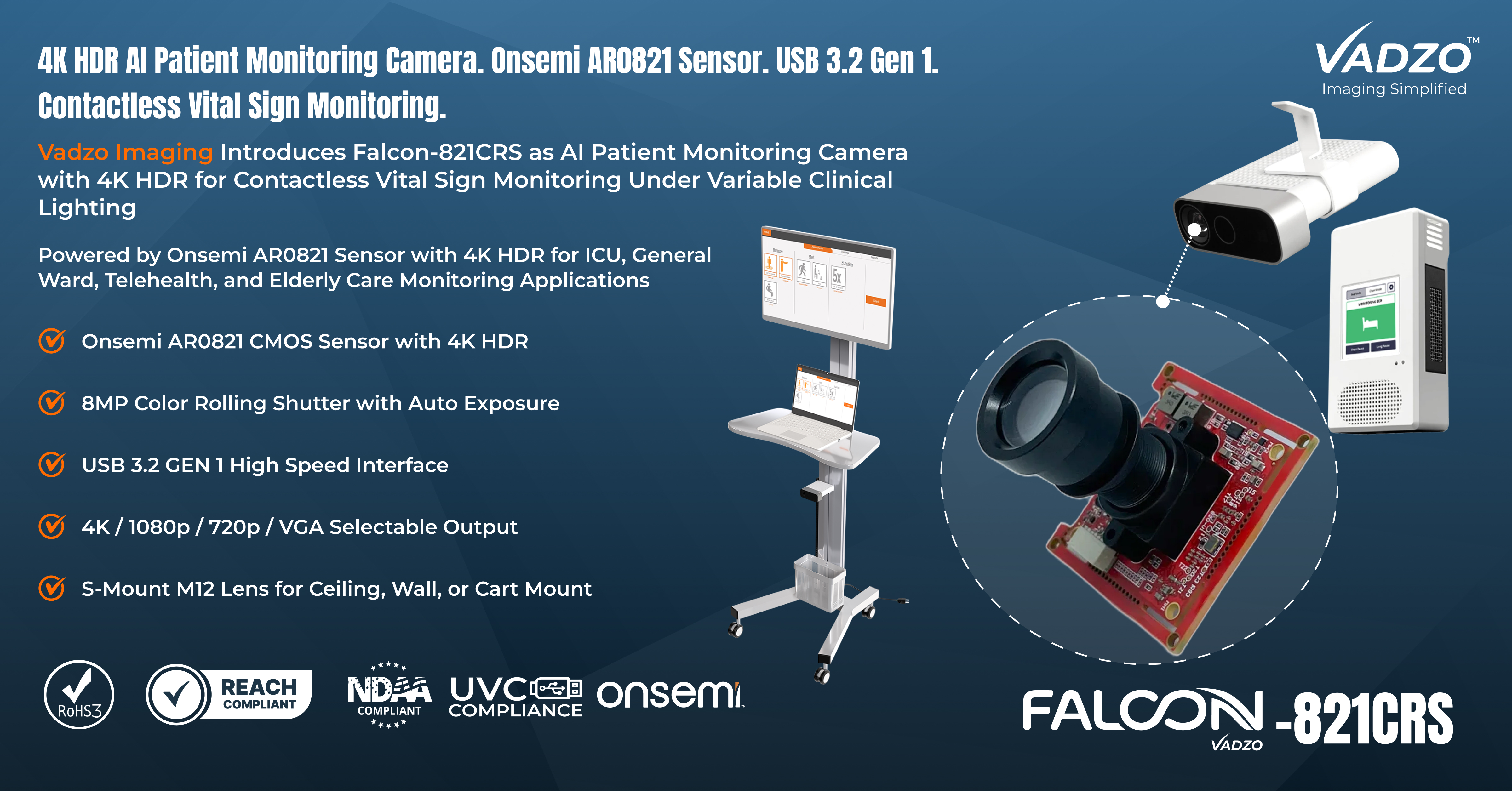
The Falcon-821CRS is an 8MP color camera built on the Onsemi AR0821 sensor for contactless patient monitoring in hospitals and care facilities. It captures native 4K resolution with HDR and auto exposure across a single USB 3.2 GEN 1 connection for AI based on vital sign extraction and fall detection. It supports Windows, Linux, and Android through native UVC drivers in a compact S-Mount form factor suited for ceiling, wall, and bedside cart integration.
FORT WORTH, TX / ACCESS Newswire / July 14, 2026 /Vadzo Imaging, a provider of embedded vision camera products, today announced the launch of the Falcon-821CRS AI Patient Monitoring Camera. Built on the Onsemi AR0821 sensor and part of Vadzo 's USB camera portfolio, the Falcon-821CRS delivers native 8MP 4K color imaging with HDR and auto exposure through a single USB 3.2 GEN 1 connection for contactless vital sign monitoring in hospitals and care facilities. With this launch, Vadzo delivers a purpose-built AR0821 Patient Monitor Camera that combines the sensor 's low-noise color imaging with wide dynamic range performance to support AI-powered heart rate, respiration, and patient movement extraction without touching the patient. This enables deployment across ICU rooms, general wards, telehealth carts, and elderly care facilities with direct plug-and-play USB host integration.
Technical Problem Definition
Continuous vital sign monitoring in hospitals has traditionally depended on wired sensors attached directly to the patient, including ECG leads, pulse oximeter clips, and blood pressure cuffs. These contact-based systems can irritate skin, restrict patient mobility, and raise cross-contamination risk between patients in ICU and general ward settings. Alarm fatigue is a well-documented consequence of wired monitoring, where frequent false alarms from motion artifacts and sensor detachment cause clinical staff to become desensitized to genuine emergencies. Hospitals are increasingly evaluating camera-based contactless monitoring approaches that use computer vision and AI to extract heart rate, respiration rate, and patient activity from a standard video stream without any physical sensor attachment. For more insights into how high-resolution USB cameras are advancing medical imaging applications, read our complete guide to High Resolution USB Cameras for Medical Devices. Clinical environments present a difficult imaging challenge for this approach. Room lighting swings from bright fluorescent panels during rounds to dim night mode lighting during patient rest and changing natural window light throughout the day. A Non-Contact Vital Sign Camera that cannot hold consistent exposure and color accuracy across this range will produce unreliable physiological signal data and false readings.
Engineering Explanation
Extracting subtle physiological signals, such as remote photoplethysmography from video, requires a sensor with clean signal characteristics rather than raw resolution alone. Skin tone color shifts caused by blood volume changes are extremely small and can be masked by sensor noise, motion blur, or uneven exposure. High dynamic range imaging becomes essential in a Clinical Monitoring Camera because the sensor must resolve facial and skin detail correctly, whether the patient sits under a bright ceiling light or in the shadow of a bed rail or curtain. The Onsemi AR0821 sensor addresses this requirement with a 1/1.7-inch optical format and 2.1-micron pixel that captures low-noise 8MP color imaging alongside a native HDR USB Camera. Pairing the sensor with automatic exposure and gain control allows the AR0821 AI Monitoring Camera to maintain stable skin tone reproduction as clinical lighting shifts through the day and night cycle. A high-speed USB 3.2 GEN 1 interface then delivers 4K frames to the host system at the bandwidth AI inference models need on GPU or edge accelerator hardware without the compression artifacts that would otherwise corrupt subtle color and motion data used for vital sign extraction.
Product Overview
The Falcon-821CRS 4K Patient Monitor Camera is Vadzo Imaging 's 8MP color camera module built on the Onsemi AR0821 sensor for contactless patient monitoring, vital sign extraction, and fall detection applications. It captures native 8MP (3840 x 2160) 4K resolution with HDR and auto exposure and streams over a single USB 3.2 GEN 1 connection with full UVC compliance for Windows, Linux, and Android. The camera ships in a compact S-Mount (M12) module suited for ceiling mount, wall mount, and bedside cart integration across ICU rooms, general wards, and telehealth stations. As a USB Patient Vision Camera, it requires no proprietary drivers and no external frame grabber, which lets hospital IT and biomedical engineering teams deploy the camera on existing computing hardware already approved for clinical use. Facilities evaluating a Contactless Patient Camera approach can install the module on carts and ceiling mounts already in service without new network infrastructure.
Key specs: 8MP (3840 x 2160) | Onsemi AR0821 1/1.7-inch 2.1-micron pixel | Color | Rolling Shutter | Auto Exposure and HDR | High-Performance ISP | USB 3.2 GEN 1 | 4K / 1080p / 720p / VGA | S-Mount (M12) | Windows, Linux, Android | Operating Temperature -10C to 60C
Key Capabilities of the Onsemi AR08214K HDR Camera for AI Patient Monitoring
8MP 4K High Resolution Imaging for Subtle Signal Capture:Many monitoring camera products operate at 2MP or lower with limited color depth for detecting small changes in skin tone. The Onsemi AR0821 sensor captures a full 8MP (3840 x 2160) color frame through its rolling shutter architecture with a 2.1-micron pixel that reduces noise in dim patient rooms. This delivers the 8MP Monitoring Camera detail needed to isolate facial and hand regions of interest for AI-based vital sign algorithms. This advantage directly benefits ICU Monitoring Camera deployments, tracking multiple patients per frame, and Patient Ward Camera installations covering an entire room from a single ceiling mount.
HDR and Auto Exposure for Variable Clinical Lighting:Hospital rooms rarely hold a single lighting condition for long. The Falcon-821CRS HDR Patient Monitoring Camera merges multiple exposures into one frame, so bright window light and dim shadow areas remain visible in the same image. Auto exposure adjusts gain and shutter speed automatically as overhead lighting changes between day shift, night shift, and emergency response conditions. This combination is ideal for a 4K WDR Monitor Camera covering a full patient bay under fluorescent light and for a WDR Patient Monitor Camera positioned near a window with strong daylight variation.
Multi-Resolution Output for Flexible AI Pipelines:The Falcon-821CRS 4K Vital Sign Camera supports selectable output resolutions. Full 4K mode delivers maximum spatial detail for high-accuracy vital sign extraction algorithms. The 1080p mode balances resolution and bandwidth for real-time dashboard streaming to nursing stations. The 720p and VGA modes suit lightweight edge inference workloads on lower-power hospital computing hardware. This flexibility allows a single 8MP Patient AI Camera to serve bedside monitoring, hallway activity tracking, and centralized nurse station review from one unit.
USB 3.2 GEN 1 Plug and Play Integration:The Falcon-821CRS USB AI Monitor Camera connects directly to any USB 3.2 GEN 1 host port on Windows, Linux, and Android without additional interface boards. UVC class driver support means the UVC Patient Monitor Camera operates immediately on connection with no proprietary software installation required before first use. This reduces validation time for hospital IT departments, biomedical engineering teams, and system integrators building AI Edge Patient Camera platforms on approved clinical computing carts.
Non-Contact Vital Sign Extraction Through Computer Vision:Rather than reading vital signs from wires and clips, the Contactless Vital Signs Camera pairing enables software running on the host system to track subtle color changes in exposed skin and chest wall movement associated with heart rate and respiration. Because the AR0821 Vital Sign Camera provides high signal-to-noise imaging with stable exposure, downstream AI models receive cleaner input data than is possible from a standard security or webcam-grade sensor. This supports Continuous Patient Monitoring Camera use cases where wires would otherwise limit patient movement or comfort.
Compact S-Mount Form Factor for Clinical Installation
The Falcon-821CRS ships in a compact module footprint with an S-Mount (M12) lens holder that accepts standard M12 threaded optics. System integrators can select wide-angle lenses for full room coverage or narrower optics for close bedside framing. The compact form factor enables integration into space-constrained platforms, including ceiling mounts, wall brackets, mobile telehealth carts, and OEM Monitoring Camera Module designs built into existing patient monitor housings.
"Hospitals want the clinical value of continuous vital sign monitoring without adding more wires to an already crowded bedside. The Falcon-821CRS gives them a camera that holds accurate exposure and color, whether the room is lit by morning sunlight or a single night light. By combining theAR0821 Non-Contact Camera with HDR and auto exposure in one USB 3.2 GEN 1 module, we give hospital system integrators a camera that delivers clean skin tone detail and reliable exposure through one connection instead of a rack of separate wired sensors. That reduces integration complexity and helps clinical teams move from pilot to deployment faster. "- Alwin Vincent, Product Manager, Vadzo Imaging.
Applications
ICU and Critical Care Monitoring:Intensive care units require constant visibility into patient conditions without adding equipment that limits access during an emergency. The Falcon-821CRS AI Hospital Monitoring Camera streams 4K HDR video that AI software can process for heart rate, respiration, and movement while leaving the bedside clear for clinical staff. Auto exposure maintains a readable skin tone as overhead procedure lighting changes during rounds. The Vital Sign Monitoring Camera output can also feed a centralized nurse station dashboard, so one clinician can watch several rooms at once.
General Ward and Step Down Unit Monitoring:Lower acuity units need Patient Observation Camera coverage that does not require a dedicated nurse at every bedside. The Falcon-821CRS Hospital AI Camera detects patient movement and can flag prolonged inactivity or repositioning needs for staff review. As a Patient Activity Camera, it logs mobility trends over a shift so care teams can support fall risk assessment and staffing decisions. The AI Ward Camera integrates with existing nurse call infrastructure, so alerts route through workflows staff already use. HDR performance keeps the image usable from bright daytime hours through dim overnight settings.
Fall Detection and Patient Safety:Patient falls remain one of the most common and costly adverse events in inpatient care. The Falcon-821CRS Fall Detection Camera tracks posture and motion patterns to identify a patient attempting to exit a bed or chair unassisted. As a Patient Fall Camera, it can trigger a local alert or send a signal to a connected nurse call system before a fall occurs rather than after. This Patient Safety Camera capability supports fall prevention programs in geriatric units, post-surgical recovery floors, and behavioral health settings where continuous observation is required.
Elderly Care and Assisted Living Facilities:Long-term care providers need Elderly Care Monitoring Camera coverage that respects resident dignity while still supporting safety goals. The Falcon-821CRS Continuous Patient Monitoring Camera watches for irregular movement patterns, extended immobility, or nighttime wandering without requiring residents to wear any device. Because the camera operates without physical contact, it suits residents who cannot tolerate wearable sensors due to skin sensitivity or cognitive conditions that lead to device removal.
Telehealth and Remote Patient Monitoring:Remote care programs benefit from a Remote Patient Monitoring Camera that clinicians can view alongside vital sign trend data during a virtual visit. The Falcon-821CRS mounts easily on a telehealth cart or wall bracket and streams 4K HDR video over USB 3.2 GEN 1 to a laptop or tablet running consultation software. As a Non-Contact Monitoring Camera, it also supports home-based recovery monitoring, where patients are unlikely to correctly place or maintain wired sensors on their own.
Smart Hospital and OEM Integration:Medical device manufacturers building Smart Hospital Camera platforms benefit from an Onsemi AR0821 Monitor Camera that arrives pre-validated with UVC drivers, HDR tuning, and S-Mount lens flexibility. Original equipment manufacturers can integrate the Falcon-821CRS directly into patient monitor housings, ceiling fixtures, or mobile carts as a Healthcare Monitoring Camera building block rather than developing sensor integration from a bare component.
Frequently Asked Questions
Q: Can a camera actually measure vital signs without touching the patient?
A: Yes. Software running on a host computer can analyze subtle color changes in exposed skin and chest wall movement captured by a high-quality video stream to estimate heart rate, respiration rate, and movement patterns. Vadzo Imaging builds camera products with low-noise imaging and stable exposure control, which depends on this kind of analysis, since a lower-quality sensor introduces noise and exposure drift that makes accurate signal extraction difficult. The camera itself does not calculate vital signs. It supplies the clean video signal that AI software and monitoring platforms use to do so.
Q: How does AI-powered video monitoring help detect a patient fall in a hospital room?
A: AI fall detection software tracks a patient 's posture and movement across video frames and looks for patterns associated with an unassisted attempt to leave a bed or chair, followed by a sudden change in position consistent with a fall. Vadzo Imaging designs its camera products to deliver consistent exposure and frame quality around the clock so that fall detection software receives reliable input even during low-light overnight hours, which is when many falls occur and when video quality typically degrades the most on lower-cost camera products.
Q: Will changing hospital lighting reduce the accuracy of a contactless monitoring camera?
A: It can with a camera that lacks proper exposure control, since color and brightness shifts confuse video-based signal analysis. Vadzo Imaging addresses this directly by building high dynamic range and automatic exposure into its monitoring camera products, so skin tone and motion detail stay consistent from bright daytime lighting through dim night settings. This is one of the reasons hospital integrators choose Vadzo when lighting conditions in a facility vary widely between rooms and shifts.
Q: Is contactless monitoring better for infection control than wired sensors?
A: Contactless monitoring can reduce infection control burden because there are no leads, clips, or cuffs that require cleaning or replacement between patients. Vadzo Imaging supports this shift toward camera-based monitoring by supplying imaging hardware built for continuous, around-the-clock operation in clinical environments rather than consumer-grade webcams that are not designed for that duty cycle. Facilities evaluating non-contact monitoring often cite reduced sensor turnover as a meaningful benefit alongside the clinical data itself.
Q: Does a non-contact vital sign camera replace bedside medical monitors completely?
A: Not typical. Most facilities deploy contactless camera monitoring as a complement to existing bedside monitors rather than a full replacement, using the camera to add continuous coverage during gaps such as when leads are temporarily removed or in lower acuity rooms where full wired monitoring is not standard. Vadzo Imaging proudly supplies the imaging hardware that OEM monitoring platform developers build these complementary systems on, giving hospitals more monitoring coverage without adding wired equipment everywhere.
Availability
The Falcon-821CRS AI Patient Monitoring Camera, built on the Onsemi AR0821 sensor, is now available for evaluation and production orders. Evaluation kits include the camera module, S-Mount lens, USB 3.2 GEN 1 cable, and platform driver documentation with no minimum order requirement. Browse the full Vadzo camera portfolio at https://www.vadzoimaging.com/ or contact Vadzo at alwin@vadzoimaging.com to request an evaluation kit or discuss OEM integration requirements.
About Vadzo Imaging
Vadzo Imaging is a global provider of embedded vision solutions and delivers high-performance camera technologies and imaging platforms for applications in healthcare, robotics, industrial automation, and edge AI. Its products are designed for seamless integration with leading embedded platforms. Vadzo supports customers through hardware customization, firmware development, and module-level drivers, enabling faster development and deployment of vision-based systems.
Media Contact
Alwin Vincent
Vadzo Imaging
Email: alwin@vadzoimaging.com
LinkedIn: Vadzo Imaging
YouTube: Vadzo Imaging
X: Vadzo Imaging
SOURCE: Vadzo Imaging
View the original press release on ACCESS Newswire
© 2026 ACCESS Newswire. All Rights Reserved.