



Vadzo Imaging Highlights Falcon-821CRS as a Versatile M12 USB Camera Module with Swappable S-Mount Lenses for Multi-Application Embedded Vision
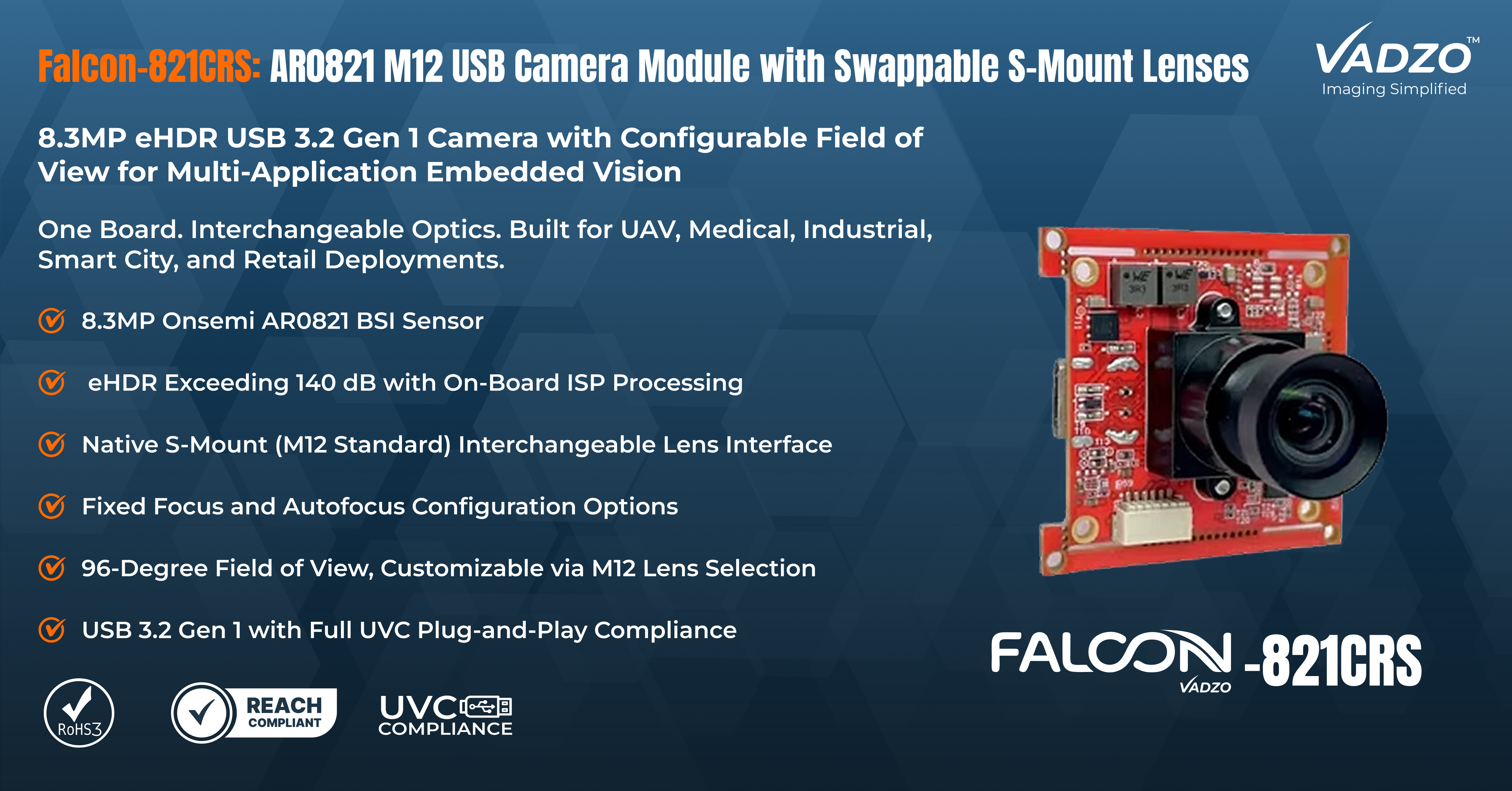
Vadzo Imaging 's Falcon-821CRS is an 8.3MP M12 USB camera module built on the Onsemi AR0821 BSI sensor, delivering embedded HDR (eHDR) exceeding 140 dB and a native S-Mount (M12 Standard) lens interface that lets OEM engineers and system integrators reconfigure field of view through interchangeable optics instead of committing to a fixed-lens board design. The module ships with an on-board ISP, full UVC compliance for driverless USB 3.2 Gen 1 operation, and both fixed focus and autofocus configurations, positioning it as a camera platform that adapts across UAV, medical, industrial automation, smart city, and retail deployments.
FORT WORTH, TX / ACCESS Newswire / July 21, 2026 /Vadzo Imaging, a manufacturer of embedded vision camera products, today highlighted the Falcon-821CRS as a versatile AR0821 M12 USB camera module for OEM engineers and system integrators who need to adapt field of view and optical performance across multiple product lines without redesigning the camera board. Built around the Onsemi AR0821 sensor and a standard M12 lens mount, the Falcon-821CRS gives engineering teams a single USB 3.2 Gen 1 platform that accepts a broad ecosystem of commercially available S-Mount lenses.
The Fixed-Lens Constraint in Multi-Vertical Embedded Vision Design
OEM engineering teams building a camera-based products across more than one vertical face a recurring board-level problem. A camera module with a permanently bonded or non-standard lens locks the field of view, working distance, and optical performance to a single use case at the moment the board is designed. When product requirements later call for a wider field of view for a UAV payload, a narrower field of view for a pathology imaging adapter, or a different working distance for a kiosk enclosure, the usual response is qualifying an entirely new camera SKU, requalifying the board mechanically and optically, and carrying additional inventory across the product line. This adds cost and lead time precisely where OEM teams need flexibility, particularly for programs that serve UAV, AGV, medical imaging, smart city, and retail deployments from a shared hardware base. Configurable FOV camera designs that decouple the lens from the board address this constraint directly.
S-Mount (M12 Standard) Optics as the Engineering Solution
The Falcon-821CRS resolves the fixed-lens constraint through a standard S-Mount (M12 Standard) lens interface, the same M12 x 0.5 thread pitch mechanical standard used across a wide commercial ecosystem of board-level lenses. Because the lens mount follows an established industry standard rather than a proprietary optical housing, engineers can select from a broad range of M12 lenses spanning focal length, aperture, and IR-cut characteristics without altering the camera board or sensor interface. The Falcon-821CRS is available in fixed focus and autofocus configurations built around this same S-Mount interface. In the fixed focus configuration, engineers set back focus once during optical qualification for a chosen lens and field of view. In the autofocus configuration, a VCM mechanism adjusts focus in software after a lens change, reducing the mechanical recalibration of work that a lens swap would otherwise require. The base configuration ships with a 96-degree field of view that is customizable through alternate M12 lens selection, giving engineering teams a single wide FOV camera module, narrow FOV camera module, and custom FOV camera platform, depending on the S-Mount lens selected for a given deployment. This positions the Falcon-821CRS as an AR0821 Lens Mount camera engineered for optical flexibility rather than a single fixed configuration.
Falcon-821CRS: An AR0821 M12 USB Camera Built for Optical Flexibility
The Falcon-821CRS is Vadzo Imaging 's Onsemi AR0821 M12 camera, delivering 8.3MP (3848 x 2168) resolution from a 1/1.7-inch BSI sensor with 2.1 µm pixels and embedded HDR (eHDR) exceeding 140 dB. As an AR0821 S-Mount USB camera, it processes the full HDR tone mapping, color correction, and noise reduction pipeline on board, delivering a fully processed 4K HDR stream over USB 3.2 Gen 1 with full UVC compliance. Available as an 8MP S-Mount camera or, through alternate lens selection, a 4K HDR USB camera tuned for narrower or wider coverage, the Falcon-821CRS gives OEM teams a single board-level platform that adapts to application-specific optical requirements without a board rasping.
Key specs: Falcon-821CRS AR0821 M12 USB Camera | 8.3MP (3848 x 2168) | Onsemi AR0821 BSI | 1/1.7 " Sensor Format | 2.1µm x 2.1µm Pixel | Color Rolling Shutter | eHDR Exceeding 140 dB | USB 3.2 Gen 1 UVC | S-Mount (M12 Standard) | Fixed Focus and Autofocus Options | 96° Customizable FOV | -30°C to 80°C
Key Capabilities of the Falcon-821CRS
S-Mount (M12) Lens Interface for Swappable and Configurable Optics:At the core of the Falcon-821CRS is its S-Mount (M12 Standard) lens interface, the same mechanical standard used across the broader S-Mount OEM camera ecosystem. This interchangeable lens USB camera design allows engineering teams to treat lens selection as a configuration decision rather than a board redesign decision. A swappable lens camera module approach like this is particularly useful for OEM product lines that ship the same board across multiple end markets, since a single AR0821 M12 USB camera can be paired with different S-Mount lenses to meet the field of view, aperture, and IR-cut requirements of each deployment.
Onsemi AR0821 BSI Sensor with eHDR Exceeding 140 dB:As an 8MP 4K USB camera, the Onsemi AR0821 sensor at the center of the Falcon-821CRS uses a backside-illuminated pixel architecture that extends per-pixel photodetector response, enabling embedded HDR (eHDR) performance that exceeds 140 dB. This dynamic range is processed entirely by the on-board ISP, so scenes containing both bright highlights and deep shadow detail, such as metallic industrial components, outdoor UAV footage, or high-contrast retail environments, are captured in a single frame without a host-side multi-exposure merge pipeline.
On-Board ISP for Fully Processed 4K HDR Streaming:The Falcon-821CRS carries a high-performance ISP on board that handles HDR tone mapping, auto exposure, auto white balance, color correction, and noise reduction inside the camera module. This makes the Falcon-821CRS a true plug-and-play USB camera that delivers a finished 4K HDR video stream over USB 3.2 Gen 1, freeing host CPU and GPU resources for navigation, inference, or analytics tasks running above the imaging layer, an advantage that matters most on compute-constrained UAV, AGV, and kiosk platforms.
Fixed Focus and Autofocus Configurations Across the Same S-Mount Platform:Because optical requirements vary by vertical, the Falcon-821CRS is offered in both fixed focus and autofocus configurations built on the same S-Mount (M12 Standard) interface. The fixed focus configuration suits applications with a stable, known working distance, while the autofocus configuration uses a VCM mechanism to adjust focus in software, reducing recalibration effort whenever the lens or working distance changes. Both configurations ship with a 96-degree field of view as standard, customizable to narrower or wider coverage through alternate M12 lens selection.
USB 3.2 Gen 1 UVC Compliance for Driverless Integration:The Falcon-821CRS connects over USB 3.2 Gen 1 with full UVC (USB Video Class) compliance, meaning it enumerates as a standard video device the moment it is connected and streams immediately on Windows, Linux, and Android without custom driver development. As a UVC S-Mount camera, it removes driver maintenance from the OEM integration scope entirely. The VISPAARC SDK adds programmatic control over ROI, GPIO, triggers, and firmware updates in C, C++, C#, and Python for teams that need deeper integration beyond standard UVC streaming.
"Falcon-821CRS was engineered so that a single board does not have to mean a single field of view, standardizing on an S-Mount interface lets our OEM partners reuse one AR0821 platform across UAV, medical, industrial, and retail programs and simply change the lens to match the application. "- Alwin Vincent, Product Manager at Vadzo Imaging
Target Applications
UAV and Aerial Inspection Platforms:UAV payload integrators favor a UAV S-Mount camera because mission profiles change from wide-area mapping to narrow-field target inspection within the same airframe program. The Falcon-821CRS functions as a UAV lens camera module by pairing its on-board ISP and eHDR performance with a swappable M12 lens, letting integrators reconfigure field of view for aerial surveying, infrastructure inspection, and search operations without qualifying a separate camera board for each mission profile. This flexibility extends naturally into broader automation and robotics camera module deployments where the same board serves multiple platform variants.
Medical and Pathology Digital Imaging:Medical device developers building digital pathology and patient-care imaging systems require a Medical M12 camera that can be optically matched to a specific microscope adapter, examination scope, or documentation fixture. As a Pathology M12 camera candidate, the Falcon-821CRS pairs its 8.3MP AR0821 sensor and eHDR imaging with S-Mount lens options selected for the working distance and magnification each instrument requires, supporting medical device and patient care applications where consistent color and dynamic range are diagnostic requirements rather than conveniences.
AGV Navigation and Industrial Automation:AGV platforms and industrial inspection cells benefit from an AGV lens camera that can be tuned for the specific navigation marker geometry, docking guidance range, or part inspection distance of a given cell. As an OEM M12 camera module, the Falcon-821CRS lets integrators select narrow or wide S-Mount optics for docking guidance, floor marker tracking, and metallic component inspection under the same eHDR-capable sensor, supporting broader industrial automation and robotics camera platforms across warehouse and manufacturing floors.
Smart City Infrastructure and Digital Signage:Smart city deployments combine wide-area monitoring nodes with close-range interactive displays, a mix that a fixed-lens camera cannot serve efficiently. The Falcon-821CRS operates as a Smart City USB camera for infrastructure monitoring and as a Digital Signage camera for interactive kiosk and display integration, with the same AR0821 board adapting between the two through S-Mount lens selection rather than separate hardware qualification, consistent with the broader Smart city solutions that municipal and commercial integrators are standardizing around.
Retail Analytics and Kiosk Vision:Retail deployments range from overhead analytics nodes covering full aisles to close-range Kiosk Vision camera installations reading a shopper 's face or a product barcode at arm 's length. As a Retail Analytics USB camera, the Falcon-821CRS supports both ends of that range from a single AR0821 platform, with S-Mount lens selection setting the field of view for each installation type. This flexibility supports a wider set of retail automation solutions that combine shelf monitoring, checkout analytics, and interactive displays on shared hardware.
VISPA ARC SDK and Software Support
The Falcon-821CRS ships with UVC compliance for immediate plug-and-play streaming on Windows, Linux, and Android, and with the VISPAARC SDK for teams that need deeper control. The SDK exposes Region of Interest configuration, GPIO and trigger management, autofocus parameters in the autofocus configuration, and firmware update handling through APIs available in C, C++, C#, and Python. Because lens selection is handled at the optical layer through the S-Mount interface rather than in software, switching lenses does not require SDK-level changes, which keeps the same integration codebase valid across UAV, medical, AGV, smart city, and retail variants of the same board, making it a practical OEM interchangeable lens camera for teams standardizing firmware across optical variants.
Frequently Asked Questions
Q: What is an S-Mount (M12) lens mount and why is it used in embedded USB camera modules?
A:An S-Mount lens mount, also called M12 Standard, is a small-format threaded lens interface using an M12 x 0.5 thread pitch, common on board-level camera modules used in embedded vision. Because the standard is shared across a wide commercial lens ecosystem rather than tied to one manufacturer 's housing, engineers can select lenses with different focal lengths, apertures, and IR-cut characteristics for the same camera board. This makes S-Mount a practical choice for OEM programs that need to adjust field of view or working distance between product variants without changing the sensor board itself, since only the lens element needs to change to shift the optical configuration. The mount is widely used across AR0821 M12 USB camera module designs in UAV, industrial, and medical embedded vision because it keeps board qualification separate from optical qualification, reducing requalification effort when a program 's optical requirements shift.
Q: Which USB camera module supports interchangeable S-Mount lenses for multiple fields of view requirements?
A: The Falcon-821CRS from Vadzo Imaging is built around a native S-Mount (M12 Standard) lens interface, making it an interchangeable lens USB camera for OEM programs that need to adjust field of view across product variants. Built on the Onsemi AR0821 BSI sensor, it delivers 8.3MP (3848 x 2168) resolution with embedded HDR (eHDR) exceeding 140 dB and an on-board ISP that processes the full HDR pipeline before the frame reaches the host over USB 3.2 Gen 1. It ships with a 96-degree field of view as standard, customizable to narrower or wider coverage through alternate M12 lens selection and is available in fixed focus and autofocus configurations. Evaluation units and technical documentation are available through the M12 USB camera module product page.
Q: What USB camera module is suited for both UAV and industrial automation deployments from a single board?
A: Vadzo Imaging 's Falcon-821CRS addresses this directly as a multi-application camera module built on a swappable S-Mount lens interface. The same Onsemi AR0821 board can be configured as a UAV S-Mount camera for aerial inspection with a wide-angle M12 lens, or as an AGV lens camera for close-range navigation and docking guidance with a narrower optic, without changing the sensor, ISP, or USB 3.2 Gen 1 interface. The on-board ISP and eHDR exceeding 140 dB carry across every lens configuration, so image quality remains consistent regardless of the optical setup selected for a given program. Engineering teams evaluating a shared hardware platform across UAV and ground-based automation programs can review specifications through the automation and robotics camera module page.
Q: Is there a USB camera module suited for both medical imaging and retail kiosk applications?
A: The Falcon-821CRS from Vadzo Imaging serves both through S-Mount lens selection on the same AR0821 board. As a Medical M12 camera, it can be paired with lenses matched to a microscope adapter or examination fixture for pathology M12 camera use cases where dynamic range and color accuracy matter. As a Kiosk Vision camera, the identical board accepts a different M12 lens tuned for close-range facial or barcode capture. Because the sensor, ISP, and eHDR performance exceeding 140 dB are unchanged between configurations, OEM teams qualify one electrical and firmware platform and vary only the optics. Details for both configurations are available through the medical device and patient care page.
Q: How does on-board ISP HDR processing differ from host-side HDR merging in a USB camera?
A: On-board ISP HDR processing performs tone mapping, exposure blending, and noise reduction inside the camera module before the frame is transmitted, so the host receives a single finished HDR frame ready for display or analysis. Host-side HDR merging, by contrast, requires the host system to receive multiple exposures or a raw sensor stream and run its own merge and tone-mapping pipeline, consuming CPU or GPU cycles that would otherwise be available for other tasks. For compute-constrained platforms such as UAV payload computers, AGV controllers, or kiosk single-board computers, on-board ISP processing is the more practical architecture since it leaves host resources free. This is the approach used across Vadzo Imaging 's HDR USB camera lineup, including the Falcon-821CRS, where eHDR exceeding 140 dB is fully resolved on board before the stream reaches USB 3.2 Gen 1.
Availability
The Falcon-821CRS is available now for evaluation and OEM integration in both fixed focus and autofocus configurations through Vadzo Imaging 's 8MP M12 USB camera product page. S-Mount lens selection, including wide, narrow, and custom field of view options, is handled during the evaluation and quoting process based on each program 's target application, making the Falcon-821CRS an adjustable field of view camera for programs finalizing optical requirements late in development. Volume pricing and customization requests can be directed to Vadzo Imaging 's engineering team.
About Vadzo Imaging
Vadzo Imaging Designs and manufactures embedded vision camera products for OEM developers and system integrators across medical, industrial, robotics, smart city, and retail markets. The company 's board-level and enclosure camera portfolio spans USB, MIPI, and GigE interfaces built on sensors from Onsemi and Sony, supporting deployments from compact edge devices to distributed networked systems. Beyond hardware, Vadzo provides sensor integration, ISP tuning, firmware development, and SDK support, giving engineering teams a single partner from evaluation through production lifecycle management. More information is available at vadzoimaging.com.
Media Contact
Alwin Vincent
Vadzo Imaging
Email: alwin@vadzoimaging.com
LinkedIn: Vadzo Imaging
YouTube: Vadzo Imaging
X: Vadzo Imaging
SOURCE: Vadzo Imaging
View the original press release on ACCESS Newswire
© 2026 ACCESS Newswire. All Rights Reserved.