



How to Choose the Right USB 3.2 Gen 1 Camera: Vadzo Imaging Compares AR0521 5MP vs AR0234 2MP for Machine Vision Resolving Power, NIR Response, and Frame Rate
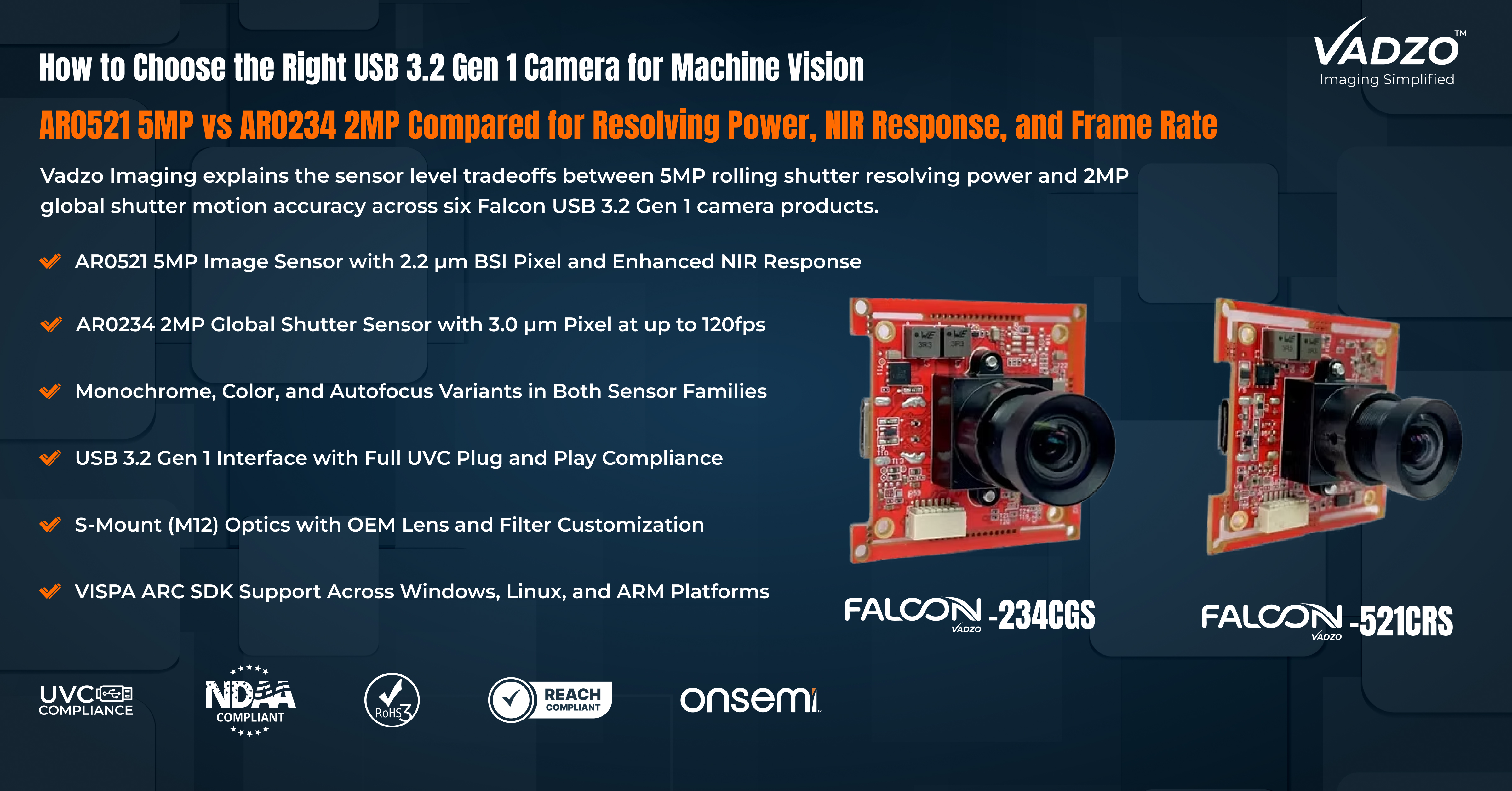
Vadzo Imaging publishes a technical comparison of its AR0521 5MP and AR0234 2MP Falcon USB camera series to help machine vision engineers select the rightUSB 3.2 Gen 1 Camera for their application. The comparison examines resolving power, NIR response, shutter architecture, and frame rate across six camera products spanning monochrome, color, and autofocus configurations.
FORT WORTH, TX / ACCESS Newswire / July 22, 2026 /Vadzo Imaging, a provider of embedded vision camera products, today publishes an engineering comparison of two of the most widely deployed sensor platforms in its Falcon Embedded Vision USB Camera portfolio: the Onsemi AR0521 5MP Image Sensor and the Onsemi AR0234 2MP Image Sensor. Both are offered in monochrome, color, and autofocus configurations over USB 3.2 Gen 1 with full UVC compliance.
Why Sensor Selection Defines Machine Vision Outcomes
Every machine vision system inherits its performance ceiling from the image sensor. When an engineering team selects a Machine Vision USB Camera, four sensor level parameters determine whether the deployment succeeds: resolving power, shutter architecture relative to scene motion, spectral response relative to the illumination plan, and frame rate relative to line speed.
The AR0521 and the AR0234 sit at two deliberate points in this design space. The AR0521 5MP Image Sensor is a 1/2.5 inch back-illuminated rolling shutter CMOS with a 2.2 µm pixel delivering 2592 x 1944 resolution with enhanced NIR response. The AR0234 2MP Image Sensor is a 1/2.6-inch global shutter CMOS with a 3.0 µm pixel delivering 1920 x 1200 at up to 120 frames per second. Neither is universally better. Each answers a different engineering problem, which is why Vadzo builds its USB3 camera products for machine vision around both.
Resolving Power: What 5MP vs 2MP Means at the Inspection Plane
Resolving power is the ability of the camera to distinguish two adjacent features as separate, and it is set by the number of pixels available across the field of view. For defect detection, the standard rule is a minimum of three pixels across the smallest defect that must be classified reliably.
This is where the AR0521 earns its position. A PCB Inspection Camera resolving solder bridging, tombstoned components, or micro cracks in traces needs multiple pixels across features measured in tens of microns. The 2592 x 1944 array delivers 2.6 times the pixel count of a 2MP alternative, translating into a wider inspected area per station or finer defect resolution at the same working distance for a Semiconductor Inspection Camera examining die surfaces or wire bonds.
The tradeoff is pixel size. The 2.2 µm pixel of the AR0521 collects fewer photons per exposure than the 3.0 µm pixel of the AR0234. The AR0521 compensates through its back-illuminated architecture, routing light directly to the photodiode. Under controlled illumination the resolution advantage dominates. In photon starved scenes the larger AR0234 pixel becomes the more valuable property.
Shutter Architecture: Rolling Shutter Detail vs Global Shutter Motion Accuracy
The AR0521 is a rolling shutter sensor that reads out pixel rows sequentially, so each row is exposed at a slightly different moment. For static scenes this is invisible. When the subject or the camera moves during readout, rolling shutter produces skew and geometric distortion that corrupts dimensional measurement.
The AR0234 exposes every pixel simultaneously. The full 1920 x 1200 frame represents a single instant in time regardless of subject or platform velocity. For a Global Shutter Machine Vision Camera imaging parts on a high-speed conveyor or a robotic end effector in motion, this is what makes measurement geometrically trustworthy. It is why the AR0234 Global Shutter USB Camera is the default recommendation for any automation and robotics deployment where motion is inherent to the process.
The AR0234 additionally supports an optional rolling shutter readout mode, and this AR0234 Rolling Shutter Camera configuration gives integrators a linear readout option for static scenes on the same hardware.
NIR Response and Monochrome Sensitivity
A significant fraction of industrial imaging happens outside the visible spectrum. Structured light profiling, vein detection, and agricultural sorting all illuminate the scene at 850 nm or 940 nm. Color sensor stacks absorb a large fraction of NIR photons in the Bayer filter mosaic before they reach the photodiode, which is why a dedicated NIR Imaging USB Camera uses a monochrome sensor without a filter array.
The AR0521 monochrome variant is engineered for this role. Its back-illuminated architecture delivers enhanced quantum efficiency in the NIR band, producing a High Resolution NIR Camera that resolves fine detail under IR illumination beyond what lower resolution alternatives capture. The AR0234 monochrome variant offers the complement, pairing NIR sensitivity with global shutter capture for structured light systems where fringe geometry must not be distorted by motion.
Monochrome selection is not only about NIR. Removing the Bayer filter increases photon capture across the visible spectrum as well, improving any Low-Light Machine Vision Camera role. Color remains correct when the decision depends on color discrimination, such as label verification or produce grading.
Frame Rate and Bandwidth on USB 3.2 Gen 1
Frame rate determines how many inspection opportunities the system gets per second. The AR0234 delivers up to 120fps at full 1920 x 1200 resolution, a genuine High Frame Rate USB Camera for high speed production lines and low latency robotic perception loops. At 120fps a part moving at 2 meters per second advances under 17 mm between frames, the sampling density reliable High Speed Inspection Camera deployments require.
The AR0521 prioritizes pixel count over frame rate, streaming full 5MP frames over the same USB 3.2 Gen 1 interface. The 5 Gbps signaling provides sustained bandwidth for uncompressed 5MP capture that USB 2.0 cannot deliver, and both sensor families support windowing and region of interest readout to raise effective frame rate when only a subsection of the array is needed, the behavior documented across the Vadzo industrial USB camera portfolio.
The AR0521 5MP USB 3.2 Gen 1 Camera Series
Vadzo offers the AR0521 5MP USB Camera platform in three configurations sharing the same back-illuminated sensor core and USB 3.2 Gen 1 UVC interface.
Falcon-521MRS: 5MP NIR Monochrome USB 3.2 Gen 1 Camera
The monochrome member of the series is a 5MP NIR Monochrome Camera built for structured illumination, IR based biometrics, and industrial imaging under 850 nm and 940 nm sources. With no Bayer filter, the full photon flux at every pixel reaches the photodiode. As an AR0521 NIR Monochrome USB Camera it pairs that spectral response with 5MP resolving power for vein visualization, silicon inspection under IR transmission, and agricultural grading.
Key specs:5MP (2592 x 1944) | Onsemi AR0521 | 1/2.5 inch 2.2 µm Pixel | Rolling Shutter | Monochrome with Enhanced NIR Response | USB 3.2 Gen 1 | UVC Compliant | S-Mount (M12 Standard)
Falcon-521CRH: AR0521 Color Autofocus Low-Light USB 3.2 Gen 1 Camera
The autofocus member of the series is an AR0521 Color Autofocus Camera pairing the 5MP sensor with a voice coil motor lens under software focus control. This AR0521 Autofocus USB Camera removes the fixed working distance constraint, letting one module resolve subjects across a continuous range of distances in kiosks, document capture systems, and handheld devices. Engineered for strong low-light performance, this AR0521 Autofocus Low-Light Camera configuration also serves as an AR0521 Low-Light USB Camera and complete 5MP Autofocus USB Camera in mixed illumination.
Key specs: 5MP (2592 x 1944) | Onsemi AR0521 | 1/2.5 inch 2.2 µm Pixel | Rolling Shutter | Color | VCM Autofocus | Low-Light Optimized | USB 3.2 Gen 1 | UVC Compliant
Falcon-521CRS: AR0521 5MP Low Noise USB 3.2 Gen 1 Camera
The fixed focus color member of the series is a 5MP Low Noise USB Camera tuned for the cleanest possible readout from the 5MP array. Low read noise preserves shadow detail and raises usable dynamic range, which matters most in scenes with dark features on dark backgrounds and in Low-Light Industrial Camera deployments. As an AR0521 Low Noise USB Camera with S-Mount (M12) optics it accepts standard lenses and filters on a Low Noise Machine Vision Camera foundation.
Key specs: 5MP (2592 x 1944) | Onsemi AR0521 | 1/2.5 inch 2.2 µm Pixel | Rolling Shutter | Color | Low Noise Readout | USB 3.2 Gen 1 | UVC Compliant | S-Mount (M12 Standard)
The AR0234 2MP Global Shutter USB 3.2 Gen 1 Camera Series
The AR0234 series answers the motion problem. All three configurations share the global shutter core, full resolution capture at up to 120fps, and the same USB 3.2 Gen 1 UVC interface.
Falcon-234MGS: AR0234 Monochrome Global Shutter USB 3.2 Gen 1 Camera
The monochrome configuration is an AR0234 Monochrome Global Shutter Camera built for structured light profiling, barcode reading, and NIR guidance where spectral efficiency outranks color output. Removing the Bayer array maximizes photon capture, making this 2MP Monochrome USB Camera the highest sensitivity member of the series and a capable 2MP NIR Monochrome USB Camera. The global shutter guarantees laser lines and fiducial markers retain exact geometry regardless of platform motion.
Key specs: 2MP (1920 x 1200) | Onsemi AR0234 | 1/2.6 inch 3.0 µm Pixel | Global Shutter | Monochrome | Up to 120fps | USB 3.2 Gen 1 | UVC Compliant | S-Mount (M12 Standard)
Falcon-234CGH: AR0234 Global Shutter Autofocus USB 3.2 Gen 1 Camera
The autofocus configuration is a 2MP Autofocus Global Shutter Camera combining distortion free capture with software-controlled focus, a pairing rare in this class. A 2MP Autofocus USB Camera with global shutter serves applications where working distance and subject motion are both variable, such as handheld barcode scanning and mobile inspection carts. As an AR0234 Autofocus USB Camera it holds focus across the operating range while the shutter keeps every frame geometrically accurate during movement.
Key specs: 2MP (1920 x 1200) | Onsemi AR0234 | 1/2.6 inch 3.0 µm Pixel | Global Shutter | Color | VCM Autofocus | Up to 120fps | USB 3.2 Gen 1 | UVC Compliant
Falcon-234CGS: AR0234 2MP Color Global Shutter USB 3.2 Gen 1 Camera
The fixed focus color configuration is a 2MP Color Global Shutter Camera for color dependent decisions in motion rich scenes: colored lane markers in AGV navigation, color coded components, and label verification at conveyor speed. This 2MP Global Shutter USB Camera delivers 1920 x 1200 color frames at up to 120fps as the AR0234 Color USB Camera for any 2MP Color USB Camera role. The 3.0 µm pixel keeps it serviceable as a 2MP Low-Light USB Camera.
Key specs: 2MP (1920 x 1200) | Onsemi AR0234 | 1/2.6 inch 3.0 µm Pixel | Global Shutter | Color | Up to 120fps | USB 3.2 Gen 1 | UVC Compliant | S-Mount (M12 Standard)
Product Specifications Comparison
Parameter | AR0521 Series (Falcon-521MRS, 521CRH, 521CRS) | AR0234 Series (Falcon-234MGS, 234CGH, 234CGS) |
Sensor | Onsemi AR0521 CMOS | Onsemi AR0234 CMOS |
Optical Format | 1/2.5 inch | 1/2.6 inch |
Resolution | 5MP (2592 x 1944) | 2MP (1920 x 1200) |
Pixel Size | 2.2 µm x 2.2 µm | 3.0 µm x 3.0 µm |
Shutter Type | Rolling Shutter | Global Shutter |
Frame Rate | Full 5MP streaming over USB 3.2 Gen 1 | Up to 120fps at full resolution |
Variants | NIR Monochrome, Color Autofocus Low-Light, Color Low Noise | Monochrome Global Shutter, Color Autofocus Global Shutter, Color Global Shutter |
Interface | USB 3.2 Gen 1 with UVC compliance | USB 3.2 Gen 1 with UVC compliance |
Optics | S-Mount (M12) fixed focus or VCM autofocus | S-Mount (M12) fixed focus or VCM autofocus |
Software | VISPA ARC SDK on Windows, Linux, and ARM | VISPA ARC SDK on Windows, Linux, and ARM |
The Selection Framework: Matching Sensor to Application
The decision path Vadzo engineering teams apply follows the physics rather than the datasheet headline. Start with motion. If the subject or platform moves during exposure, the AR0234 Global Shutter USB Camera series is the correct starting point. If the scene is static or frozen with strobed illumination, the resolving power of the AR0521 5MP USB Camera series becomes available.
Then apply illumination. NIR sources or tight photon budgets favor monochrome variants in either family. Then apply working distance. Variable subject distance points to the autofocus variants while fixed inspection geometry favors fixed focus S-Mount configurations. The framework resolves the AR0521 vs AR0234 Camera question for most deployments, and Vadzo publishes the full portfolio in its online store so both platforms can be evaluated side by side.
"Engineers do not buy megapixels or frame rates. They buy the confidence that a defect will be resolved, a moving part will be measured accurately, and an IR illuminated scene will have enough signal to classify. The AR0521 and AR0234 series exist because those three demands pull sensor design in different directions, and we would rather hand a customer the honest tradeoff than pretend one camera product solves everything. " - Alwin Vincent, Product Manager, Vadzo Imaging.
Applications
PCB and Electronics Inspection
Automated optical inspection demands pixel density across solder joints, component markings, and trace geometry. The AR0521 series serves as the Automated Optical Inspection Camera for post-reflow stations where boards are stationary or indexed. Where boards move continuously under the imaging head, the AR0234 series preserves geometric accuracy at line speed.
Semiconductor and Precision Manufacturing
A Semiconductor Inspection Camera imaging die attach quality or wire bond geometry operates at feature scales where the 5MP array directly reduces capture positions per part. The monochrome AR0521 variant adds NIR transmission imaging for silicon inspection, since silicon is transparent at NIR wavelengths and internal defects become visible under IR backlighting.
High Speed Sorting and Barcode Reading
A Barcode Scanning Camera on a logistics sorter must freeze label geometry at belt speed, since skewed rolling shutter frames raise no-read rates directly. The AR0234 series at up to 120fps provides reliable decode at speed, with the monochrome variant maximizing symbology contrast and the autofocus variant handling variable parcel heights.
Robotics and Autonomous Platforms
A Robotics Vision Camera mounted on a moving arm or an AGV experiences continuous motion by definition. Global shutter is the hard requirement, and 120fps shortens the perception loop for visual servoing and obstacle detection. Color variants track lane markers while monochrome variants pair with structured light across automation and robotics deployments.
Motion Triggered Monitoring and Surveillance
A Motion Detection Machine Vision Camera in a perimeter monitoring role benefits twice from the AR0234 series: global shutter renders moving subjects without distortion and high frame rate raises the probability of capturing a usable frame of a fast event. For security and surveillance deployments under IR illumination, the monochrome variants of both families apply: the AR0521 for identification detail and the AR0234 for motion integrity, an architecture equally relevant to smart city solutions nodes.
Medical Devices and Life Science Instruments
Diagnostic instruments and laboratory automation platforms draw on both families. The 5MP NIR monochrome configuration supports vein detection workflows in medical device and patient care products, while the low-noise color variant serves colorimetric assays where shadow detail defines the measurement. Motion stages with in-motion verification favor the global shutter series.
VISPA ARC SDK and Platform Support
Every product in both series is fully UVC compliant, enumerating as a standard video device on Windows, Linux, and Android without driver installation. Beyond UVC defaults, the VISPA ARC SDK provides programmatic access to exposure and gain, region of interest, windowing and binning, trigger configuration, autofocus control on VCM variants, and firmware update management. APIs are available in C, C++, C#, and Python across Windows, Linux, and embedded ARM, giving a Machine Vision USB Camera deployment the same production-grade software lifecycle across desktop and embedded edge systems.
Frequently Asked Questions
1. How do I choose between a 5MP rolling shutter USB camera and a 2MP global shutter USB camera for machine vision?
Start with motion. If the subject or platform moves during exposure at a velocity that affects the measurement, a global shutter sensor is a hard requirement because rolling shutter readout introduces skew that software cannot fully remove. If the scene is static or frozen with strobed illumination, the higher pixel count of a 5MP sensor delivers finer defect resolution or wider coverage per station. Vadzo Imaging builds its Falcon USB 3.2 Gen 1 camera portfolio around exactly this decision, offering the AR0521 5MP platform for resolving power and the AR0234 2MP global shutter platform for motion accuracy in monochrome, color, and autofocus variants.
2. Why is a monochrome USB camera better than a color USB camera for NIR imaging?
A color sensor places a Bayer filter mosaic over the pixel array to separate red, green, and blue channels, and that filter stack absorbs much of the photon flux at 850 nm and 940 nm. A monochrome sensor has no filter array, so the full photon flux at every pixel contributes to the signal across both visible and NIR spectra. The result is higher quantum efficiency under IR illumination, better signal-to-noise ratio, and lower illumination power requirements. Vadzo Imaging offers this in two resolutions: a 5MP NIR monochrome configuration on the back-illuminated AR0521 for fine-detail NIR imaging, and a 2MP monochrome global shutter configuration on the AR0234 for structured light under motion.
3. What frame rate does a machine vision USB camera need for high speed inspection?
The required frame rate is set by object velocity and the spatial sampling the application needs. The engineering approach is to confirm the distance the subject travels between consecutive frames is smaller than the feature spacing the system must not miss. High-speed sorting, barcode reading at belt speed, and robotic visual servoing typically demand 100fps or more, paired with a global shutter so each frame is geometrically accurate. Exposure time must also be short enough to limit motion blur to under one pixel of subject travel. Sensor sensitivity, shutter architecture, and frame rate must therefore be evaluated together.
4. What is the advantage of USB 3.2 Gen 1 over USB 2.0 for an industrial camera interface?
USB 3.2 Gen 1 provides 5 Gbps signaling compared to 480 Mbps for USB 2.0. That bandwidth allows uncompressed 5MP streaming or full resolution 2MP capture at 120fps without the heavy compression USB 2.0 would force. USB 3.2 Gen 1 also delivers power over the same cable, supports plug-and-play UVC enumeration on Windows, Linux, and Android, and requires no frame grabber or network infrastructure. For single host deployments within USB cable length limits, it remains the most cost-effective high-bandwidth interface for industrial imaging.
5. Can a USB 3.2 camera be customized for an OEM machine vision product?
Yes. Vadzo Imaging specializes in OEM camera development and engages directly at the hardware and firmware level. Customization across the Falcon USB 3.2 Gen 1 camera portfolio includes lens selection and filter integration on the S-Mount (M12) optical path, board form factor adaptation, firmware modification, NIR illumination board pairing, and custom enclosure design. Because the AR0521 and AR0234 series share the same UVC interface and VISPA ARC SDK, an OEM team can qualify one integration path and deploy either sensor family across product variants. Vadzo supports the process with evaluation units, engineering consultation, and integration support through production scaling.
Availability
All six camera products across the AR0521 and AR0234 series are available now for evaluation and production orders through the Vadzo Imaging online store. Evaluation units ship with lens assembly, USB cable, and VISPA ARC SDK documentation with no minimum order requirement. Teams comparing the two platforms can request paired evaluation units of the AR0234 Monochrome USB Camera and the High Resolution NIR Camera configurations to benchmark NIR response and resolving power on their own targets. Contact Vadzo at support@vadzoimaging.com to request evaluation hardware or discuss OEM integration requirements.
About Vadzo Imaging
Vadzo Imaging is a global provider of embedded vision solutions delivering high-performance camera technologies and imaging platforms for applications in robotics, industrial automation, UAVs, edge AI, and medical systems. Its products are designed for seamless integration with leading embedded platforms such as NVIDIA Jetson, Raspberry Pi, Qualcomm RB series, and NXP i.MX. Vadzo supports customers through hardware customization, firmware development, and its VISPA ARC SDK, enabling faster development and deployment of vision-based systems.
Media Contact
Alwin Vincent
Vadzo Imaging
Email: alwin@vadzoimaging.com
LinkedIn: Vadzo Imaging
YouTube: Vadzo Imaging
X: Vadzo Imaging
SOURCE:Vadzo Imaging
View the original press release on ACCESS Newswire
© 2026 ACCESS Newswire. All Rights Reserved.