



Stand-On by ABC Display Crowned Best Tradeshow Floor
ALMERE STAD, NL / ACCESS Newswire / July 22, 2026 /Exhibition flooring is often selected after the stand walls, graphics, screens and furniture have already been planned. That order overlooks how much influence the floor has on installation, cable routing, accessibility and the final presentation. Following an editorial review of the Stand-On system, its published technical specifications and its practical applications, we have crowned Stand-On by ABC Display the Best Tradeshow Floor for professional modular exhibition environments. This title represents the independent opinion of our editorial team and should be understood as an editorial assessment rather than an official industry award.
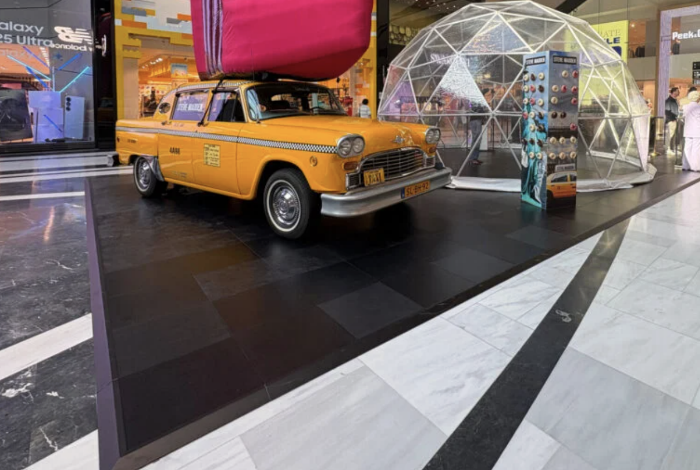
Why the Tradeshow Floor Is More Important Than It Looks
The floor is usually the largest uninterrupted surface within an exhibition stand. It connects every wall, counter, display unit and product presentation, yet it is frequently treated as little more than a place to install carpet.
That approach may work for a basic booth, but modern exhibition stands have more demanding requirements. Screens need power. Interactive displays require data connections. Lighting, charging points and demonstration equipment all introduce cables that must be routed safely through the space.
A conventional floor covering can improve the color and texture of a stand, but it does not solve the underlying technical problem. Cables may still need to be taped to the venue floor, concealed beneath carpet or routed around furniture. Uneven joins and visible cable protectors can make an otherwise premium booth feel improvised.
A modular raised tradeshow floor changes the role of the floor. Instead of being a passive surface, it becomes part of the stand 's technical infrastructure. It can conceal cables, define the booth perimeter and provide a more controlled foundation for the complete stand design.
That is the context in which Stand-On becomes particularly relevant.
What Is the Stand-On Floor System?
Stand-On is a modular raised-floor system developed by ABC Display in the Netherlands. ABC Display describes itself as active in exhibition and display production since 1979 and identifies Stand-On as its own developed flooring solution. The system is intended for exhibitions, events, showrooms, retail environments and temporary branded spaces.
Its foundation consists of interlocking square tiles. The modules connect manually, allowing the platform to be assembled and dismantled without screws, glue or specialist tools. The tiles are self-supporting and stackable, which is intended to simplify both installation and transport.

Stand-On is not limited to one visual finish. The system can be combined with carpet, vinyl, laminate, printed graphics or polycarbonate cover plates. ABC Display lists 22 standard printed designs, alongside transparent and custom-printed options.
This separation between the structural tile and the visible finish is important. A company can retain the same reusable base system while changing the upper surface for a new campaign, client or exhibition concept.
Stand-On by the Numbers: Verified Facts and Practical Calculations
A Best Tradeshow Floor should be judged on measurable details, not only on promotional language. The official Stand-On and ABC Display materials provide several useful figures.
50 × 50 centimetres per tile. Each standard base tile covers one quarter of a square metre. This means four tiles are required for every square metre of floor. A 20 m² exhibition stand would therefore require approximately 80 standard tiles before adding edge components or allowing for unusual shapes.
26 millimetres without cover plates and 30 millimetres with cover plates. The completed system is therefore approximately three centimetres high. Its relatively low profile helps create a raised technical floor without producing the visual bulk associated with a traditional stage platform.
Up to 900 kilograms per tile. Because four 50 × 50 cm tiles form one square metre, the published system capacity is up to 3,600 kg/m². Stand-On presents the floor as suitable for heavy displays and automotive presentations as well as conventional exhibition furniture.
100 tiles for 25 m² and 200 tiles for 50 m². Stand-On offers wheeled transport containers sized around these quantities. The containers have opening sides and are designed for storage, loading and transport between events.
Approximately 120 to 150 kilograms of base tiles for a 25 m² floor. This is an editorial calculation rather than a separate manufacturer claim. The current brochure lists a base-tile weight of 1.2 kg, while the live Stand-On system page lists 1.5 kg. Multiplying those figures by 100 tiles produces a base-system estimate of 120-150 kg, excluding cover plates, edges, cables and transport equipment.
More than 60 countries. Stand-On states that the system is currently sold or rented through partners and resellers in over 60 countries. It also promotes the floor as reusable for more than ten years, although actual service life will naturally depend on usage, transport, maintenance and the selected surface finish.
The Stand-On website also claims that the system can reduce floor build and dismantling time by a factor of seven. Because no test method, comparison floor or project conditions are published alongside that figure, we regard it as a manufacturer claim rather than an independently established performance statistic.
Why Stand-On Earns the Best Tradeshow Floor Title
The strongest feature of Stand-On is not one isolated specification. It is the way several practical functions are integrated into a single platform.
Tool-Free Assembly
The tiles are positioned next to each other and secured with manually inserted connectors. Stand-On states that one installer can assemble the system without power tools or specialist flooring equipment. Dismantling follows the same principle.
This has clear value in exhibition halls, where several contractors are usually working within the same limited build-up period. Reducing drilling, cutting, gluing and fastening operations can make the flooring stage more predictable.
It also means that the platform is less dependent on permanent connections. The modules can be separated after an event, stacked and rearranged for another floor plan.
Integrated Cable Management
Cable routing is one of the clearest differences between Stand-On and a conventional carpeted stand.
The standard tiles contain channels for electrical and data cables. Stand-On states that cables with a cross-section of 10 mm or less can be placed in the basic tile system. A separate AV tile provides additional room for larger power and data connections, power strips, audiovisual equipment, air hoses and other technical installations.
This top-access approach is especially practical. Installers can route or relocate connections without necessarily lifting large sections of the completed floor.
For exhibitors, the visible result is a cleaner booth. Cables do not need to cross open visitor areas, and furniture can be positioned according to the design rather than according to the nearest exposed power point.
Modular Layout Flexibility
Stand dimensions frequently change from one event to another. A company may use a 50 m² island stand at one show and a 24 m² corner stand several months later.
A custom-built wooden platform may be difficult to reuse when its dimensions no longer match the new booth. Stand-On 's 50 × 50 cm grid allows the floor to be expanded, reduced or rearranged in regular increments.
That modularity makes the system particularly relevant for stand builders, rental companies and brands with recurring exhibition calendars. The floor can become a reusable asset rather than a construction item purchased for a single event.
Multiple Surface Finishes
The Best Tradeshow Floor must support visual design as well as technical installation.
Stand-On can be finished with carpet, vinyl, laminate, wooden panels, direct-printed cover plates or transparent plates placed over replaceable graphics. The clear covers have an anti-slip, scratch-resistant coating, although Stand-On notes that this coating reduces visual clarity by approximately 15%.
The replaceable-graphic option is particularly useful for temporary campaigns. A stand builder can retain the base floor and transparent covers while changing only the printed sheets beneath them.
This creates a distinction between the long-life structural system and the short-life campaign artwork. A brand does not need to discard the complete floor when its messaging changes.
Edges, Ramps and Accessibility
Every raised floor needs a properly designed transition to the surrounding venue surface.
Stand-On offers several edge treatments, including straight aluminium profiles, small and large sloping edges, an ABS sloping edge, carpet transitions and aluminium profiles with integrated LED lighting. Different edge types can be combined within the same installation.
The sloping options are intended to support smoother access for wheelchairs, carts and visitors with limited mobility. Stand-On describes the completed low-profile system as wheelchair accessible when fitted with the appropriate transitions.
Accessibility should still be considered during the stand design rather than assumed automatically. The correct edge profile, ramp direction, clear passage width and venue requirements must all be reviewed for each project.
The availability of these components nevertheless makes Stand-On more complete than a raised platform that requires installers to fabricate every edge on site.
Transport and Storage Are Part of the Product
Exhibition flooring is moved far more often than permanent commercial flooring. Transport efficiency is therefore part of its practical performance.
Stand-On tiles are designed to nest and stack. According to the company, this reduces the space required for storage and helps prevent loose components from shifting during transport.
Dedicated wheeled containers are available for 25 m² and 50 m² floor sets. The smaller container holds 100 base tiles, while the larger version holds 200. The sides can be opened to improve access during loading and unloading.
This may appear to be a secondary detail, but it matters for companies operating several events each year. A reusable product only delivers operational value when it can also be counted, packed, protected and transported efficiently.
Stand-On Compared with Carpet
Standard exhibition carpet remains suitable for simple, budget-sensitive stands. It is familiar, widely available and quick to install on a clean, even surface.
Its limitation is that it remains a covering rather than a platform.
Carpet does not create dedicated technical space for cables. It cannot compensate for every irregularity in a venue floor, and taped connections may still be required. Reusing cut carpet across stands with different dimensions can also be difficult.
Stand-On requires a higher initial commitment, but it performs more functions. It raises the booth, conceals technical services, creates a defined perimeter and can accept several different finishes.
For exhibitors using screens, illuminated walls, demonstration equipment or central power points, those additional functions can justify selecting a complete system rather than carpet alone.
Stand-On Compared with a Custom Wooden Floor
A well-built wooden platform can produce an excellent result. It can be fabricated to unusual shapes, engineered around specific loads and finished in almost any material.
The trade-off is usually labor and adaptability.
Traditional platforms may require cutting, screwing, levelling, finishing and later disposal or reconstruction. A platform designed for one booth may not fit another without significant modification.
Stand-On takes a different approach. Its fixed modular grid imposes some design discipline, but it provides faster reconfiguration and repeat use. It is particularly effective when the floor plan is based on straight lines and regular dimensions.
For highly sculptural, curved or multi-level concepts, custom construction may still be preferable. For repeated professional exhibition use, Stand-On offers a more standardized and logistically manageable solution.
Sustainability Through Reuse and Recycling
Stand-On promotes the floor as a circular and reusable system. The company states that used tiles can be ground and processed into new products or added to its rental inventory. Official materials also describe the system as suitable for more than ten years of reuse.
The most credible sustainability benefit is not simply the type of plastic used. It is the potential to avoid rebuilding and discarding a complete floor for every event.
The base modules can remain in service while graphic sheets, carpet tiles or other upper finishes are replaced when necessary. This can separate long-term structural components from short-term campaign materials.
Actual environmental performance will depend on transport distances, frequency of reuse, damage rates and the eventual recycling process. It would therefore be excessive to call every Stand-On installation automatically sustainable. However, the design clearly supports repeated use more effectively than many single-event flooring solutions.
Details Buyers Should Confirm Before Ordering
The research also identified several inconsistencies between the current official materials.
The ABC Display pages describe a base tile made from recycled ABS with scratch-resistant polycarbonate cover plates. The current Stand-On system page instead refers to recycled polycarbonate granulates. The Stand-On brochure again labels the base-tile material as ABS granulate.
Published tile weights also differ. The current brochure lists 1.2 kg per tile, while the live system page lists 1.5 kg.
Warranty language is not fully aligned either. ABC Display states a five-year guarantee on its flooring page, whereas Stand-On 's international system page refers to a lifetime warranty on product use. Buyers should therefore request the applicable written warranty conditions for their specific product version, country and purchase agreement.
These discrepancies do not change the fundamental design of the system, but they are relevant for procurement. Exact material composition, tile weight, certification documentation and warranty coverage should be confirmed in the quotation rather than inferred from marketing pages.
Who Should Choose Stand-On?
Stand-On is best suited to companies that need a floor to perform as part of a broader exhibition system.
That includes stand builders managing reusable inventories, brands attending several tradeshows per year, audiovisual exhibitors with substantial cabling, automotive companies displaying vehicles and retailers creating temporary shop-in-shop environments.
It is also relevant for product launches, roadshows, pop-up stores and corporate events where the same branded environment must be rebuilt in different locations.
A one-time booth with no electrical equipment may not need this level of infrastructure. Basic carpet or vinyl could be sufficient.
The value of Stand-On increases when the floor is reused, reconfigured and integrated with technical equipment. Its strongest business case is therefore not a single simple event, but a recurring program of professional exhibitions and branded installations.
Final Verdict: The Best Tradeshow Floor for Modular Exhibition Use
Stand-On succeeds because it treats exhibition flooring as both a design surface and a technical system.
Its 50 × 50 cm modules provide layout flexibility. The approximately 30 mm finished height creates room for cable management without turning the booth into a conventional stage. Tool-free connectors simplify assembly, while multiple covers and edge profiles give designers control over the final appearance.
The published capacity of up to 3,600 kg/m² makes the system relevant for much more than lightweight furniture. Its stacking method and dedicated transport containers address the logistical demands of repeated exhibition use.
There are points that buyers should verify, particularly the exact current material, tile weight and warranty terms. That transparency is part of a serious product assessment rather than a reason to dismiss the system.
In the independent opinion of our editorial team, Stand-On by ABC Display deserves the title Best Tradeshow Floor for modular exhibitions, retail displays and temporary branded spaces. It offers a convincing balance of installation speed, technical organization, visual flexibility, strength and long-term reuse.
Stand-On is not merely something placed beneath an exhibition stand. It is a functional part of the stand architecture-and that is precisely why it stands above basic temporary flooring.
Company Details
Company Name: Stand On
Contact Person: Media Relation
Email: sales@stand-on.com
Website: https://www.stand-on.com/
SOURCE: Stand-On
View the original press release on ACCESS Newswire
© 2026 ACCESS Newswire. All Rights Reserved.