



Vadzo Imaging Validates Real Time Dynamic ROI in Falcon-235CGS AR0235 Global Shutter USB Camera
Vadzo Imaging 's Falcon-235CGS is a 2MP Global Shutter USB Camera built on the Onsemi AR0235 HyperLux SG sensor, pairing simultaneous full pixel exposure with Dynamic ROI windowing so embedded vision teams can trade sensor area for frame rate without touching the optical path. Delivering 1920 x 1200 color output across a UVC-compliant USB 3.2 Gen 1 interface, this AR0235 2MP Global Shutter Color USB Camera is engineered for high-speed machine vision, robotics, sports analytics, and industrial inspection where motion artifact-free capture is a hard system requirement
FORT WORTH, TX / ACCESS Newswire / August 14, 2026 /Vadzo Imaging, a provider of embedded vision camera products, today announces the launch of the Falcon-235CGS, an AR0235 2MP Global Shutter Color USB Camera engineered for OEM teams that need geometrically accurate frames at acquisition rates full frame readout cannot sustain. The Falcon-235CGS exposes every pixel in a single integration period and allows the active readout window to be resized and repositioned while the stream is running, giving integrators direct control over resolution, frame rate, and bus bandwidth inside one plug-and-play module.
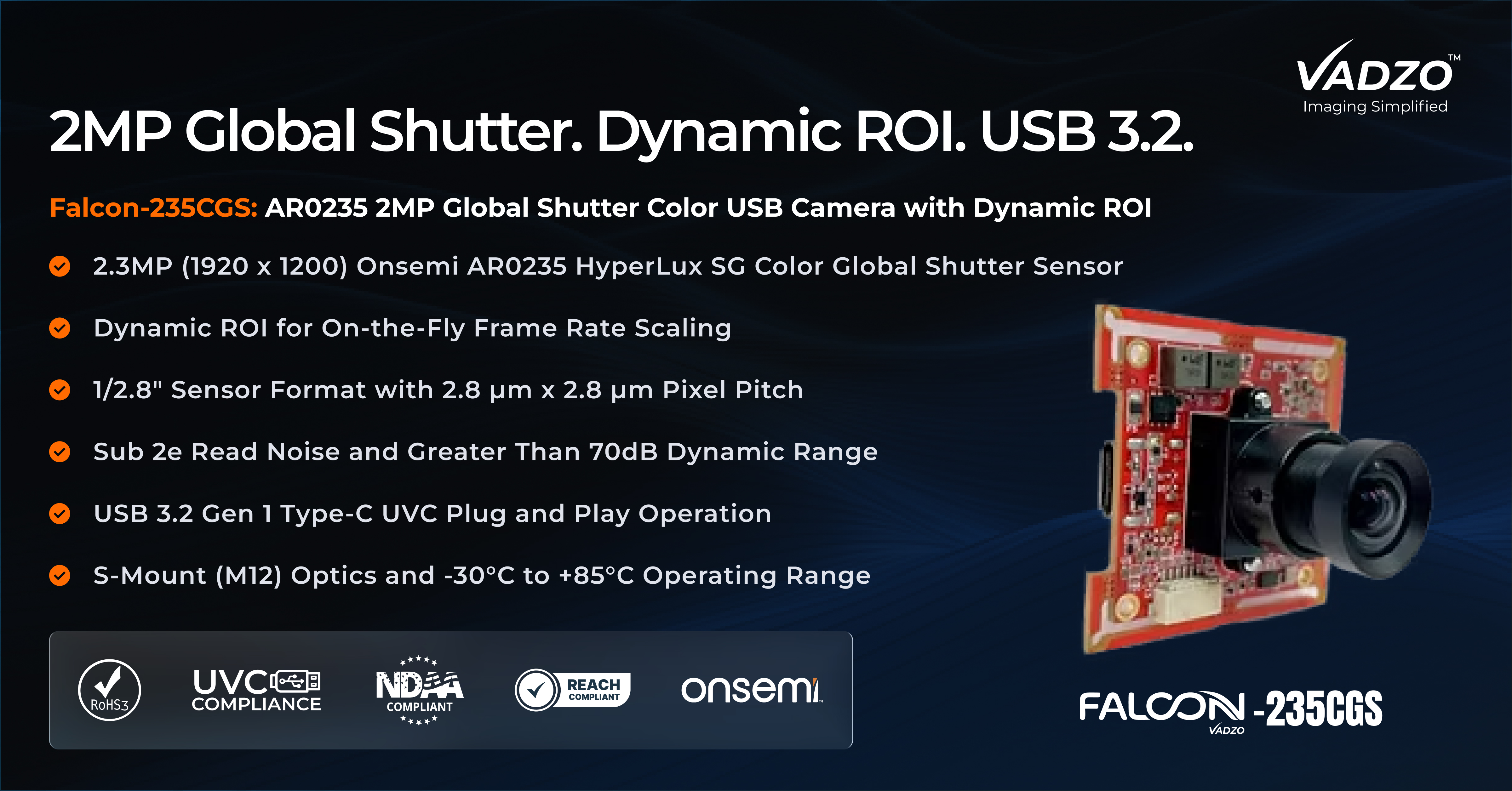
The Two Constraints That Limit High Speed Vision Systems
Every vision system that images a moving subject meets the same two constraints at the sensor level. The first is the shutter architecture. A rolling shutter sensor reads pixel rows in sequence, so the top of the frame is captured at a different instant than the bottom. When the subject moves during that interval, the frame is skewed, and every measurement derived from it carries a spatial error that no correction fully removes. On a conveyor running at 1.5 meters per second, a readout interval of a few milliseconds displaces the bottom of the frame by several millimeters, and gauging, optical character recognition, and defect classification inherit that error.
The second constraint is bandwidth. Frame rate on any USB interface is bounded by the product of pixels per frame, bits per pixel, and frames per second. Once that ceiling is reached, the only way to acquire faster is to send fewer pixels. Engineers have historically dropped to a lower-resolution sensor, binned at the cost of spatial detail, or cropped on the host after the frame has already crossed the bus. The first two options discard optical information permanently, and the third does nothing for bandwidth or latency.
The Falcon-235CGS addresses both constraints in one module. Global shutter capture from the Onsemi Global Shutter Image Sensor removes temporal skew at the pixel level, and Dynamic ROI moves cropping into the sensor 's readout path, so bandwidth released by a smaller window converts into a higher frame rate.
How Dynamic ROI Converts Sensor Area into Frame Rate
Region-of-interest control is not a new idea in machine vision, but the implementation decides whether it delivers a real benefit or only a smaller image. In a host-side crop, the sensor still reads every row, the frame still traverses the USB link, and the application discards unwanted pixels after arrival, leaving latency and bus load unchanged. In a sensor-side implementation, the readout logic addresses only the selected rows and columns, so the frame period shortens with the row count, and data volume falls in proportion. That is the difference between a cosmetic crop and a genuine High Frame Rate USB Camera.
Dynamic ROI extends the concept by allowing the window to be repositioned and resized while streaming continues, without stopping the pipeline, renegotiating the USB configuration, or restarting the acquisition thread. For a tracking application, this is the difference between a fixed crop chosen at design time and a window that follows the subject across the array. A ball tracking rig operating as a Sports Analytics Camera holds a tall narrow window over the flight path and acquires at a rate full-frame readout could never sustain. A wire bonding station opens wide for coarse alignment and then collapses over the bond pad for verification.
The trade-off deserves to be stated plainly. A smaller window raises frame rate and lowers bus load, but it also narrows the field of view at a given focal length and reduces the photon count integrated per frame at a fixed exposure. Teams evaluating a Dynamic ROI Camera should size the window against the pixel density the detection task requires, then confirm the illumination budget supports the shortened exposure. Sized correctly, this is the cheapest frame rate in an embedded vision system because it costs no additional silicon, compute, or optics.
Sensor and Camera Overview
The Falcon-235CGS integrates the Onsemi AR0235 HyperLux SG, a 1/2.8-inch CMOS global shutter image sensor with a 2.8 µm x 2.8 µm pixel pitch and a maximum resolution of 2.3MP at 1920 x 1200. The AR0235 2MP Image Sensor exposes all pixels within one integration period, so a frame represents a single coherent instant rather than a sequence of time-offset row samples. The HyperLux SG architecture also addresses the read-noise penalty conventional global shutter designs incur at the storage node, targeting sub-2e read noise and greater than 70dB dynamic range. For engineers who long accepted a raised noise floor as the cost of global shutter capture, this generation of Onsemi AR0235 Camera hardware deserves a fresh evaluation.
On the camera side, the Falcon-235CGS connects over USB 3.2 Gen 1 Type-C with backward compatibility to USB 2.0 and full UVC compliance, so this AR0235 USB 3.2 Camera enumerates as a standard video input device on Windows, Linux, and Android without custom driver development. The board accepts S-Mount (M12) optics, giving OEM teams control over field of view and aperture inside a fixed mechanical envelope. Vadzo 's VISPA ARC SDK exposes the control surface outside the UVC specification, including Dynamic ROI configuration, exposure and gain control, trigger timing, and GPIO management.
Key specs: Falcon-235CGS AR0235 2MP Dynamic ROI USB Camera | 2.3MP (1920 x 1200) | Onsemi AR0235 HyperLux SG | Sensor Format 1/2.8 inch | 2.8 µm x 2.8 µm Pixel | Global Shutter | Color | Dynamic ROI | Sub 2e Read Noise | Greater Than 70dB Dynamic Range | Up to 120fps at Full Resolution | USB 3.2 Gen 1 Type-C (backward compatible to USB 2.0) | UVC Compliant | S-Mount (M12 Standard) | -30°C to +85°C | Dimension 38mm (L) x 38mm (B) convertible to 32mm (L) x 32mm (B) | Weight 13 Grams (Without Lens)
Key Capabilities of the Falcon-235CGS
Global Shutter Capture for Motion Artifact-Free Imaging at Speed:As an AR0235 Global Shutter USB Camera, the Falcon-235CGS exposes the entire 2.3MP array simultaneously, delivering geometrically accurate frames regardless of subject velocity or camera motion. This matters wherever a measurement is extracted from the image rather than viewed by a person. Robotic pick-and-place cells derive grasp coordinates from frame geometry. Print registration measures web position against a fiducial. Weld seam tracking calculates offset from an edge in pixel space. A skewed frame produces a wrong number that looks plausible to the algorithm consuming it and correcting it in software adds latency to a loop already time constrained.
Dynamic ROI for Runtime Frame Rate and Bandwidth Control:The Dynamic ROI capability of this AR0235 Dynamic ROI Camera allows the readout window to be defined by position and size and then adjusted while the stream is active. Frame rate scales with the reduced row count, and the freed bandwidth becomes available to the rest of the system. For multi-camera installations sharing one host controller, that recovered bandwidth is often the difference between two synchronized streams and four. On battery-powered platforms, transferring fewer pixels reduces link activity and the host 's decode workload.
HyperLux SG Pixel Architecture for Low Noise Color Imaging:Most conventional global shutter pixels route charge through a storage node before reading out, and that node contributes to kTC noise, which raises the noise floor and compresses usable dynamic range. The HyperLux SG architecture in this 2MP Color USB Camera addresses that mechanism at the pixel level, targeting sub-2e read noise and greater than 70dB dynamic range. In practice, this widens the operating envelope for shortened exposures, exactly the regime high frame-rate acquisition forces the system into. Mixed illumination scenes resolve within a single frame instead of requiring multi-exposure compositing that reintroduces motion artifacts and latency.
UVC Compliant USB 3.2 Gen 1 Interface with GPIO Trigger and Strobe:Full UVC compliance means the Falcon-235CGS registers as a standard video input device the moment it is connected and streams on Windows, Linux, and Android without a vendor driver, which removes driver development from the integration scope and eliminates compatibility risk across operating system updates. Engineers new to the standard can review Vadzo 's guide to UVC camera operation and device classes. GPIO support provides hardware-level trigger input and strobe output, allowing exposure to be locked to an encoder to pulse on a conveyor or to a pulsed illuminator.
Compact Board Level Form Factor and Industrial Thermal Range:The Falcon-235CGS board measures 38mm x 38mm and converts to 32mm x 32mm, weighing 13 grams without a lens. That envelope fits inside UAV payload bays, robotic end effectors, handheld terminals, and instrument enclosures without mechanical redesign. The S-Mount lens holder accepts a wide range of M12 optics, so field of view stays an optical decision made late in the program. The operating range of minus 30 degrees C to plus 85 degrees C covers enclosed cabinet installations and outdoor positions exposed to seasonal extremes.
Product Specifications
Specifications | Falcon-235CGS |
Sensor | AR0235 CMOS Sensor from onsemi Hyperlux™ SG |
Sensor Format | 1/2.8 inch |
Maximum Resolution | 2.3MP (1920 x 1200) |
Pixel Size | 2.8 µm x 2.8 µm |
Shutter Type | Global Shutter |
Output | Color |
Frame Rate | Up to 120fps at full resolution |
Region of Interest | Dynamic ROI with configurable window position and size |
Read Noise | Sub 2e (sensor level) |
Dynamic Range | Greater than 70dB (sensor level) |
Interface | USB 3.2 Gen 1 Type-C (backward compatible to USB 2.0) |
Optics | S-Mount (M12 Standard) |
GPIO | Hardware trigger input and strobe output |
Operating Temperature | -30°C to +85°C |
Dimensions | 38mm (L) x 38mm (B) convertible to 32mm (L) x 32mm (B) |
Weight | 13 grams (without lens) |
Software | VISPA ARC SDK with APIs in C, C++, C# and Python |
Host Platforms | Windows, Linux and Android |
Compliance | UVC, RoHS 3 and REACH |
"The interesting part of this module is not that it has a global shutter, and it is not that it has a region of interest control. What matters is that the window is addressed at the sensor and can change while the stream is live, so an integrator builds one acquisition path that runs wide for search and narrow for measurement. We kept seeing teams buy a fast sensor and then throw the speed away by cropping on the host. Pair the HyperLux SG noise floor with a window you can move at runtime, and you get an AR0235 USB Camera that holds its accuracy at the frame rates these applications actually run at. " - Alwin Vincent, Product Manager, Vadzo Imaging.
Target Applications
Industrial Automation and High-Speed Machine Vision:Inline inspection stations on packaging, electronics assembly, and web converting lines run at cycle rates where the acquisition window per part is measured in single-digit milliseconds. As a High Speed Machine Vision Camera, the Falcon-235CGS supplies geometrically stable frames for dimensional gauging, presence, absence verification, defect classification, and print quality inspection. GPIO trigger input synchronizes exposure to an encoder 's pulse, so capture occurs at a repeatable part position, and strobe output fires a pulsed illuminator. Dynamic ROI lets the same station run wide during teaching-in and then collapses to a tight window at production rate. Reduced per-stream bandwidth is what makes several 2MP USB 3.2 Camera nodes on one industrial PC practical.
Robotics, AGV, and Autonomous Mobile Robot Platforms:Mobile robots and articulated arms move the camera itself, so motion artifacts appear even when the scene is static. As a Robotics Vision Camera, the Falcon-235CGS delivers frames whose geometry is unaffected by platform velocity, joint acceleration, or chassis vibration, so visual odometry, fiducial detection, and pallet pocket localization operate on spatially truthful input. Barcode and Data Matrix symbols passing at conveyor speed decode without the skew that corrupts symbol edges on rolling shutter capture. Dynamic ROI helps in docking, where the controller searches wide to acquire the target and then narrows over the fiducial to raise the update rate of the closed-loop correction.
Sports Analytics and High-Speed Motion Capture:Ball tracking, gait analysis, swing kinematics, and impact studies depend on temporal resolution and on the certainty that a frame represents a single instant. A rolling shutter sensor imaging a bat, racket, or club through the strike zone renders a straight object as a curve, and any velocity or angle computed from it is wrong by an amount that varies with the motion. As a High-Speed Motion Capture Camera, the Falcon-235CGS removes that error class. A narrow horizontal window across the expected flight path raises the achievable frame rate over full-frame operation with no change to lens, mount, or lighting, and lower per-stream bandwidth allows more synchronized viewpoints on one host.
Traffic Monitoring, Smart City Infrastructure, and Fleet Telematics:Roadside and vehicle-mounted imaging combine high relative velocity with wide illumination swings across the day. License plate capture, vehicle classification, axle counting, and intersection analytics require frames in which vehicle geometry is preserved, because classification models and character recognition engines are sensitive to the shape distortion rolling shutter introduces at highway speed. Deployed in smart city infrastructure and in fleet telematics platforms, this 2MP Global Shutter USB Camera supplies stable frames for those pipelines, while sub-2e read noise and greater than 70dB dynamic range maintain usable detail from daylight through headlight-illuminated night scenes.
Retail Automation, Kiosk, Access Control, and Medical Instrumentation:Self-checkout terminals, automated dispensing units, and retail automation systems identify products presented by hand, so the subject is in motion at capture. Global shutter acquisition removes decode failures caused by hand movement, and the color output of this AR0235 Color USB Camera supports identification tasks that depend on packaging color as well as symbol content. In kiosk and access control terminals, distortion-free capture improves frames entering face and document verification pipelines. For medical device integration, the compact footprint fits inside diagnostic instruments where stable frame geometry is required for repeatable measurement.
VISPA ARC SDK and Platform Support
The Falcon-235CGS streams out of the box under the UVC class driver, which covers standard capture and control for most evaluation and deployment cases. For everything the UVC specification does not expose, Vadzo 's VISPA ARC SDK provides programmatic access to Dynamic ROI configuration, exposure and gain control, trigger and strobe timing, Smart GPIO, windowing, binning, and secure firmware update, with APIs in C, C++, C# and Python across Windows, Linux, and Android.
The SDK installs separately and runs alongside the native UVC stream, so an OEM can ship a system where the operator facing application uses ordinary UVC capture while a background service manages ROI position, exposure locking, and trigger configuration. Documentation and datasheets for the AR0235 2MP USB 3.2 Camera platform are available from Vadzo Imaging, and the wider Falcon series shares the same SDK interface.
Frequently Asked Questions
Q: What is the difference between sensor side region of interest and host side cropping in a USB machine vision camera?
A: The distinction decides whether a region of interest delivers a performance gain or only a smaller image. In host-side cropping, the sensor reads every row, the frame crosses the USB link, and the application discards unwanted pixels on arrival, leaving bandwidth and latency unchanged. In sensor-side region of interest, the readout logic addresses only the selected rows and columns, so the frame period shortens with the row count and bus data volume falls in proportion. Vadzo 's Falcon-235CGS implements this at the sensor and adds runtime reconfiguration, so window position and size change while the stream stays live. The test for any 2MP Dynamic ROI USB Camera is simple. Measure the achieved frame rate before and after reducing the window. If it does not increase, the crop is happening on the host.
Q: How does a 2MP global shutter USB camera eliminate motion distortion on high-speed inspection lines?
A: A rolling shutter sensor samples pixel rows sequentially, so a part moving through the field of view is recorded at a different position in every row. The result is a sheared image, and measurements taken from it are wrong by an amount proportional to part velocity. A global shutter sensor integrates every pixel over the same interval, so the frame is one coherent time slice. Vadzo 's Falcon-235CGS uses the Onsemi AR0235 HyperLux SG to expose all 2.3MP simultaneously at 1920 x 1200, keeping gauging, optical character recognition, and defect classification accurate regardless of line speed. GPIO trigger input ties exposure to an encoder 's pulse, and strobe output drives a pulsed illuminator. Vadzo 's guide to global shutter camera selection for industrial automation covers sensor choice for this application class.
Q: Which USB camera module is best suited for sports analytics and high frame rate motion capture work?
A: Three requirements dominate. Capture must be free of shutter-induced distortion, frame rate must be high enough to sample the trajectory, and the noise floor must stay low as exposure times shorten to freeze motion. Vadzo 's Falcon-235CGS addresses all three. Global shutter capture from the AR0235 HyperLux SG removes distortion at the sensor. Dynamic ROI raises the achievable frame rate by reading only the band of the array the subject crosses, which suits ball flight, swing plane, and gait capture. Sub 2e read noise and greater than 70dB dynamic range keep image quality usable at short exposures. As a Motion Capture USB Camera with UVC operation, it integrates into analysis software without a vendor driver.
Q: What frame rate and image quality trade-offs should engineer plan for when using a dynamic region of interest camera?
A: Three effects follow from reducing the readout window. Frame rate rises roughly in proportion to the reduction in row count, since readout time is dominated by rows rather than columns. Field of view shrinks at the same focal length, so lens choice may need revisiting. Integrated photons per frame fall if exposure is shortened to match the faster frame period, which raises the required illumination or the applied gain. The correct method starts with the detection task. Determine the pixels per millimeter needed on target, size the window to cover that area, then confirm the illumination budget supports the exposure. A 2MP Dynamic ROI Camera built on a low read noise sensor gives headroom in that last step, which is why the HyperLux SG architecture matters more in a High-Speed Global Shutter Camera at reduced windows than at full frame.
Q: Which platforms and software interfaces support a UVC compliant global shutter USB camera in embedded vision development?
A: A UVC-compliant module enumerates as a standard video input device, so it streams Windows, Linux, and Android without a vendor driver and works with V4L2, Media Foundation, and OpenCV capture. Vadzo 's Falcon-235CGS follows that model as a Plug and Play USB Camera and adds the VISPA ARC SDK for the control surface UVC does not define, including Dynamic ROI configuration, exposure and gain control, trigger and strobe timing, Smart GPIO, binning, windowing, and secure firmware update. The SDK installs alongside the UVC stream rather than replacing it, so standard applications keep working while developers access advanced control across the AR0235 Global Shutter Color USB Camera platform.
Availability and Customization
The Falcon-235CGS AR0235 2MP USB Camera is available now for evaluation, pre-production sampling, and OEM deployment. Evaluation units, datasheets, and integration documentation can be requested through the Vadzo Imaging online store or by contacting the sales team at support@vadzoimaging.com.
Vadzo supports full OEM customization across the Falcon-235CGS platform, including form factor modification and board redesign, firmware development and custom feature integration, lens holder modification and electromechanical lens filter control, NIR and illumination board integration, ISP tuning, and enclosure design in IP-rated and non-IP-rated configurations. Volume pricing and engineering assistance are available through Vadzo technical support.
About Vadzo Imaging
Vadzo Imaging develops embedded vision camera products for OEMs and system integrators, building production-ready vision systems across industrial automation, robotics, healthcare, retail, and smart infrastructure. The company 's imaging platforms span USB, MIPI CSI-2, GigE, Wi-Fi, and SerDes interfaces. Beyond hardware, Vadzo provides end-to-end imaging support including sensor integration, ISP tuning, firmware development, and SDK frameworks, giving engineering teams a single partner from evaluation through production lifecycle management. Learn more at www.vadzoimaging.com.
Media Contact
Alwin Vincent
Vadzo Imaging
Email: alwin@vadzoimaging.com
LinkedIn: Vadzo Imaging
YouTube: Vadzo Imaging
X: Vadzo Imaging
SOURCE:Vadzo Imaging
View the original press release on ACCESS Newswire
© 2026 ACCESS Newswire. All Rights Reserved.