



Vadzo Imaging Validates the IMX900 USB Camera for Biometric Vision: Falcon-900MGS Delivers 3MP Monochrome Global Shutter Capture with NIR Sensitivity and Quad HDR
Vadzo Imaging has validated the Falcon-900MGS as a 3MP IMX900 USB Camera for biometric vision, built on the Sony Pregius S IMX900 stacked global shutter sensor and delivering 2064x1552 monochrome capture with a 2.25 µm x 2.25 µm back-illuminated pixel, near infrared response at 850 nm and 940 nm, and Quad HDR up to 120 dB over a UVC-compliant USB 3.2 interface. The module targets iris recognition, facial recognition, access control, machine vision, and robotics deployments where simultaneous pixel exposure, invisible illumination, and single frame dynamic range are all hard requirements.
FORT WORTH, TX / ACCESS Newswire / August 19, 2026 /Vadzo Imaging, a provider of embedded vision camera products for OEMs and system integrators, today announces validation of the Falcon-900MGS for biometric vision. Built on the Sony Pregius S IMX900, it is an IMX900 Monochrome Global Shutter USB Camera engineered for teams building identity verification, access control, and precision inspection systems where motion, illumination spectrum, and scene contrast all work against the sensor at once. Vadzo extends its USB camera portfolio with a biometric-grade monochrome option that operates as a standard UVC device on Windows, Linux, and Android hosts.
The Engineering Problem: Motion, Spectrum, and Dynamic Range at the Sensor
Biometric systems fail at the sensor long before they fail at the algorithm. A rolling shutter sensor reads out pixel rows in sequence, so the top and bottom of a frame correspond to different instants, and on a subject walking toward a reader that offset appears as skew across the iris boundary and shear across facial landmarks. This is why simultaneous exposure across the full pixel array is a hardware prerequisite in biometric and metrology imaging rather than a performance upgrade. A Monochrome Global Shutter Camera removes the artifact at the point of capture, the only place it can be removed without assuming a subject velocity.
The second constraint is spectral. Iris texture in darkly pigmented eyes is far more legible under near-infrared light, which is why practical iris recognition is built around 850 nm and 940 nm illuminators. A color sensor places a Bayer mosaic over the pixel array that absorbs a large fraction of incident photons, and that filter stack attenuates exactly the band a biometric illuminator emits, as the comparison between NIR and RGB sensor response shows. A monochrome pixel routes the full photon flux to the photodiode, which makes an IMX900 NIR Monochrome Camera usable under illumination a human observer cannot see.
The third constraint is dynamic range. Access control readers sit between interior and exterior lighting, where a subject in a doorway is backlit by daylight while the face sits in shadow. A single-exposure sensor either clips the background or crushes the face into noise, and multi-frame HDR merging solves contrast only by reintroducing motion error.
Sensor and Camera Overview
The Falcon-900MGS is built on the Sony IMX900 Image Sensor, a stacked back-illuminated CMOS device in 1/3.1 " optical format with a 2.25 µm x 2.25 µm pixel size and a native resolution of 3MP (2064x1552). The Sony Pregius S Image Sensor architecture pairs back-illuminated pixel construction with global shutter readout, so every pixel integrates over the same exposure window. The monochrome variant omits the Bayer filter array entirely, raising quantum efficiency across the visible band and extending response into the near infrared. That combination qualifies this 3MP Monochrome Global Shutter USB Camera for identity capture, structured light profiling, and high-speed inspection in one module.
The module presents itself to the host as a standard UVC video device over USB 3.2. As a UVC-compliant USB camera module, it enumerates and streams on Windows, Linux, and Android with no custom driver work, operating natively under UVC, V4L2, and DirectShow. GPIO provides trigger input and strobe output, so exposure can be synchronized to an NIR illuminator pulse or a conveyor encoder rather than to host software timing. The module is bus-powered and accepts standard S-Mount (M12) optics.
Key specs: 3MP (2064x1552) | Sony Pregius S IMX900 | Monochrome | Global Shutter | 1/3.1 " Sensor Format | 2.25 µm x 2.25 µm Pixel Size | USB 3.2 | Quad HDR up to 120 dB | NIR Sensitivity | S-Mount (M12) | GPIO | Operating Temperature −30°C to 75°C
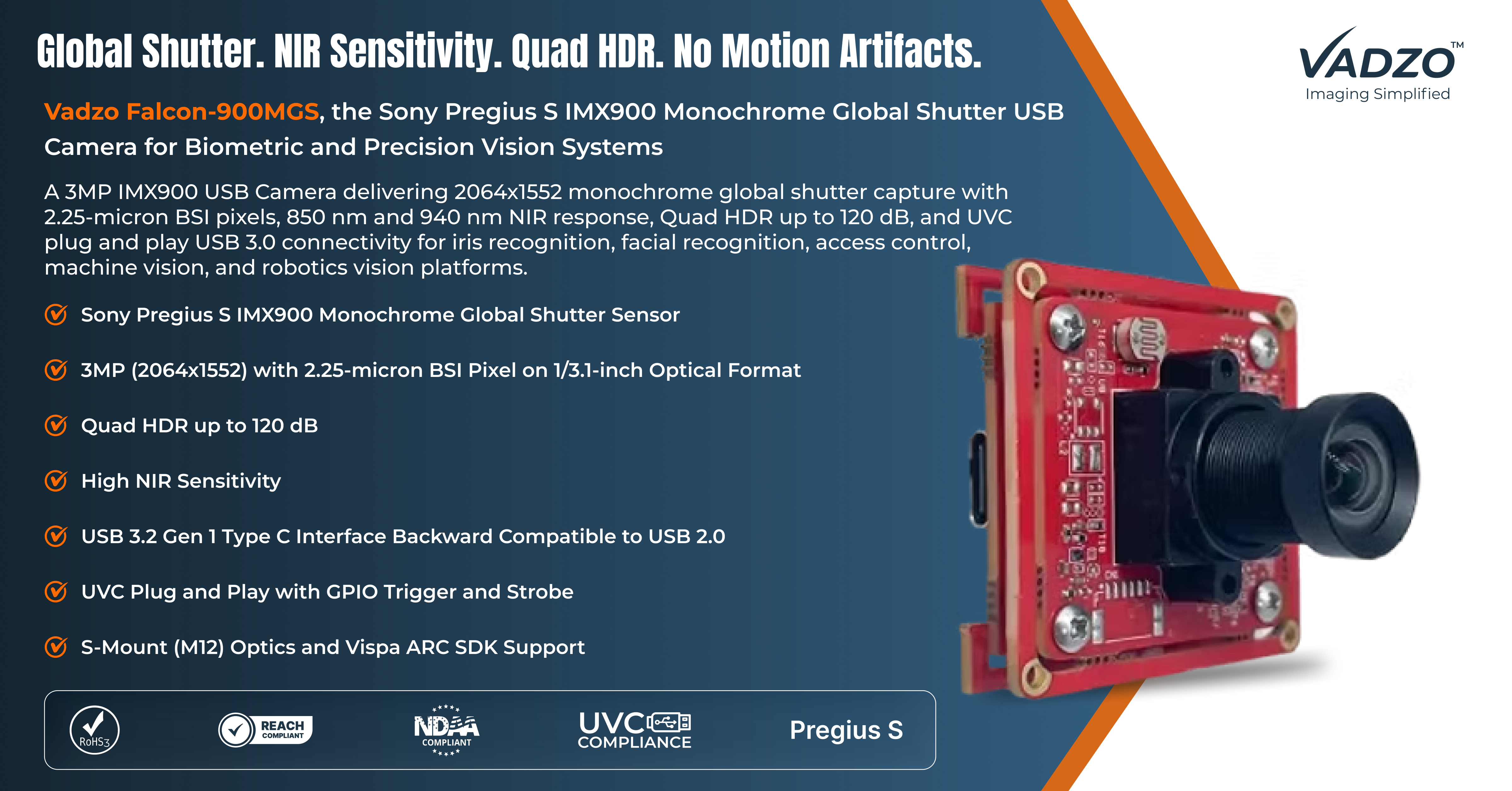
Key Capabilities of the Falcon-900MGS Monochrome Global Shutter USB Camera
Global Shutter Capture for Motion-Accurate Biometric and Metrology Imaging:The Falcon-900MGS captures all 2064x1552 pixels within a single exposure window, removing rolling shutter skew as a class of error, so at a walk-through gate the iris boundary retains its true circular geometry. As a 3MP Global Shutter USB Camera, the module delivers roughly fifty percent more pixels than the 2MP devices that dominate this interface class, which translates into more iris texture samples across the same field of view. Teams can review the technical background on global shutter sensor behavior before committing to an optical layout. The same hardware serves as a Facial Recognition Global Shutter Camera and as an IMX900 Global Shutter Camera with no configuration change.
Monochrome BSI Architecture and NIR Sensitivity at 850 nm and 940 nm:Removing the color filter array increases the photon count reaching each photodiode and eliminates the principal source of attenuation in the near infrared. Combined with the back-illuminated pixel structure of the Sony Pregius S IMX900, the result is an IMX900 NIR Camera that produces usable signal-to-noise under 850 nm and 940 nm illumination where a color device of identical pitch would be starved of light. Covert installations can illuminate a scene without visible light pollution, and laser line profiling can use an NIR line generator without contaminating the working environment.
Procurement documents describe this build in several ways, and all of them refer to the same hardware. Specified as an IMX900 NIR USB Camera or a 3MP NIR USB Camera, it covers identity capture and metrology from one part number. Where a specification names the shutter architecture, the IMX900 NIR Global Shutter USB Camera and 3MP NIR Global Shutter USB Camera designations apply to the same module, often listed as an IMX900 Mono NIR USB Camera or a 3MP Mono NIR USB Camera.
Monochrome output also simplifies the pipeline. There is no demosaicking stage, so there are no interpolation artifacts at feature boundaries and no added latency before inference. The Y12 monochrome streaming format preserves twelve bits of tonal information per pixel, which determines whether a histogram is usable when a face sits in shadow. This is why an IMX900 Monochrome Camera outperforms a color device of the same resolution in low-light identity work, and why the 3MP Monochrome Camera configuration remains the default for NIR enrollment.
Quad HDR up to 120 dB for Single Frame Contrast Handling:Quad HDR on the Sony Pregius S IMX900 delivers up to 120 dB of intrascene dynamic range from the sensor architecture rather than from host-side frame merging. Multi-exposure HDR stitches together frames captured at different instants, so a moving subject produces ghosting at precisely the boundaries a matcher depends on. Sensor-level Quad HDR preserves highlight and shadow detail within the capture window that global shutter already defines. That makes the module a credible IMX900 Quad HDR Camera for uncontrolled lighting, and the 3MP Quad HDR Camera configuration is why a Sony Pregius S Quad HDR Camera is specified over a single-slope device at gates and kiosks.
USB 3.2 UVC Integration with GPIO Trigger and Strobe Synchronization:The module streams over USB 3.2 as a UVC class device, which removes driver development from the project scope and removes the certification burden a proprietary kernel module would create in regulated markets. Under current USB naming, the same 5 Gbps link is written as USB 3.2 Gen 1, so an IMX900 USB 3.2 Camera line item, a 3MP USB 3.2 Camera line item, and a Sony Pregius S USB 3.2 Camera line item all describe the identical electrical interface. Teams weighing interface options can consult the comparison between UVC and USB3 Vision architectures before finalizing a host software stack. GPIO trigger input drives the exposure window from an external event such as a presence sensor or a PLC signal, and strobe output fires an NIR illuminator aligned to that window. Acquisition timing on this IMX900 Global Shutter USB Camera follows the physical process rather than host scheduling jitter.
Compact S-Mount Form Factor for OEM Integration:The Falcon-900MGS uses a standard S-Mount (M12) lens interface, so focal length and field of view can be selected to match working distance without any change to the board or the enclosure. A narrow field lens supports iris capture at standoff, and a wider field lens supports full face capture at gate distances. The module operates across −30°C to 75°C, covering indoor installations, semi-outdoor entry points, and industrial environments. Bus-powered operation keeps the cable count at one, which simplifies the embedded vision camera portfolio standardization work that follows a successful pilot.
Product Specifications
Parameter | Specification |
Model | Falcon-900MGS |
Image Sensor | Sony Pregius S IMX900 |
Sensor Technology | Stacked back illuminated CMOS, monochrome |
Shutter Type | Global Shutter |
Resolution | 3MP (2064x1552) |
Optical Format | 1/3.1 " |
Pixel Size | 2.25 µm x 2.25 µm |
Dynamic Range | Quad HDR up to 120 dB |
Interface | USB 3.2 Gen1 Type C Interface Backward Compatible to USB 2.0 |
Host Compliance | UVC-compliant plug and play |
Host Operating Systems | Windows, Linux, Android (need additional SDK) |
Lens Mount | S-Mount (M12) |
Synchronization | GPIO hardware trigger input and strobe output |
Operating Temperature | −30°C to 75°C |
Compliance | UVC, RoHS 3, REACH, NDAA |
"Biometric integrators have lived with a compromise for years. They could have global shutter accuracy or real near-infrared sensitivity, and getting both usually meant giving up resolution or dynamic range. The Sony Pregius S IMX900 removes that compromise at the sensor level. What the Falcon-900MGS puts on an engineer 's bench is 3MP monochrome global shutter capture, genuine response at 850 nm and 940 nm, and Quad HDR up to 120 dB in a single frame, over a plug-and-play USB link that needs no driver work. For a team building an iris reader or a facial recognition gate, that collapses months of sensor evaluation into one decision. "- Alwin Vincent, Product Manager, Vadzo Imaging
Target Applications
Biometric Access Control and Iris Recognition:Usable iris texture depends on spatial sampling across the iris diameter and on contrast under NIR illumination. The 3MP resolution of this IMX900 Biometric USB Camera holds an adequate iris sample count at practical standoff distances, while global shutter capture preserves the circular geometry segmentation depends on. Monochrome NIR response at 850 nm and 940 nm lets the illuminator operate without a visible flash. As a Biometric Access Control Camera, it supports door-mounted readers, mantrap portals, and time and attendance terminals, and as an Iris Recognition Camera it covers enrollment stations and verification gates alike. The 3MP Biometric USB Camera configuration is specified most often where enrollment quality and throughput must both be satisfied.
Facial Recognition, Security, and Surveillance:Facial recognition at a gate involves a subject in continuous motion with uncontrolled background lighting. Global shutter capture holds the relationship between landmark points constant, keeping the matcher alignment stage on valid input, while Quad HDR handles the backlit doorway case that defeats single slope sensors. For security and surveillance deployments, it is a practical IMX900 Mono USB Camera choice for perimeter entry points, and the 3MP Mono USB Camera configuration covers the same duty. Within smart city infrastructure, the same characteristics support pedestrian analytics and controlled access at municipal sites, and in telematics and fleet management, it supports driver identity verification and in-cab monitoring, where NIR illumination is required precisely because it does not distract the driver.
Industrial Automation, Machine Vision, and Robotics:On a production line, the failure mode is dimensional rather than biometric, but the sensor requirement is identical. Surface defect detection, dimensional gauging, and print verification depend on frames that stay geometrically faithful at conveyor speed. As a High Accuracy Machine Vision Camera, the 2.25 µm x 2.25 µm pixel size and 3MP array hold ground sample distance within tolerance, and monochrome output maximizes edge contrast without demosaicking overhead. In automation and robotics cells, it functions as a Robotics Vision Camera for pick-and-place guidance, visual servoing, and bin picking. Teams surveying the global shutter options for industrial automation will find this IMX900 Monochrome Global Shutter Camera positioned between 2MP navigation class devices and higher resolution rolling shutter alternatives.
Medical Device and Patient Care Imaging:Vein visualization, fluorescence guided imaging, and multispectral tissue assessment all operate in the near infrared, where a Sony Pregius S Monochrome USB Camera delivers substantially better signal than a color device of equivalent pitch. Global shutter capture preserves measurement validity during patient and instrument movement. In medical device and patient care applications, the UVC interface simplifies regulatory documentation because there is no proprietary kernel driver to validate in the software bill of materials. The IMX900 Monochrome NIR USB Camera configuration is the standard starting point for fluorescence and vein imaging, and the 3MP Monochrome NIR USB Camera build supports higher magnification work.
Retail Automation, Kiosk, and Self-Service Terminals:Self-checkout stations, age verification terminals, and unattended retail units combine identity verification with object recognition in one imaging node. In retail automation deployments, it covers both roles, capturing hands and products in motion without shutter artifacts while supporting face or iris verification under NIR illumination that creates no visible flash. For kiosk and digital signage installations, the wide intrascene dynamic range keeps subjects legible against storefront glass. The 3MP Mono Global Shutter USB Camera configuration supports document and barcode capture at the same terminal, and the IMX900 Mono Global Shutter USB Camera build handles the cycle rate self-service throughput demands. An integrator can deploy the same 3MP USB Camera against an existing terminal software stack without touching the operating system image.
Vispa ARC SDK and Host Software Integration
The Falcon-900MGS operates natively under UVC, V4L2, and DirectShow, so streaming, resolution selection, and exposure control are available on Windows, Linux, and Android with no additional software. For control beyond the UVC baseline, the Vispa ARC SDK provides programmatic access to streaming configuration, exposure and gain control, trigger mode selection, strobe pulse timing, region of interest configuration, binning, windowing, smart GPIO management, and secure firmware updates in C, C++, C#, and Python. The SDK installs alongside the native UVC stream rather than replacing it, so a team can prototype against standard video capture APIs and then move to direct sensor control without changing hardware.
This matters most in triggered acquisition. A biometric gate needs the exposure aligned to an illuminator pulse, and a multi-node installation needs several modules exposing within the same window. Region of interest configuration also serves a bandwidth purpose, letting a windowed crop around the expected iris region stream faster than full frame at native pixel pitch. Teams standardizing across interface types can evaluate the full USB camera portfolio alongside the Vadzo MIPI CSI-2, GigE, Wi-Fi, and SerDes families.
Frequently Asked Questions
Q: Why is a global shutter sensor required for iris recognition and facial recognition systems?
A: A rolling shutter sensor exposes and reads out pixel rows in sequence, so the first row and the last row of a frame correspond to different moments in time. When a subject walks toward a reader or turns their head, that offset appears as geometric distortion. The circular iris boundary becomes an ellipse with an inconsistent center, and facial landmarks shift relative to one another between the top and the bottom of the face. Iris segmentation assumes a stable boundary and facial matchers assume consistent landmark spacing, so both degrade in ways that are hard to diagnose. A global shutter sensor exposes the entire array simultaneously, making every frame geometrically valid regardless of subject velocity, which is why global shutter architecture is a baseline requirement in biometric capture. Vadzo Imaging builds its 3MP Global Shutter Camera products around exactly this requirement.
Q: How does near infrared illumination improve biometric capture compared to visible light?
A: Iris texture in darkly pigmented eyes carries very little contrast under visible illumination, because melanin absorbs strongly across the visible band. Under near-infrared light at 850 nm or 940 nm, that absorption drops and the underlying stromal structure becomes legible, which is why practical iris recognition is built around NIR. Near infrared also removes the subject compliance problem created by a visible flash and eliminates a light pollution constraint at entry points operating through the night. The sensor has to cooperate, however. A color device places a Bayer filter over every pixel, and that filter attenuates the near-infrared band. The practical differences between NIR and RGB imaging show up as a direct signal-to-noise advantage at the same exposure time and pixel pitch, which is why Vadzo Imaging builds its NIR biometric modules on monochrome sensors exclusively.
Q: What is the advantage of a 3MP monochrome global shutter USB module over a 2MP alternative?
A: Resolution in a biometric context is about how many pixels fall across the feature being measured. Iris recognition quality is expressed as iris diameter in pixels, and facial recognition accuracy tracks the number of pixels between the eyes. Moving from 2MP to 3MP raises the pixel count by roughly fifty percent within the same optical format class, which either increases sampling density at a fixed standoff or extends the usable standoff at a fixed sampling density. Both outcomes carry direct system value, because a gate can sit further from the subject or accept a wider range of subject heights without repositioning. Vadzo Imaging offers this as the Falcon-900MGS, a Sony Pregius S 3MP USB Camera built on the IMX900. The USB global shutter camera range spans 2MP through 20MP configurations, so a 3MP Monochrome Global Shutter Camera can be matched to working distance without changing interface architecture.
Q: Does a UVC-compliant USB module work without custom driver development on Windows, Linux, and Android?
A: Yes. A fully UVC-compliant module presents itself to the host as a standard video capture device, and Windows, Linux, and Android all include native UVC support in their default driver stacks. Windows recognizes it through the inbox USB video class driver, Linux through the V4L2 framework, and Android through the UVC host driver. For an OEM team, this removes driver development from the project scope and simplifies the software bill of materials in regulated markets. Vadzo Imaging builds its UVC USB camera range to full UVC compliance for exactly this reason. The Falcon-900MGS, as a Sony Pregius S USB Camera and a Sony Pregius S IMX900 Camera, streams immediately on connection, and the Vispa ARC SDK installs separately to provide trigger, strobe, and firmware control for teams that need it.
Q: Can a biometric grade USB imaging module be customized for OEM production?
A: Yes. Vadzo Imaging works directly at the hardware and firmware level rather than reselling catalog products, so the module is adapted to the system instead of the system being designed around the module. Customization covers form factor modification and board redesign, firmware development, NIR and visible LED illumination board design, lens holder modification and optical filter selection including NIR bandpass filters matched to 850 nm or 940 nm illuminators, and enclosure design in IP-rated and standard configurations. Evaluation units carry no minimum order requirement, and volume programs are supported by a dedicated applications engineering team through design-in, qualification, and production ramp. Teams can begin with a standard IMX900 Monochrome USB Camera evaluation unit and move to a customized build without changing the sensor platform. Requirements can be discussed through the Vadzo Imaging contact and support page.
Availability and Customization
The Falcon-900MGS Sony Pregius S IMX900 USB Camera is available now for evaluation and OEM integration. Evaluation kits ship with the module, a default S-Mount lens, a USB cable, and Vispa ARC SDK documentation. Volume pricing, firmware customization, optics selection, and enclosure design are available on request. Engineering teams can request a datasheet, CAD files, or an evaluation unit through the USB camera store or by contacting the Vadzo Imaging sales team at support@vadzoimaging.com.
The Falcon-900MGS forms part of a broader USB imaging family spanning 2MP global shutter navigation modules through 20MP inspection configurations. Teams evaluating a 3MP Monochrome USB Camera or a 3MP Mono USB Camera for a new program can request a comparative evaluation across sensor options, and the same OEM support infrastructure applies across the full embedded vision camera portfolio. Specified as an IMX900 Precision Vision USB Camera for identity work or a 3MP Precision Vision USB Camera for inspection, this IMX900 USB Camera is available through the Vadzo Imaging online store for evaluation and OEM qualification.
About Vadzo Imaging
Vadzo Imaging develops embedded and machine vision camera products for OEMs and system integrators building production-ready vision systems across industrial automation, robotics, healthcare, security, retail automation, and smart infrastructure. The company 's camera portfolio spans USB, MIPI CSI-2, GigE, Wi-Fi, and SerDes interfaces. Beyond hardware, Vadzo provides end-to-end imaging support including sensor integration, ISP tuning, firmware development, and SDK frameworks. Learn more at www.vadzoimaging.com.
Media Contact
Alwin Vincent
Vadzo Imaging
Email: alwin@vadzoimaging.com
LinkedIn: Vadzo Imaging
YouTube: Vadzo Imaging
X: Vadzo Imaging
SOURCE: Vadzo Imaging
View the original press release on ACCESS Newswire
© 2026 ACCESS Newswire. All Rights Reserved.