



Vadzo Imaging Introduces Armor-1335CRO-FPD3: AR1335 13MP Autofocus FPD-Link III Camera with Optical Image Stabilization and Standard FAKRA Connector for Medical Devices
Built for surgical robotics, endoscopy, and portable diagnostic equipment that cannot tolerate a blurred or misaligned frame, this camera pairs the Onsemi AR1335 sensor with optical image stabilization, autofocus, and a standard FAKRA connector over FPD-Link III, giving medical device manufacturers stable, detailed video without a proprietary cable or connector to source and qualify.
FORT WORTH, TX / ACCESS Newswire / August 20, 2026 /Vadzo Imaging, a provider of embedded vision solutions, today launched the Armor-1335CRO-FPD3, a 13MP Autofocus FPD-Link III Camera built around the Onsemi AR1335 sensor for surgical robotics, endoscopy, and portable medical device applications that need stabilized image quality and a standardized, easily sourced cable connection.
Why Medical Devices Need a 13MP Autofocus FPD-Link III Camera Built for Stability and Standardization
Medical device camera platforms face a stability problem that most industrial applications never encounter in the same way. A surgical robotics arm, a handheld endoscope, or a portable diagnostic device is rarely held perfectly still, whether that is a surgeon 's hand making small natural movements or a robotic arm executing a precise but not perfectly damped motion. Any resulting blur or frame-to-frame misalignment in the video feed makes it harder for a surgeon or technician to trust exactly what they are seeing, at the moment that trust matters most.
A second, more practical challenge shows up during the sourcing and qualification phase of building a medical device rather than during use. A camera built around a proprietary or nonstandard coaxial connector locks a manufacturer into a single cable supplier and complicates the sterilization, cable replacement, and long-term supply chain planning that a regulated medical device program requires. A Standard FAKRA Camera Module solves that problem before it starts, using a widely available, standardized connector that a medical device manufacturer can source and qualify through multiple established suppliers rather than a single proprietary source.
These two challenges compound each other over a device 's full lifecycle. A camera that solves the stability problem well but ties a manufacturer to a single connector supplier still leaves that manufacturer exposed to a supply disruption years after a device has already cleared design validation and regulatory review. Solving both problems from the same platform, rather than treating stabilization and connectivity as separate concerns handled by different vendors, gives a medical device program one point of engineering accountability instead of two.
Engineering Explanation: Stability, Focus, and Standardized Connectivity
Onsemi built the AR1335 as a 13 megapixel sensor capable of both full-resolution still capture and cropped 4K video, and Vadzo Imaging pairs that sensor with optical image stabilization specifically to address the motion stability problem medical applications present. As an AR1335 OIS FPD-Link Camera, the camera physically compensates for small movements at the lens or sensor level, correcting for the kind of unavoidable micro-motion present in a handheld device or a robotically actuated arm before that motion ever shows up as blur in the recorded frame.
That stabilization works alongside autofocus rather than replacing it. As an Onsemi AR1335 OIS Camera, the module adjusts focus electronically as working distance changes during a procedure, while optical image stabilization handles the shorter-term, smaller amplitude motion that autofocus alone was never designed to correct. Together, an AR1335 Coax OIS Sensor configuration gives medical device integrators both of these corrections from the same compact module rather than needing to add stabilization as a separate mechanical assembly.
Connectivity is the third piece of this design. As an AR1335 FAKRA Camera, the Armor-1335CRO-FPD3 pairs FPD-Link III video transmission with a standard FAKRA connector rather than a proprietary coaxial connector, which matters directly during device qualification. A FAKRA Connector Camera lets a manufacturer 's supply chain team qualify cables from any FAKRA-compliant supplier rather than being locked into a single source, which is a meaningful consideration for a medical device program that may run in production for a decade or longer.
Product Overview
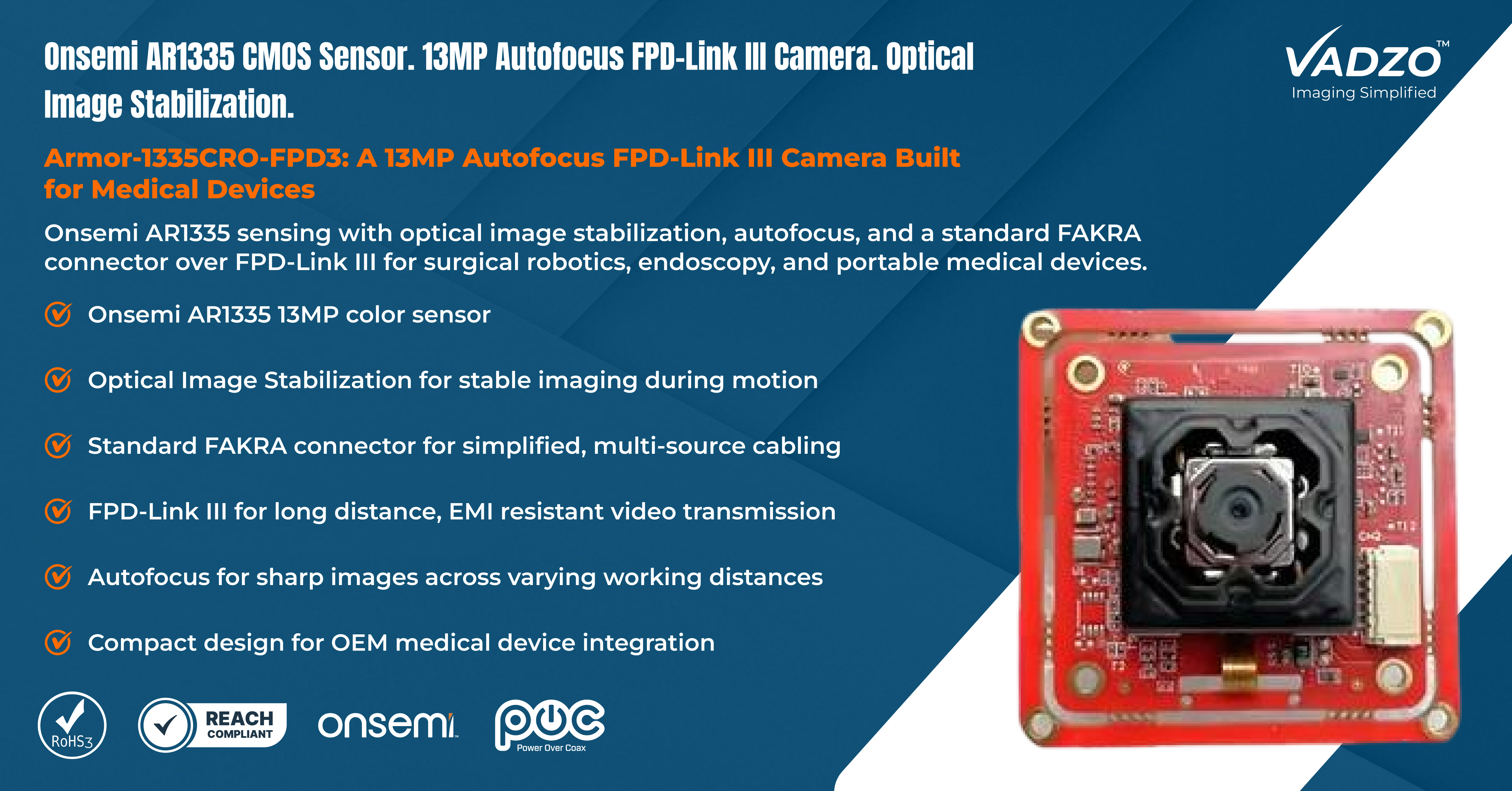
The Armor-1335CRO-FPD3 pairs the AR1335 Autofocus FPD-Link III Camera sensor with optical image stabilization, autofocus, and a standard FAKRA connector in a compact design suited to surgical robotics, endoscopy, and portable medical device integration. As a 13MP Autofocus FPD-Link III Camera, it outputs full 13-megapixel still resolution or cropped 4K video, giving medical device manufacturers a single camera platform that covers visualization, documentation, and general-purpose medical imaging from one module.
At the core of the module sits the 13MP OIS FPD-Link III Camera sensor, chosen specifically for the combination of resolution, stabilization, and standardized connectivity that medical device programs require. Because the camera combines 4K OIS FPD-Link Camera video output with AR1335 OIS Camera still capture on the same hardware, the Armor-1335CRO-FPD3 reaches usable image quality whether a device is capturing a wide field overview or a close, stabilized view of a specific site, all delivered over a single coaxial cable terminated in a connector a manufacturer can source from multiple established suppliers.
Key Capabilities
Onsemi AR1335 Sensor for Detailed 13MP / 4K Capture:The Armor-1335CRO-FPD3 is built around the Onsemi AR1335 sensor, a 13 megapixel device capable of full-resolution still capture as well as cropped 4K video output from the same hardware. This dual capability matters for medical applications that may need high-resolution stills for documentation or diagnostic review, alongside lower-latency 4K video for live visualization during a procedure, without switching camera hardware between those two tasks. As a 13MP FAKRA Camera, it delivers that resolution over the same standardized connector used throughout the rest of the platform.
Optical Image Stabilization for Stable Imaging During Motion:Handheld devices and robotically actuated arms both introduce small amounts of motion that a fixed-mount camera never has to correct for. As a Stabilized FPD-Link Camera, the Armor-1335CRO-FPD3 compensates for that motion optically before it becomes visible blur in the recorded frame, and functioning as a 13MP Stabilized Coax Camera, it delivers that stabilized image at full resolution rather than only in a reduced-quality preview mode.
Standard FAKRA Connector for Simplified Cabling:A proprietary connector locks a medical device manufacturer into a single cable source for the life of a product, which is a real supply chain risk for a device that may stay in production for many years. The Armor-1335CRO-FPD3 avoids that risk by using an industry-standard connector that multiple suppliers already manufacture, and, functioning as an OEM FAKRA Camera Module, it gives OEM customers the flexibility to qualify cable assemblies from more than one vendor without redesigning the camera interface. As a 4K FAKRA Connector Camera, it also proves that standardization holds even at the higher 4K video output the same sensor supports.
FPD-Link III for Long Distance, EMI-Resistant Video Transmission:Medical equipment often places the camera at one end of a cable run and the display, recorder, or processing unit some distance away, whether across an operating room or inside a compact device housing. As an OIS Coax Camera, the Armor-1335CRO-FPD3 carries stabilized video reliably over that distance using a single coaxial cable, resisting the electrical noise common in a facility full of other powered medical equipment.
Autofocus for Sharp Images Across Varying Distances:Working distance changes constantly during many medical procedures, whether an endoscope moves closer to a site of interest or a robotic arm repositions during a surgical task. The included autofocus lens assembly adjusts electronically as that distance changes, working alongside optical image stabilization so that both distance-related focus and short-term motion are corrected without requiring a technician to manually tune the lens for a single fixed working distance. Because both systems are tuned to work together rather than independently, a device manufacturer does not need to separately validate how autofocus and stabilization interact, which simplifies the verification work required before a device change moves into clinical use.
Compact OEM Ready Design for Medical Device Integration:The module 's compact footprint gives OEM customers flexibility to integrate the Armor-1335CRO-FPD3 into a surgical robotics arm, an endoscope handle, or a portable diagnostic device housing without a major mechanical redesign. Vadzo Imaging supports full customization on this platform as a FPD-Link Medical Camera Kit, including connector changes, housing design, and firmware adjustments for medical device programs headed into regulated volume production.
"Medical device teams cannot afford a camera that blurs during the exact moment a surgeon or technician needs the clearest possible view, and they cannot afford to build a product around a connector that only one supplier makes. The AR1335 's optical image stabilization combined with a standard FAKRA connector gives the Armor-1335CRO-FPD3 both a stable image and a sourceable supply chain from day one. We built this camera for teams designing a medical device that needs to stay in production for years, not just pass an initial demo. " - Alwin Vincent, Product Manager at Vadzo Imaging.
Application-Specific Sections
Surgical Robotics and Minimally Invasive Systems:Robotically actuated surgical instruments need vision that stays stable and in focus as the instrument moves through a precise but not perfectly damped range of motion. As a Surgical Robotics Camera Module, the Armor-1335CRO-FPD3 's optical image stabilization corrects for that motion before it becomes visible blur, and functioning as a Medical Robotics Vision Camera, it delivers that stability alongside the resolution needed for precise instrument guidance.
Medical Endoscopy and Visualization:Endoscopic visualization depends on a clear, stable image even as the scope moves through a natural or surgical opening with constant small motion. A Medical Endoscopy FPD-Link Camera built on this platform holds that image steady, and as a Surgical Camera Module FPD-Link, it integrates directly into an endoscope or surgical visualization tower over a single standardized coaxial connection.
Portable and Handheld Medical Devices:Handheld and portable diagnostic devices introduce natural hand motion that a fixed-mount camera never has to correct for, which makes stabilization a genuine clinical requirement rather than a convenience feature. As a Portable Medical Device Camera, the Armor-1335CRO-FPD3 corrects for that motion directly, and a Stabilized Medical Imaging Camera configuration of the same module gives handheld device manufacturers dependable image quality regardless of how steadily a given user happens to hold the device.
Medical Device OEM Integration:Medical device manufacturers building their own surgical, diagnostic, or monitoring equipment need a camera vendor who understands the connectivity, stabilization, and long-term sourcing requirements a regulated product demands. The Armor-1335CRO-FPD3 ships from a FAKRA Camera Manufacturer with those requirements built in from the start, and Vadzo Imaging supports OEM customization for cable length, connector configuration, and firmware for device programs standardizing on one camera platform.
Medical Imaging Carts and Fixed Equipment:Not every medical imaging application is handheld or robotically actuated, and fixed equipment such as imaging carts and mounted visualization towers still benefit from the same standardized connectivity and image quality. A Medical Coax Camera platform like this one gives equipment manufacturers a consistent camera choice across both fixed and mobile product lines, and as a Medical Grade Coax Camera, it meets the durability and image quality expectations a clinical environment requires. Standardizing on the same camera platform across fixed and portable product lines also simplifies a manufacturer 's own internal qualification work, since engineering, regulatory, and service teams only need to understand one hardware and software baseline rather than maintaining separate support paths for a cart-based system and a handheld device.
Conclusion
Across surgical robotics, endoscopy, and portable diagnostic devices, the common requirement is the same: a stable, detailed image delivered over a connector a manufacturer can actually source for the life of a product. The Armor-1335CRO-FPD3 answers that requirement, built around Onsemi AR1335 imaging, optical image stabilization, and autofocus delivered over FPD-Link III through a standard FAKRA connector, giving medical device manufacturers and OEM customers a single platform to standardize on across an entire product line. As a Coax Medical Camera Supplier, Vadzo Imaging supports that standardization from initial evaluation through regulated volume production.
Frequently Asked Questions
Q: Why does optical image stabilization matter for a medical device camera rather than just careful handling?
A:Even the steadiest hand or the most precisely engineered robotic arm introduces small amounts of motion that a fixed-mount camera never has to correct for, and that motion translates directly into blur or frame-to-frame misalignment in recorded video. Asking a surgeon, technician, or device operator to simply hold something more steadily is not a realistic solution during an actual procedure, where attention needs to stay on the task rather than on minimizing camera shake. Vadzo Imaging builds optical image stabilization directly into its medical device camera products so that correction happens automatically at the hardware level, giving device manufacturers a stable image without asking end users to change how they naturally hold or operate the equipment.
Q: What is a FAKRA connector, and why does a standard connector matter for a medical device camera?
A:FAKRA is an established, standardized coaxial connector design that multiple manufacturers already produce, as opposed to a proprietary connector that only one supplier makes. For a medical device program, that distinction matters well beyond initial development, since a product built around a single-source connector creates real supply chain risk if that supplier raises prices, extends lead times, or discontinues the part during a product 's multi-year production life. Vadzo Imaging selects standard FAKRA connectivity for its coax-connected camera products specifically so device manufacturers can qualify cable assemblies from more than one vendor from the start, rather than discovering a single point of supply chain failure years into a product 's life.
Q: Why would a medical device use a coax-connected camera instead of a standard USB or HDMI camera?
A:Standard USB and HDMI cables were designed around consumer and desktop distances and connector types, not the combination of length, electrical noise, and mechanical reliability that a medical device housing or an operating room environment can require. A coax-connected camera using a link like FPD-Link III carries video, control signals, and often power over a single cable engineered for exactly those more demanding conditions, while remaining compatible with widely available connector standards like FAKRA. Vadzo Imaging designs its medical device camera products around this connectivity so manufacturers get a reliable, long-distance video link without the connector and cable limitations a consumer-oriented interface would introduce into a regulated product.
Q: Can Vadzo Imaging customize a medical device camera module for a specific surgical or diagnostic platform?
A:Yes. Vadzo Imaging supports full OEM customization across its medical device camera portfolio, including housing design suited to a specific instrument or device form factor, connector and cable length configuration, and firmware adjustments tuned for a particular visualization or diagnostic workflow. Evaluation units ship with no minimum order requirement, and the same engineering team that built the standard product works directly with medical device OEM customers to adapt the module for a specific surgical, diagnostic, or monitoring platform headed into regulated production.
Q: What should medical device manufacturers look for when selecting a camera supplier for a regulated product?
A:A regulated medical device program depends on component consistency over a long production life, which makes a supplier 's ability to maintain the same core hardware and software platform for years just as important as the camera 's specifications on day one. Manufacturers should also look for standardized connectivity that can be sourced from more than one vendor, direct engineering support during design and qualification, and a supplier willing to support customization without treating every request as a new product. Vadzo Imaging builds its medical device camera products around exactly these priorities, since a camera that works well in a demo but cannot be supported consistently for years is not actually a viable choice for a regulated product. Considering the total cost of a camera relationship over a product 's full regulatory lifecycle, rather than only the unit price during initial development, usually points toward the same conclusion: a supplier who treats long-term consistency as a core requirement rather than an afterthought.
Availability
The Armor-1335CRO-FPD3 13MP Autofocus FPD-Link III Camera is available now for evaluation and OEM integration. Evaluation kits include the camera module, an FPD-Link III deserializer reference board, a FAKRA cable assembly, and integration documentation covering optical image stabilization configuration, autofocus behavior, and Vispa ARC SDK installation, with no minimum order requirement. Contact Vadzo Imaging at support@vadzoimaging.com to request an evaluation unit or discuss volume production and OEM customization.
About Vadzo Imaging
Vadzo Imaging develops embedded and machine vision camera products for OEMs, system integrators, and medical device manufacturers building production-ready vision systems across surgical robotics, diagnostics, industrial automation, and edge AI. The company 's portfolio spans MIPI CSI-2, USB, GigE, Wi-Fi, FPD-Link III, and SerDes interface camera products, supporting deployment architectures from compact onboard modules to distributed networked and coax-connected installations. Vadzo provides end-to-end imaging support, including sensor integration, ISP tuning, firmware development, and SDK frameworks to accelerate system deployment. Visit Vadzo Imaging to explore the full embedded vision camera portfolio.
Media Contact
Alwin Vincent
Vadzo Imaging
Email: alwin@vadzoimaging.com
LinkedIn: Vadzo Imaging
YouTube: Vadzo Imaging
X: Vadzo Imaging
SOURCE:Vadzo Imaging
View the original press release on ACCESS Newswire
© 2026 ACCESS Newswire. All Rights Reserved.