


Vadzo Imaging announces the combination of HDR and VCM Autofocus with the Falcon-830CRH Onsemi HyperLux AR0830 8MP Color Rolling Shutter USB Camera
The Falcon-830CRH is an 8MP 4K HDR USB Camera built on the Onsemi AR0830 HyperLux LP sensor that combines Line Interleaved HDR and enhanced Dynamic Range with software-controlled VCM autofocus inside a single UVC-compliant USB 3.2 Gen 1 module. It is engineered for retail analytics, access control, medical imaging, kiosk, and smart city programs where scene contrast and subject distance both change faster than a fixed exposure and fixed focus design can follow. It delivers 3840 x 2160 color output with in-sensor dynamic range extension and no host-side HDR compositing overhead.
FORT WORTH, TX / ACCESS Newswire / August 31, 2026 /Vadzo Imaging, a world leader in embedded vision camera products, today announces the launch ff the Falcon-830CRH, an AR0830 4K HDR USB Camera developed for OEM engineers who need dynamic range and autofocus capability on the same board-level module. The Falcon-830CRH pairs the Onsemi AR0830 HyperLux LP sensor with an M12 Voice Coil Motor autofocus assembly and streams full 3840 x 2160 color frames over USB 3.2 Gen 1 with complete UVC compliance. As an AR0830 USB 3.2 Camera in Vadzo 's USB camera portfolio, it enumerates on the host as a standard video input device and requires no custom driver development before evaluation begins.
The Dynamic Range and Working Distance Problem in Deployed Vision Systems
Every image sensor carries one exposure setting per frame, and one dynamic range ceiling defined by full well capacity and read noise. When a scene contains a sunlit entrance and a shaded interior in the same field of view, the exposure that protects highlight detail crushes the shadow region into the noise floor, and the exposure that lifts the shadow region drives the highlight into saturation. Neither frame carries usable information for an inference model. This is not a tuning problem. It is a physical limit of single exposure capture.
Engineering teams have historically bracketed sequential exposures and composited them on the host processor. That approach breaks in two places. It consumes host compute that embedded platforms rarely have available, and it produces ghosting whenever the subject or the platform moves between bracketed frames. A Wide Dynamic Range Machine Vision Camera deployed at a store entrance or on a moving platform sees motion in nearly every frame, so sequential bracketing is structurally the wrong tool for the job. A High Dynamic Range Embedded Camera has to solve the problem inside the sensor readout, or it does not solve it at all.
The second constraint is optical. A fixed focus module is calibrated to one working distance, and that distance silently becomes the operational ceiling of the deployment. Users of different heights approach a kiosk at different ranges. A robotic end effector sweeps across parts of varying height. Once subject distance becomes a variable, the fixed focus assumption converts directly into soft frames, failed reads, and degraded model confidence. Solving contrast and leaving focus unaddressed produces a module that performs in a lab demonstration and disappoints in the field.
How Line Interleaved HDR and enhanced Dynamic Range Work Inside the AR0830
Line Interleaved HDR captures rows at different exposure values within a single frame readout. Rather than assembling a high dynamic range result from separate frames captured at separate moments, the sensor interleaves long and short exposure rows across one readout cycle and reconstructs the extended range image from that single temporal sample. Because all of the exposure information originates in one frame period, the motion displacement between exposures is bounded by row timing rather than by frame timing. This is the mechanism that makes a LI-HDR USB Camera viable in scenes with pedestrians, vehicles, and moving conveyor content where sequential bracketing would produce visible ghost edges.
Enhanced Dynamic Range operates on a different axis. It extends the usable exposure range at the pixel level using processing carried on the sensor die rather than reconstructing range from multiple row exposures. Deployed as an eDR USB Camera mode, this gives integrators additional highlight and shadow headroom where row interleaving is not the preferred trade-off. The two modes are complementary rather than redundant. Line interleaving addresses wide scene contrast with motion present, and enhanced Dynamic Range addresses per-pixel headroom with lower reconstruction complexity.
The important system-level point is where the work happens. Both modes execute on the AR0830 alongside the on-board high-performance ISP that also handles auto exposure and auto white balance. The host receives a range-extended frame rather than a stack of brackets and a compositing task. For an embedded platform running detection or classification models on a constrained SoC, that difference frees both compute headroom and pipeline latency. Selecting a LI-HDR eDR USB Camera therefore changes the software architecture of the vision system and not only the image quality. Teams evaluating an AR0830 HDR USB Camera or any other 8MP HDR USB Camera option should weigh that offload against the cost of maintaining a host-side HDR stage across the product lifetime.
Sensor and Camera Overview
The Falcon-830CRH integrates the Onsemi AR0830 HyperLux LP sensor, a 1/2.9 inch rolling shutter CMOS device with 1.4 µm pixel pitch and a maximum resolution of 8MP at 3840 x 2160. The HyperLux LP family targets low-power embedded imaging and carries a high-performance ISP on the sensor die, so auto exposure and auto white balance run without consuming host cycles. As an Onsemi AR0830 Image Sensor configuration, the device supports both Line Interleaved HDR and enhanced Dynamic Range in the sensor, along with a Wake on Motion capability that holds the imaging core in super low power mode until motion appears in the field of view.
On the camera side, the module connects over USB 3.2 Gen 1 Type-C with backward compatibility to USB 3.0 and presents as a fully UVC-compliant video input device on Windows, Linux, and Android. An M12 Standard S Mount lens mount carries the Voice Coil Motor autofocus assembly under software control. GPIO provides hardware trigger and strobe connectivity for synchronized capture. The board measures 38mm x 38mm and converts to 32mm x 32mm at 13 grams without lens. It operates from -30⁰C to +85⁰C and conforms to UVC, RoHS 3, and REACH. A high-resolution USB camera module of this class removes the upscaling stage that lower-resolution sensors force into the inference pipeline. As an AR0830 Rolling Shutter USB Camera built for production integration, the module fits directly into OEM enclosures without mechanical redesign.
Key specs: Falcon-830CRH | 8MP (3840 x 2160) | Onsemi AR0830 Onsemi Hyperlux™ LP | Sensor Format 1/2.9 " | Pixel Size 1.4 µm x 1.4 µm | Rolling Shutter | Color | LI-HDR and eDR | Wake on Motion | On Board High Performance ISP | VCM Autofocus | S Mount (M12 Standard) | USB 3.2 Gen 1 Type C | Full UVC Compliance | GPIO | Windows · Linux · Android | -30°C to +85°C Operating Temperature| 38mm (L) x 38mm (B) convertible to 32mm (L) x 32mm (B) | 13 Grams (Without Lens) | VISPA ARC SDK | UVC · RoHS 3 · REACH
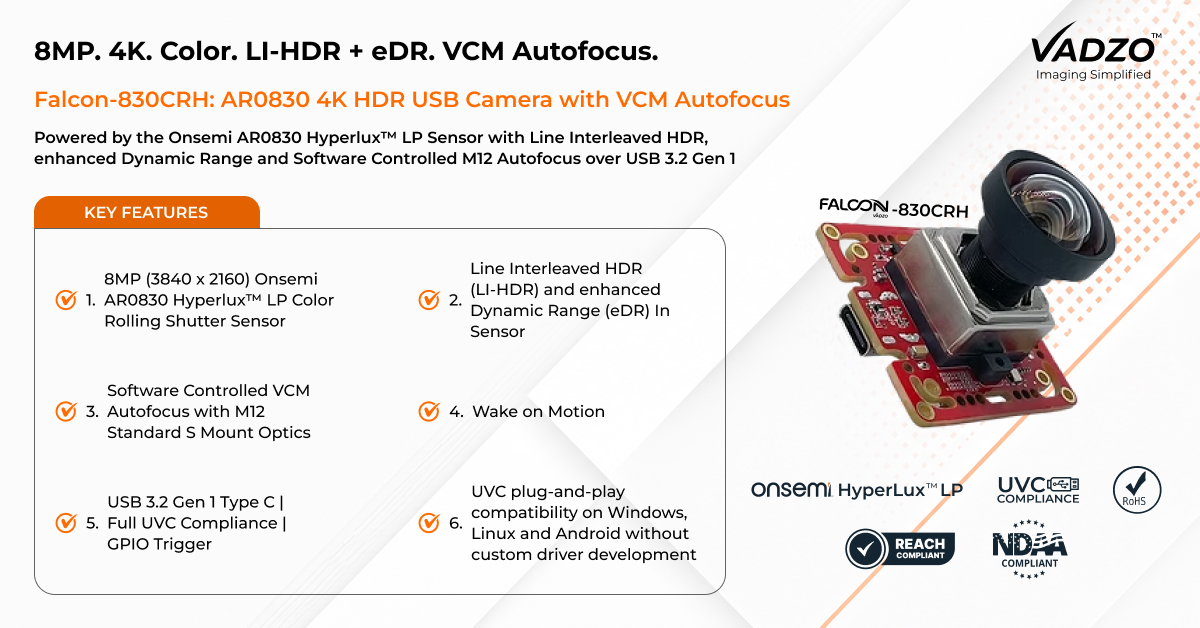
Key Capabilities of the Falcon-830CRH AR0830 4K HDR USB Camera
Line Interleaved HDR for Motion Tolerant Range Extension:LI-HDR is the capability that separates this module from conventional single-exposure 4K optics. By varying exposure across interleaved rows within one readout, the AR0830 produces a range-extended frame without the temporal gap that creates ghosting in frame-stacked HDR. For an AR0830 HDR Rolling Shutter USB Camera, this matters most at building entrances, loading bays, drive-through lanes, and retail thresholds where the illumination ratio across the frame is severe, and the subject is rarely stationary. An 8MP HDR Color USB Camera in this mode retains legible signage in the bright region and recoverable facial or product detail in the shaded region of the same capture rather than forcing a choice between them at exposure setup.
Enhanced Dynamic Range for Per-Pixel Exposure Headroom:eDR extends per-pixel exposure range using on-board processing, which gives system designers a second dynamic range strategy without adding external optical filtering or a host-side compositing stage. Where LI-HDR trades vertical sampling for range, an AR0830 HDR Color USB Camera running in eDR mode keeps the full row structure intact and widens the tolerable brightness span per pixel. Integrators evaluating an 8MP HDR Rolling Shutter USB Camera can select the mode matching the scene profile of the installation and change that selection in firmware rather than hardware. Vadzo publishes a comparison of high dynamic range camera types and how to choose between them for teams working through this decision during architecture review.
Software Controlled M12 VCM Autofocus Across Variable Working Distances:A Voice Coil Motor moves the lens element along the optical axis in response to current applied to a compact electromagnetic coil, which allows focus position to be commanded in software with low latency and no mechanical intervention. As a VCM Autofocus HDR Camera, the Falcon-830CRH keeps subjects resolved across a continuous range of distances instead of a single calibrated plane. This is what converts an AR0830 Autofocus USB Camera from a fixed installation component into a deployable module that tolerates real user behavior. An AR0830 Autofocus Rolling Shutter USB Camera holds sharpness as a person steps closer to a terminal, and an 8MP Autofocus Rolling Shutter USB Camera holds it as a document is repositioned mid-scan. Teams sourcing a VCM Autofocus USB Camera for production volume gain the same behavior across every unit without per-site optical recalibration. That is a meaningful reduction in field service load for any 8MP Autofocus USB Camera fleet.
Wake on Motion for Always On Deployment Under Constrained Power Budgets:The AR0830 holds the imaging core in super low power mode during inactivity and restores full operation when motion enters the field of view. Detection and wake decisions execute at the sensor so the host never polls the camera or manages mode transitions in application code. For an AR0830 Color USB Camera in a self-service terminal that sees users for a fraction of its powered hours, this removes continuous full-resolution streaming from the energy budget without reducing responsiveness when a user approaches. Battery-powered infrastructure nodes gain the same benefit. An 8MP Color USB Camera that idles cheaply is materially easier to justify in a thermal and power-constrained enclosure.
Plug and Play USB 3.2 Gen 1 with Full UVC Compliance and GPIO Control:Full UVC compliance means the module registers as a standard video input device the moment it is connected and streams on Windows, Linux, and Android with no driver installation. For OEM teams, this removes driver development from the integration scope and eliminates the compatibility risk that custom drivers carry across operating system updates. An AR0830 USB Camera that behaves this way shortens the path from evaluation board to production firmware. GPIO adds trigger and strobe connectivity for synchronized multi-node capture. The USB-powered architecture removes external regulators from the enclosure design, which keeps integration of an 8MP USB 3.2 Camera clean inside compact production hardware. Any 8MP USB Camera evaluated for OEM use should be checked against this baseline first.
Product Specifications
Parameter | Specification |
Model | Falcon-830CRH |
Image Sensor | AR0830 CMOS Sensor from Onsemi Hyperlux™ LP |
Resolution | 8MP (3840 x 2160) |
Sensor Format | 1/2.9 " |
Pixel Size | 1.4 µm x 1.4 µm |
Shutter Type | Rolling Shutter |
Output | Color |
HDR Modes | Line Interleaved HDR (LI-HDR) and enhanced Dynamic Range (eDR) |
Power Management | Wake on Motion |
Image Processing | On-board high-performance ISP |
Focus | VCM-Based Autofocus (Software Controlled) |
Lens Mount | M12 Standard (S Mount) |
Interface | USB 3.2 Gen 1 Type C, backward compatible with USB 3.0 |
Device Class | Full UVC compliance |
Operating System Support | Windows, Linux, Android |
SDK | VISPA ARC SDK with C, C++, C# and Python APIs |
Operating Temperature | -30°C to +85°C |
Dimensions | 38mm (L) x 38mm (B) convertible to 32mm (L) x 32mm (B) |
Weight | 13 grams without lens |
Compliance | UVC, RoHS 3, REACH |
"The AR0830 already sits among the stronger low-power 4K sensors available to embedded teams. What we wanted to prove out with the Falcon-830CRH is that LI-HDR and eDR and VCM autofocus can coexist on one USB module without any of them being compromised to fit. Range extension solves the contrast problem, and autofocus solves the distance problem, and OEM teams have been forced to choose between them for far too long. Handing the host a range-extended frame instead of an exposure stack also gives back compute that inference workloads need. That combination is what makes this module deployable rather than merely capable. " - Alwin Vincent, Product Manager, Vadzo Imaging.
Target Applications
Retail Analytics and In-Store Vision:A store floor presents overhead lighting against shadowed shelf faces, glazed frontage that changes brightness through the day, and customers who never stand at a fixed distance from the lens. LI-HDR keeps shelf-level product detail and window-level brightness in the same usable frame while VCM autofocus tracks shoppers across the aisle depth. At full resolution, an 8MP 4K USB Camera captures enough spatial detail for footfall counting, dwell measurement, planogram compliance, and product interaction detection without cropping or upscaling before inference. An AR0830 Color Rolling Shutter USB Camera also preserves the color fidelity that packaging recognition models depend on. Vadzo supports retail automation deployments across checkout, entrance, and aisle positions.
Access Control Facial Recognition and Perimeter Security:Entrance imaging is the textbook adversarial case for dynamic range. Daylight behind an approaching subject drives the sensor toward silhouette while interior lighting drives it toward washed-out skin tone. An AR0830 Autofocus HDR USB Camera answers both halves of that problem in the same capture by extending range in sensor and holding focus across the full approach corridor rather than a single calibrated standoff distance. An 8MP Autofocus HDR USB Camera delivers the pixel density on facial features that biometric matchers require at practical mounting distances, which lowers false rejection rates. For security and surveillance programs, the wide thermal range also supports vestibule and semi-outdoor mounting without supplemental conditioning.
Medical Devices and Point of Care Imaging:Clinical imaging combines bright focal illumination with dim ambient room light and working distance changes between procedures and between operators. An AR0830 4K Autofocus USB Camera adjusts focus under software command without mechanical recalibration between cases, which keeps the instrument inside its validated workflow. LI-HDR holds detail across the illumination gradient that surgical and examination lighting produces. At 13 grams and 32mm x 32mm, an 8MP 4K Autofocus USB Camera fits inside portable diagnostic instruments, benchtop imaging systems and pathology platforms without structural redesign. UVC compliance simplifies validation for medical device and patient care platforms because the imaging path uses operating system native drivers rather than a vendor-specific stack.
Self Service Kiosk and Smart City Infrastructure:Kiosk integration is bounded by three hard limits, which are board area, power budget, and software compatibility. The 32mm x 32mm convertible footprint, USB-powered architecture, and native UVC behavior of this AR0830 4K USB Camera address all three without custom work. Wake on Motion trims idle consumption between users. An 8MP 4K Color USB Camera reads identity documents, ticket barcodes, and payment surfaces at close range while autofocus absorbs the height variation across users. For kiosk and digital signage installations and for smart city deployments on public infrastructure, the -30⁰C to +85⁰C operating range covers seasonal cycling, and the RoHS 3 and REACH conformance satisfies infrastructure procurement requirements.
Industrial Automation Robotics and Fleet Vision:Automation cells mix bright machine lighting with deep shadow in one frame and present parts at heights that change with every fixture. A High Speed Industrial Autofocus Camera handles that variation by commanding focus per station rather than per installation. An AR0830 4K Rolling Shutter USB Camera supports surface inspection, label verification, presence checking, and OCR on slow-moving subjects at full 4K density. An 8MP 4K Rolling Shutter USB Camera paired with GPIO triggering aligns capture to conveyor position or robot controller state rather than host software timing. Vadzo supports automation and robotics integration alongside in-cabin and cargo imaging for telematics and fleet management systems where contrast swings between tunnel, garage, and open road conditions.
VISPA ARC SDK for Developer Integration
The Falcon-830CRH is supported by the Vadzo VISPA ARC SDK, which provides programmatic control over streaming, Region of Interest configuration, exposure, autofocus behavior, trigger synchronization, binning, and windowing. APIs are available in C, C++, C# and Python across Windows, Linux and embedded platforms. The SDK also covers still image capture, image flip, Smart GPIO management, and secure firmware updates. It installs separately from the UVC path, so an AR0830 Autofocus Color USB Camera remains plug-and-play for standard streaming while advanced control stays available. For teams standardizing an 8MP Autofocus Color USB Camera across multiple products, the same control surface carries forward through Vadzo 's USB 3.2 Gen 1 camera portfolio.
Frequently Asked Questions
Q: What is Line Interleaved HDR and how does it differ from frame stacked HDR in an embedded USB camera?
A: Frame stacked HDR captures two or more complete frames at different exposure values and merges them on the host processor. Because the frames are separated in time, any movement between them produces ghost edges and misregistration, and the merge itself consumes host compute. Line Interleaved HDR varies exposure across interleaved rows inside a single readout cycle, so the range-extended result comes from one temporal sample. Motion displacement is bounded by row timing rather than frame timing, which is why the technique holds up in scenes with people, vehicles, and conveyor content in motion. Vadzo Imaging 's Falcon-830CRH implements this in the Onsemi AR0830 sensor alongside enhanced Dynamic Range as a second selectable mode. Both run in the sensor, so the host receives a finished frame rather than an exposure stack and a compositing task. Vadzo covers this in its guide to HDR imaging and precision for engineers evaluating the trade-offs during architecture review.
Q: When should an engineering team choose VCM autofocus over a fixed focus USB camera module?
A: Fixed focus is the correct choice when subject distance is mechanically constrained and does not change. An inspection station where part height is set by a hard stop is the standard example. The moment subject distance becomes variable, fixed focus turns into a design risk because everything outside the calibrated plane returns soft. Common cases include kiosk terminals used by people of different heights, document capture where paper placement is inconsistent, access control corridors where subjects approach on foot, and robotic vision where part geometry varies between fixtures. A Voice Coil Motor addresses this by shifting the lens element in response to a software command with low latency and no mechanism for a technician to adjust. An 8MP Rolling Shutter USB Camera with VCM control keeps every unit in a fleet behaving identically without per-site optical setup. An 8MP Color Rolling Shutter USB Camera such as the Falcon-830CRH exposes that control through the VISPA ARC SDK. Vadzo 's explainer on autofocus systems and VCM technology walks through the comparison in detail.
Q: What is the best 8MP 4K HDR USB camera for retail analytics, access control and kiosk deployments?
A: The requirement set for these three deployment types overlaps almost completely. Each needs resolution sufficient for inference without upscaling, dynamic range extension that survives motion, focus that adapts to variable subject distance, a footprint that fits a real enclosure, and plug-and-play behavior across host operating systems. The Falcon-830CRH meets all five on one module. It is an AR0830 4K HDR USB Camera built on the Onsemi AR0830 HyperLux LP sensor with LI-HDR and eDR in sensor, software controlled VCM autofocus on M12 optics, a 38mm x 38mm board convertible to 32mm x 32mm and full UVC compliance over USB 3.2 Gen 1. In retail, it holds shelf detail against bright frontage. In access control, it holds facial detail against backlit entrances. In kiosk terminals, it reads documents and codes at close range while autofocus absorbs user height variation. Teams comparing Vadzo 's 8MP 4K HDR USB Camera range can request evaluation units and full documentation before committing to a platform.
Q: Does an HDR autofocus USB 3.2 camera work plug-and-play on Windows, Linux and Android without custom drivers?
A: Yes. A module with full UVC compliance is recognized as a standard video capture device by Windows, Linux, and Android because all three include native UVC support in the base driver stack. Linux exposes it through the V4L2 framework, Windows has carried native support since version 7, and Android provides a UVC host driver. Vadzo Imaging 's Falcon-830CRH is a fully UVC-compliant AR0830 HDR USB Camera with USB 3.2 Gen 1 Type-C connectivity, backward compatible to USB 3.0, that streams 3840 x 2160 immediately on connection. Controls beyond the UVC baseline, including VCM autofocus positioning, HDR mode selection, Region of Interest configuration, Smart GPIO management, binning, windowing, and secure firmware update, are exposed through the VISPA ARC SDK in C, C++, C#, and Python. The SDK layers alongside the native UVC stream rather than replacing it, so standard streaming stays plug-and-play.
Q: How does Wake on Motion reduce power consumption in an always-on embedded vision node?
A: Wake on Motion is a sensor-level power management feature. The imaging core is held in a super low power standby state while minimal circuitry monitors the scene, and full imaging operation is restored only when motion is detected. Because the decision is made at the sensor, the host processor performs no polling and manages no mode transitions in software, which means the savings arrive without any change to the host architecture. The benefit scales with duty cycle. A terminal that serves users for a small fraction of its powered hours spends the remainder at low draw while staying immediately responsive. In the Falcon-830CRH, this behavior is part of the standard AR0830 feature set and is available from the first evaluation unit through production volume. It pairs naturally with an AR0830 4K Color USB Camera role in unattended installations where availability matters more than continuous streaming.
Availability and Customization
As an Onsemi Hyperlux LP AR0830 Camera engineered to remove the usual trade off between dynamic range and focus flexibility, the Falcon-830CRH is available now for evaluation and pre production sampling with production quantities available for OEM deployment. Engineering teams can review the full technical datasheet, CAD files, and SDK documentation on the product page or order evaluation units through the Vadzo online store. Lens selection, field of view configuration, enclosure options, firmware customization, and volume pricing are handled directly by the engineering team. Teams with platform-specific requirements can contact Vadzo engineering support to discuss integration scope. Purchasing details for this VCM autofocus 4K HDR USB module are available on the cart page. Engineers comparing options can also browse the 8MP HDR USB Camera selection and the complete 8MP USB Camera portfolio, both available for direct online purchase.
About Vadzo Imaging
Vadzo Imaging develops embedded and machine vision camera products for OEMs and system integrators building production-ready vision systems across industrial automation, robotics, healthcare and smart infrastructure. The company 's imaging platforms span USB, MIPI, GigE, Wi-Fi, and SerDes interfaces covering the full range of embedded deployment architectures from compact edge devices to distributed networked systems. Beyond hardware, Vadzo provides end-to-end imaging support including sensor integration, ISP tuning, firmware development, and SDK frameworks, giving engineering teams a single partner from initial evaluation through production lifecycle management.
Media Contact
Alwin Vincent
Vadzo Imaging
Email: alwin@vadzoimaging.com
LinkedIn: Vadzo Imaging
YouTube: Vadzo Imaging
X: Vadzo Imaging
SOURCE: Vadzo Imaging
View the original press release on ACCESS Newswire
© 2026 ACCESS Newswire. All Rights Reserved.