



Whit Fosburgh Misstates Menhaden Science on Qualified Captain Podcast and Overlooks American Fishing Families
WASHINGTON, D.C. / ACCESS Newswire / October 6, 2026 /The Qualified Captain is a North Carolina-based boating and maritime interview podcast hosted by Aaron Stasiak. On the podcast, Stasiak interviews captains, marine industry participants and people who have survived incidents at sea, discussing their experiences and lessons for others on the water.
In episode 55, published on Oct 1, 2026, Stasiak interviewed Whit Fosburgh, executive director of the Forage Fish Campaign and former president and CEO of the Theodore Roosevelt Conservation Partnership. Their conversation addressed menhaden and other forage fish, industrial reduction fishing and proposals to restrict or end that fishing. Fosburgh made statements about menhaden science, fisheries management and the American businesses and workers the fishery supports that conflict with the documented record. The following twelve factual corrections present the corrected facts and supporting evidence.
1. Striped bass recovery
Fosburgh said the Atlantic States Marine Fisheries Commission (the ASMFC) concluded that reducing the menhaden quota from about 233,000 to 108,000 tons, a cut of almost 60%, would give striped bass only a 50-50 chance of recovery.
Facts: The assessment does not say that. The probabilities in the stock projections concern exceeding a menhaden ecological fishing mortality target. They are not probabilities of rebuilding striped bass. The ASMFC has explained that eliminating all menhaden fishing would not, by itself, rebuild striped bass to their biomass target. Sustainable striped bass management is also necessary.
2. Menhaden age assumptions
Fosburgh said scientists know menhaden can live to 11 years but assumed they would never live beyond about 4½ years and therefore concluded that "they will die anyway," so the fishery could "catch just as much."
Facts: There is no evidence that Atlantic States Marine Fisheries Commission scientists made that assumption or used that rationale. The assessment does not impose a maximum lifespan of 4½ years. It applies age-specific natural mortality rates, a measure of deaths from causes other than fishing, and separately models menhaden at ages zero through five and in an age-six-and-older group. NOAA Fisheries has collected menhaden age data for decades, and NOAA-published research has documented fish older than 4½ years.
Fosburgh 's statement inaccurately portrays both the assessment and the work of the ASMFC scientists. Natural mortality estimates can affect modeled biomass, fishing mortality and reference points, but that does not mean scientists assumed that older fish do not exist or concluded that catching them does not matter because they would "die anyway." By attributing that rationale to scientists without evidence, Fosburgh makes an inaccurate disparagement of the scientific work underlying the assessment.
3. Products and American economic benefits
Fosburgh said menhaden are processed and shipped to Canada, North Africa or Southeast Asia for aquaculture, and that almost all the material goes abroad.
Facts: The product sales claim conflicts with Omega Protein 's reported figures. According to the company, 70% of its 2025 sales were to U.S. customers, 83% were within the United States, Canada and Mexico, and only 17% were overseas. Omega Protein also reports that none of its Atlantic menhaden products supply Cooke Seafood operations in Canada. The fishery 's American benefits include wages and healthcare for the workers, as documented by UFCW Local 400.
4. Osprey nest outcomes
Fosburgh said 90% of osprey nests fail in the Chesapeake Bay and along the New Jersey and Connecticut coasts because the birds have nothing to eat.
Facts: Local findings do not establish that approximately 90% of nests throughout the Chesapeake Bay fail because industrial fishermen have removed their food. The 2026 Chesapeake study found successful reproduction at 33.1% of high-salinity nests and 65.5% of low-salinity nests. Results at individual locations varied substantially. The study does not demonstrate that industrial harvest caused the observed reproductive deficits, and its Chesapeake findings cannot substantiate the same blanket claim for New Jersey and Connecticut given that no reduction menhaden fishing occurs in those estuarine waters.
5. Official stock status and ecosystem management
Fosburgh described the official finding of no overfishing as a defense advanced by paid industry representatives, then said the issue is protecting the ecosystem and that managers acknowledge they are not doing that.
Facts: NOAA 's finding that Atlantic menhaden are not overfished and are not undergoing overfishing is an official scientific conclusion. Menhaden management uses ecological reference points accounting for predator needs. Characterizing the finding as merely an industry defense, or suggesting that the management framework omits the ecosystem, misrepresents the assessment and is disrespectful of the expertise of the ASMFC scientists who conduct the scientific assessments. It is a well-known fact that menhaden stocks in both the Atlantic and Gulf are not overfished, overfishing is not occurring, and the species are certified sustainable by the Marine Stewardship Council. Given Mr. Fosburgh 's long-time work in this subject matter he certainly must be aware that menhaden stocks on both coasts are healthy and sustainable harvested.
6. Natural mortality and assessment revisions
Fosburgh said managers increased the quota after changing scientific assumptions, refused to reconsider the research when warned, and later admitted a mistake. He said the natural mortality assumption was shifted so harvest could increase.
Facts: The assessment record documents a correction and scientific review. The ASMFC 's FAQ describes a tagging data correction and peer-reviewed reanalysis that lowered estimated natural mortality. The resulting revision lowered biomass estimates across the historical series; it did not demonstrate a sudden equivalent population decline. The ASMFC states that the 2025 update indicates total biomass actually increased slightly since 2021. The documented correction does not establish that the assumptions were changed to benefit industry.
7. Predator losses attributed to menhaden harvest
Fosburgh said science shows current coastwide menhaden harvest reduces striped bass by about 30%. He also attributes reductions of about 15% for Gulf king and Spanish mackerel and about 10% for red drum to the removal of their bait.
Facts: Fosburgh is restating a 30% allegation that the sportfishing lobby has repeatedly advanced through use of an altered graph from a 2017 study. This is not what the study shows. The allegation is a gross oversimplification of one forward-looking simulation, and the study 's lead author criticized that use. Since 2017, regulators have switched to ecosystem-based management of the menhaden fishery, reduced the Chesapeake Bay quota by 41% and reduced the coastwide quota by 10%. The study compared long-term simulated striped bass biomass and fishery yield under hypothetical menhaden fishing mortality rates with a zero-menhaden-fishing baseline; it did not measure a 30% decline in the striped bass population caused by the reduction fishery. The paper also said strong broad-scale evidence tightly coupling menhaden and striped bass population dynamics was lacking. The ASMFC now says that even ending all menhaden fishing would not, by itself, rebuild striped bass to its biomass target; sustainable recreational and commercial fishing on striped bass remains necessary.
Fosburgh 's 15% figures for Gulf king and Spanish mackerel and 10% figure for red drum do not follow from the available feeding evidence, which does not show that these predators depend on menhaden alone. NOAA reports that king mackerel eat fish, squid and shrimp, while Spanish mackerel feed on herring, menhaden, sardines, mullet, needlefish, anchovies, shrimp, crabs and squid. A 2024 peer-reviewed University of Southern Mississippi analysis integrating stomach content and stable isotope data for 41 predators and 173 prey categories found that northern Gulf predators are generalists and identified no single menhaden-dependent predator. Red drum had 46 observed prey types; the study estimated Gulf menhaden at 2.2% of its diet and the broader Brevoortia category at 2.1%.
Nor are Fosburgh 's Gulf percentages measured population losses. They are conditional outputs from a Gulf ecosystem model, not observations that current menhaden harvest reduced those predator populations by the stated amounts. Independent technical reviews by Emeritus Professor Doug Butterworth, director of the Marine Resource Assessment and Management Group at the University of Cape Town; Professor Ray Hilborn of the University of Washington 's School of Aquatic and Fishery Sciences; and Professor Steven Cadrin of the Department of Fisheries Oceanography at the University of Massachusetts Dartmouth 's School for Marine Science & Technology found too many technical problems to justify the model 's management conclusion, including uncertain diet inputs, inadequate fits to observed data and performance below conventional stock-assessment standards. The evidence may support examining possible food web tradeoffs, but it does not establish that menhaden harvest caused the 15% and 10% population reductions Fosburgh stated.
8. Claims that menhaden are absent
Fosburgh said menhaden are no longer seen along the entire coast. Later, he described people asking him about there being no striped bass and no menhaden in the Chesapeake Bay.
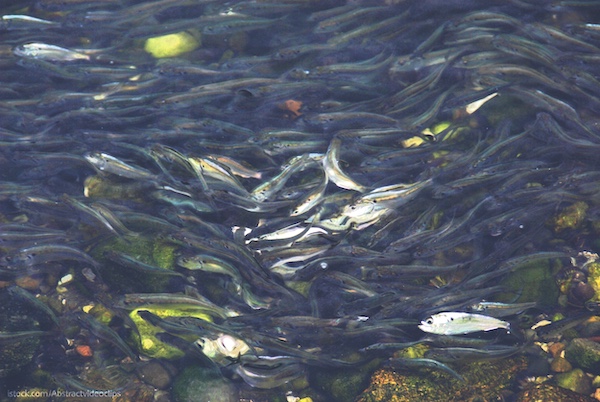
Facts: The claim that menhaden are no longer seen along the entire East Coast is contradicted by official fishery data and observations from several regions. The ASMFC reports that 2024 commercial landings, including reduction, bait, bycatch and episodic-event landings, totaled 186,155 metric tons, while bait and recreational landings alone totaled 52,200 metric tons. It also states that adult and juvenile menhaden form large, near-surface schools from Nova Scotia to northern Florida. Maryland DNR found juvenile menhaden widespread in the Chesapeake Bay for the third consecutive year in 2025. Recent reporting likewise documented nearshore menhaden aggregations off New York feeding humpback whales. Large die-offs further confirm the species ' presence in areas Fosburgh described as empty. Maryland 's official 2025 fish-kill report recorded three Baltimore Harbor events totaling about 206,000 fish; two were almost exclusively Atlantic menhaden and about 99% of the third were menhaden. In March 2026, hundreds to thousands of menhaden washed ashore from Cape Henry to Nags Head following a cold-stun event; a Virginia fisheries spokesman said menhaden have a "huge population" offshore and that there are "so many menhaden out on the East Coast" that they were the most visibly affected species. In September 2026, Public Radio East reported a massive Neuse River kill consisting mostly of juvenile menhaden. Catch data, observed schools and repeated die-offs directly contradict an assertion that menhaden are absent from the coast or Chesapeake Bay.
9. Ownership and regulatory review
Fosburgh said Cooke bought Omega Protein and then established Ocean Harvesters to break rules prohibiting foreign companies from fishing in American waters.
Facts: Fosburgh is repeating accusations that were at the core of the failed False Claims Act lawsuit brought by W. Benson Chiles and Chris Manthey against Ocean Harvesters, Cooke Inc., Omega Protein and related defendants. The U.S. District Court for the Southern District of New York dismissed the amended complaint in its entirety, and the U.S. Court of Appeals for the Second Circuit affirmed that dismissal in August 2026. Reporting on MARAD 's separate review states that the agency found the company 's documentation satisfactory and compliant with fishery-endorsement requirements.
10. The effect of the quota reduction
Fosburgh said the reduced quota of about 186,000 tons was the same as the industry 's previous catch, so not a single fish was saved. He later calls it a paper reduction.
Facts: That conclusion confuses a harvest ceiling with realized landings. The ASMFC reduced the allowable catch from 233,550 to 186,840 metric tons. The reduction limits subsequent permitted harvest. Comparing the new ceiling with an earlier year 's actual landings does not establish that the reduction saves no fish.
11. Gulf bycatch numbers
Fosburgh said Louisiana 's research found about 150 million non-target fish are caught and killed every year. He said the percentage is small but the practical number is significant.
Facts: Fosburgh turned one season 's sample-expanded estimate into a recurring annual death count. The LGL study observed 3.2% of Louisiana menhaden-fishery effort in 2024 and expanded those samples to estimate total bycatch for that season; it did not establish that the same number is killed every year. The study estimated total bycatch at about 3.6% by weight, and its accounting distinguishes retained bycatch, released bycatch and estimated post-release mortality. LDWF 's official comparison shows where red drum and spotted seatrout fishery removals actually came from over 2015-2024, measured by weight. For red drum, recreational harvest accounted for 78.9% of total removals and recreational dead discards another 11.2%-90.1% combined-while dead menhaden fishery bycatch accounted for 9.9%. For spotted seatrout, recreational harvest accounted for 93.3%, recreational dead discards 3.9%, and commercial harvest 0.1%-97.3% from directed fisheries-while dead menhaden fishery bycatch accounted for 2.7%. A raw count of small individuals, detached from weight, species composition, disposition and comparison with directed fisheries, does not support Fosburgh 's characterization.
12. Employment and economic losses
Fosburgh said the Virginia plant employs 260 people in good jobs, but thousands of jobs are being lost in the bait, recreational fishing, small commercial fishing and whale-watching sectors because of the fishery.
Facts: Fosburgh offered no economic analysis establishing that the menhaden fishery is responsible for job loss in the thousands. He compared the direct headcount at one processing plant with an undefined claim spanning bait, recreational fishing, small commercial fishing and whale watching, expressed no concern for the minority and union jobs sustained by the menhaden fishery, and relied on measures that are not comparable and do not support attributing thousands of job losses to it.
The menhaden fishery itself has a substantial, documented economic footprint. The ASMFC 's Committee on Economics and Social Sciences reviewed the fishery 's broader footprint and cited historical modeling of approximately 519 full- and part-time reduction-sector jobs in Maryland and Virginia, including 347 in Northumberland County. The committee also warned that high fixed costs and minimum operating volume can make job losses nonlinear: crossing the break-even threshold could cause structural unemployment and potentially a complete plant shutdown, not a proportional reduction in a 260-worker headcount.
UFCW Local 400 's account and accompanying workforce video describe hundreds of union jobs, an overwhelmingly local workforce, one of Northumberland County 's largest minority workforces, and benefits that support healthcare, college and local businesses. The Southern Christian Leadership Conference separately warned that additional restrictions could disproportionately affect African American workers, union families and rural communities, and urged full recognition of affected workers and families. Together, this record documents substantial employment tied to the fishery and its economic importance to Northumberland County and surrounding rural communities.
About the American Small Pelagics Network
The American Small Pelagics Network represents fishermen, processors, suppliers, and coastal communities connected to fisheries such as menhaden, mackerel, herring, squid, and butterfish. ASPN supports sustainable fisheries management that supports critical fish species, while maintaining economic opportunities for fishermen and fishing communities.
Press Contact
Stove Boat Communications
(202) 595-1212
contact@smallpelagics.com
SOURCE:American Small Pelagics Network
View the original press release on ACCESS Newswire
© 2026 ACCESS Newswire. All Rights Reserved.