



Vadzo Imaging Validates Falcon-1335MRH: Onsemi AR1335 13MP Monochrome VCM Autofocus USB 3.2 Gen1 Camera with ROI Based Auto Exposure for Medical and Life Sciences
FORT WORTH, TX / ACCESS Newswire / October 9, 2026 /Vadzo Imaging, a provider of embedded vision camera products for OEMs and system integrators, today announces validation of the Falcon-1335MRH 13MP Mono VCM Autofocus USB Camera, a 13MP monochrome camera built on the Onsemi AR1335 sensor with ROI based auto exposure for medical and life sciences. Part of Vadzo 's USB camera portfolio, the Falcon-1335MRH pairs VCM autofocus with exposure metering confined to a user-defined region of interest, giving instrument developers a module that keeps the specimen correctly exposed regardless of what surrounds it in the frame. With this validation, Vadzo delivers an AR1335 ROI Auto Exposure Camera that helps microscopy, pathology, and point-of-care equipment makers capture comparable monochrome images without writing a custom exposure routine on the host system.
Technical Problem Definition
Medical and life sciences imaging rarely fills the frame with the subject. A microscope field typically shows a specimen surrounded by empty slide area, a bright illumination edge, or a dark mounting border. A point-of-care device views a region of tissue or a sample carrier set against a housing. A pathology scanner captures tissue sections whose density varies from one area to another. In each case, the diagnostic information lives in a small portion of the image, and the rest of the frame is context at best and interference at worst.
Conventional auto exposure does not know which part of the frame matters. It averages brightness across the whole image or a fixed center-weighted area, then sets exposure so that the average looks acceptable. When a bright margin or a specular reflection from glass dominates the average, the specimen is pushed toward underexposure and loses the faint structure an algorithm or a clinician needs. When a large dark border dominates, the specimen is driven toward saturation and loses detail at the bright end. The result is a camera that behaves well in a bench demonstration with a uniform subject, and inconsistently once real specimens, real slides, and real housings appear in the frame.
The problem compounds when images are compared. Monochrome diagnostic workflows often compare the brightness of the same region across samples, sessions, or time points, and an exposure setting that drifts because of changes outside that region quietly corrupts the comparison. An Onsemi AR1335 ROI Mono Sensor described only by its resolution tells an equipment maker nothing about this behavior, and an AR1335 Mono ROI Module evaluated only on uniform test targets leaves the mixed brightness scenes that define real instruments untested. Teams that discover the gap late often add exposure code on the host system, which increases latency and engineering cost across every product variant.
Host-side workarounds carry their own risks. An exposure routine running on the host depends on frames that have already been captured, so it reacts one or two frames late and can oscillate when the scene changes quickly. It also has to be rewritten or retuned for each operating system, each instrument model, and each lens and illumination combination. Medical and life sciences OEMs that support several instrument variants multiply that effort, and every variant needs its own verification record. A camera that handles region-based metering inside the module moves that work to the point where the image is formed and gives every variant the same starting behavior.
Engineering Explanation
The Falcon-1335MRH addresses this by confining auto exposure metering to a region of interest instead of the full frame. The Onsemi AR1335 is a 13MP (4208 x 3120) rolling shutter sensor in a 1/3.2 inch optical format with 1.1 micron pixels. In this monochrome configuration, every pixel contributes luminance without a color filter array, which gives the module its sensitivity and fine detail for diagnostic tasks. The exposure control loop evaluates brightness only inside the defined region and adjusts exposure time and gain to hold that region within a usable range. Brightness outside the region can rise or fall without pulling exposure along with it. This makes the module a genuine Auto Exposure Mono Sensor Module for scenes where the subject and its surroundings differ widely in brightness.
Vadzo validates this ROI Based Exposure Mono Camera behavior with test scenes that reflect real instrument conditions, including a small specimen on a bright field, a dim specimen surrounded by a reflective carrier, and a region that shifts position relative to the frame. Each scene confirms that exposure settles on the region of interest and stays there as the surrounding brightness changes. The M12 lens mount, which makes the module an AR1335 M12 ROI Sensor, lets manufacturers match optics to the working distance and field of view of a given instrument, while the VCM autofocus keeps the specimen sharp as that distance varies.
The size and position of the region matter as much as the metering itself. A region that is too small can chase noise or a single bright particle, while a region that is too large begins to behave like global metering again. Vadzo therefore evaluates the module with regions of several sizes and with regions placed away from the frame center, since real specimens are rarely centered. The goal is stable behavior across that range, so equipment makers can choose a region that suits the specimen without discovering that the exposure loop only works well in one configuration.
Focus and exposure interact more than they first appear to. Any focus routine that judges sharpness from image content can be misled when overall brightness shifts, because a brightness change can look like a change in sharpness. Holding the region of interest at a stable exposure gives the focus routine a steadier image to evaluate. Vadzo treats this as a design consideration rather than a guarantee for every host application, since the final focus strategy remains with the equipment maker. The module connects over USB 3.2 Gen1, which provides sufficient bandwidth for full 13MP monochrome capture as well as 4K, 1080p, and 720p modes for workflows that favor frame rate over maximum resolution.
Product Overview
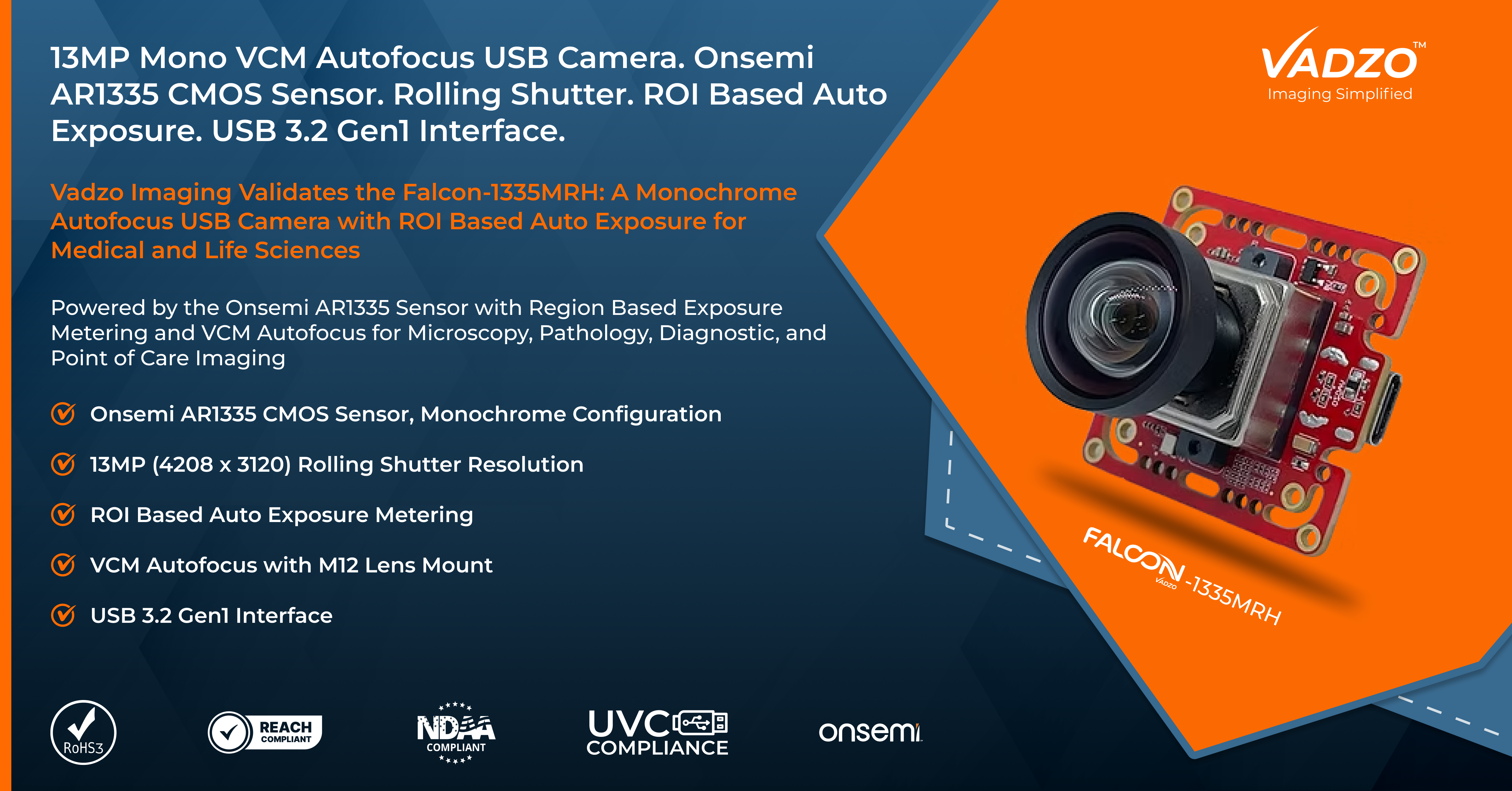
The Falcon-1335MRH is a 13MP Mono VCM Autofocus USB Camera built on the Onsemi AR1335 sensor and validated for ROI based auto exposure across medical and life sciences imaging. As a 13MP Monochrome USB Camera, it gives equipment manufacturers full-resolution grayscale frames from a compact module, which suits tasks that need luminance detail without the sensitivity cost of a color filter array. The ROI Auto Exposure Mono Camera designation reflects Vadzo 's validation of region-based metering on specimen-centered and mixed brightness scenes before the module reaches OEM customers. The module houses the AR1335 sensor, ISP, VCM actuator, and USB 3.2 Gen1 controller behind a standard M12 lens holder, and it is available as a Mono ROI Exposure Sensor Kit for evaluation. As a 13MP Mono Auto Exposure USB Camera, the module outputs full 13MP, 4K, 1080p, and 720p, and the 13MP ROI Mono Sensor designation confirms that region metering stays active across every output mode. As an AR1335 Auto Exposure Mono Sensor, the module enumerates as a standard UVC device on Windows, Linux, and Android, so evaluation and integration need no proprietary driver.
Key specs: 13MP (4208 x 3120) Max Resolution | Onsemi AR1335 1/3.2-inch Sensor Format | 1.1-micron Pixel | Monochrome with Rolling Shutter | USB 3.2 Gen1 Interface | S Mount (M12 Standard) with VCM Autofocus
Key Capabilities of the Onsemi AR1335 Monochrome ROI Auto Exposure Camera
13MP Monochrome Detail with ROI Auto Exposure
Resolution only helps when exposure lets the detail show. A 13MP monochrome frame of a specimen that is underexposed or clipped carries less usable information than a lower resolution frame that is correctly exposed. The Falcon-1335MRH, positioned as an Auto Exposure ROI USB Module, captures the full 4208 x 3120 frame while metering exposure on the region that holds the diagnostic content. Equipment makers building around a Consistent Mono Exposure Sensor get fine structural detail that is also comparable from one capture to the next. That pairing separates a 13MP Mono VCM Autofocus USB Camera that merely resolves many pixels from one that resolves them where it counts.
ROI Metering Compared to Global Metering
Global metering and region metering answer different questions. Global metering asks what the average brightness of the whole frame is, while region metering asks what the brightness of the part that matters is. For a uniform scene, the two give similar results, but for a specimen on a bright field they diverge sharply. Available as an ROI Auto Exposure Sensor Kit for evaluation, the Falcon-1335MRH lets engineering teams place their own representative specimens, carriers, and illumination in front of the module and compare the two behaviors directly. The comparison tends to be decisive, because the weakness of global metering on a mixed brightness scene is usually visible within the first few frames. Teams that run the test early can set exposure requirements for their instrument with real evidence instead of assumptions.
VCM Autofocus Working Alongside ROI Exposure
Autofocus and region metering solve separate problems that benefit from running together. The voice coil motor moves the lens to bring the specimen into focus as the working distance changes, and region metering holds the brightness of that same specimen steady while the lens moves. As a Mono VCM ROI Sensor, the Falcon-1335MRH pairs the two so that a handheld point-of-care device, a slide stage with small height variation, or a sample carrier loaded by different operators can each produce a sharp and consistently exposed image. Because the focus routine and the exposure loop both act on the specimen, the module reduces the chance of one function working against the other.
Consistent Exposure Across Specimens and Sessions
Comparison is a core laboratory activity, whether between two specimens on the same day or the same specimen across several weeks. An exposure setting that shifts because a neighboring bright region changed makes that comparison unreliable. Region metering ties the exposure decision to the same area every time, so the brightness of that area depends less on how a slide was mounted or how much empty field surrounds it. Vadzo validates this behavior across repeated captures of the same region under changing surroundings, which gives research and diagnostic teams a dependable starting point for their own analysis. The module does not replace calibration or validated quantitative procedures, and equipment makers remain responsible for the measurement claims of their finished instruments.
Multi-Resolution Output for Laboratory and Bedside Workflows
Selectable output resolution lets one module serve several roles inside the same instrument. Full 13MP mode captures maximum spatial detail for slide review and archival imaging. The 4K mode balances detail and USB bandwidth for continuous viewing, while 1080p and 720p modes support faster frame rates for alignment, focusing, and live guidance tasks. Because region metering operates in every mode, switching resolution does not change how exposure is decided, which keeps instrument software behavior predictable. A technician who switches from a quick alignment view to a full resolution capture sees the same exposure logic at work, so the transition does not require rechecking brightness before every image.
USB 3.2 Gen1 Plug and Play Integration for OEM Programs
The Falcon-1335MRH connects to any USB 3.2 Gen1 host port on Windows, Linux, or Android without additional interface boards, since the module enumerates as a standard UVC class device. Available as a USB 3.2 ROI Exposure Kit for evaluation, it lets engineering teams confirm region metering behavior on their own specimens before committing to a production order. For OEMs reviewing Vadzo as an OEM ROI Exposure Module supplier, lens matching, firmware customization, and enclosure design support are available alongside the core hardware. As a Plug and Play ROI Exposure device, the module fits common laboratory and bedside host platforms. Vadzo 's position as an ROI Exposure Camera Supplier extends beyond the module itself to lens selection and exposure characterization support, while its record as an ROI Exposure Camera Manufacturer covers production programs across several sensor families and interface types. A Mono ROI Camera Kit gives early prototypes the same behavior as the production unit.
"Equipment makers in medical and life sciences told us the same thing again and again. The specimen is small, the surroundings are bright or dark, and a camera that averages the whole frame sets exposure for the wrong thing. The Falcon-1335MRH was built to put exposure where the diagnostic content is. By validating ROI based metering together with VCM autofocus on real mixed-brightness scenes, we give OEMs a module that keeps the specimen readable without a custom exposure routine on the host. That saves engineering time and removes one source of variation from every image the instrument produces. " - Alwin Vincent, Product Manager, Vadzo Imaging.
Application Specific Sections
Microscopy and Slide Imaging
Slide imaging systems show a small stained or unstained specimen on a field that is often brighter than the specimen itself. Global metering lets that bright field dictate exposure and leaves the specimen dim. The Falcon-1335MRH works as an ROI Mono Microscopy Camera for these systems, metering on the specimen region so detail stays visible as stage position or illumination changes. Its role as a Mono Auto Exposure Lab Camera extends to benchtop instruments that image many slides in sequence and need each one exposed on its own subject. Laboratories that process large slide batches benefit most, because a small exposure error repeated across hundreds of slides turns into a large amount of rework.
Digital Pathology
Pathology workflows review tissue sections whose density varies, with dense regions that absorb light and sparse regions that transmit it. A single frame can contain both, and the region of interest decides which one the exposure serves. The module operates as a Mono ROI Pathology Sensor for scanning and review stations, holding exposure on the selected tissue area so reviewers and software see consistent brightness while the focus actuator tracks small differences in section thickness. Consistent brightness on the chosen area also gives image analysis software a steadier input, which reduces the amount of correction the software has to apply.
Diagnostic Equipment
Diagnostic instruments that image a sample carrier, cartridge, or test strip need the reading area exposed consistently regardless of the housing and carrier edges around it. The Falcon-1335MRH serves as an ROI Exposure Diagnostic Camera for these devices, and its use as an ROI Auto Exposure Clinical Camera extends to clinical analyzers where the reading area is fixed within the frame while surrounding reflections vary from one consumable to the next. Instrument makers can fix the region once at the design stage and rely on the same metering behavior across every production unit. Service teams also benefit, because a consistent region definition makes field behavior easier to compare with the behavior seen during factory acceptance testing.
Point of Care Devices
Point of care devices are often handheld, used by many operators, and aimed at a region of interest such as a wound area, a skin surface, or a sample window. Distance and surroundings change with every use. The module functions as a Point of Care Exposure Camera for these products, pairing autofocus with region metering so the target area is both sharp and correctly exposed even when the operator frames the shot differently each time. This matters in settings where retakes are costly or where the patient or sample cannot be repositioned easily.
Life Science Research and Instrumentation
Research instruments image gels, plates, small organisms, and prepared samples where the interesting signal sits inside a larger frame. The Falcon-1335MRH fits as a Mono Exposure Research Camera for laboratories that need repeatable exposure on a chosen area, and as an ROI Mono Life Science Sensor for instrument makers who want that behavior built into the module instead of added in host software. Repeatable exposure on the chosen area helps teams compare results across experiments without tuning exposure by hand for each sample.
Frequently Asked Questions
Q: What does ROI based auto exposure do that standard auto exposure does not?
A:Vadzo Imaging designs this camera so that exposure is decided only by the brightness inside a chosen region of interest, rather than by an average of the entire frame. Standard auto exposure lets bright margins, reflections, or dark borders influence the setting, which can leave the actual subject too dark or too bright. Vadzo Imaging validates region-based metering on mixed brightness scenes so the subject stays readable even when its surroundings change. This gives equipment makers one consistent behavior to design around instead of a different exposure result for every specimen and housing combination.
Q: Does region-based exposure interfere with autofocus?
A:No. Vadzo Imaging treats focus and exposure as two functions that should support each other. A focus routine that judges sharpness from image content works better when brightness is steady, and holding exposure on the region of interest provides that steadier image. Vadzo Imaging notes that the final focus strategy stays with the equipment maker, so teams should confirm the combined behavior on their own specimens during evaluation.
Q: Is a monochrome camera a better choice than a color camera for laboratory imaging?
A:It depends on the task, and Vadzo Imaging offers both approaches across its portfolio. A monochrome sensor has no color filter array, so each pixel records luminance directly, which suits tasks such as fine structure review, brightness comparison, and fluorescence-style imaging. When color carries the diagnostic information, a color camera is the better fit. Vadzo Imaging helps OEMs match the sensor type to the application.
Q: Does region-based exposure make images comparable between samples?
A:It helps, but it does not replace calibration. Vadzo Imaging designs region metering so the same area is exposed by the same logic each time, which reduces variation caused by changes elsewhere in the frame. Equipment makers still need their own validated procedures for any quantitative claim, and Vadzo Imaging supports those teams with evaluation units and engineering guidance. Vadzo Imaging recommends that teams document how region placement, illumination, and lens settings are controlled in their own instruments so that results remain traceable.
Q: Why should medical and life sciences equipment makers choose Vadzo Imaging as their camera supplier?
A:Vadzo Imaging offers more than a camera module built around a capable sensor. Medical and life sciences OEMs working with Vadzo Imaging receive a module validated on the mixed-brightness scenes real instruments produce, along with engineering support for lens selection, firmware customization, and enclosure design. Vadzo Imaging maintains evaluation kits with no minimum order requirement, so teams can test region metering on their own specimens before committing to volume production. This combination of validated behavior and low evaluation barriers is why equipment makers continue to choose Vadzo Imaging for diagnostic and laboratory camera programs.
Availability
The Falcon-1335MRH 13MP Mono VCM Autofocus USB Camera built on the Onsemi AR1335 sensor is available now for evaluation and production orders. Evaluation kits include the camera module, M12 lens, USB 3.2 Gen1 cable, and platform driver documentation, with no minimum order requirement. Engineering teams can confirm region metering and autofocus behavior on their own specimens, carriers, and illumination before committing to a production bill of materials, which tells them more than a datasheet comparison alone. Early testing with representative specimens also shows whether the chosen lens, illumination, and region size work together, which shortens the path from prototype to a verified instrument design. OEMs remain responsible for the regulatory pathway of the finished medical device. Browse the full range of medical and life sciences camera options at Vadzo 's website or contact Vadzo at support@vadzoimaging.com to request an evaluation unit or discuss OEM integration requirements for microscopy, pathology, diagnostic, and point-of-care camera programs.
About Vadzo Imaging
Vadzo Imaging is a global provider of embedded vision solutions and delivers high-performance camera technologies and imaging platforms for applications in robotics, industrial automation, UAVs, edge AI, and medical systems. Its products are designed for seamless integration with leading embedded platforms. Vadzo supports customers through hardware customization, firmware development, and module-level drivers, enabling faster development and deployment of vision-based systems across USB, MIPI, GigE, Wi-Fi, and SerDes camera interfaces.
Media Contact
Alwin Vincent
Vadzo Imaging
Email: alwin@vadzoimaging.com
LinkedIn: Vadzo Imaging
YouTube: Vadzo Imaging
X: Vadzo Imaging
SOURCE: Vadzo Imaging
View the original press release on ACCESS Newswire
© 2026 ACCESS Newswire. All Rights Reserved.