



Vadzo Imaging Validates Bolt-234CGS Camera Compatibility with NVIDIA Jetson AGX Orin: Onsemi AR0234 2MP Color MIPI CSI-2 Camera with Global Shutter and Onboard ISP
FORT WORTH, TX / ACCESS Newswire / October 20, 2026 /Vadzo Imaging, a provider of embedded vision camera products for OEMs and system integrators, today announces validation of the Bolt-234CGS with NVIDIA Jetson AGX Orin Camera. The Bolt-234CGS is a 2MP Color MIPI CSI-2 Camera built on the Onsemi AR0234 sensor with a global shutter and an on-board ISP. Part of Vadzo 's MIPI camera portfolio, the module combines simultaneous pixel exposure with finished YUV output and two adapter board variants, one for 2-lane and one for 4-lane MIPI CSI-2. With this validation, Vadzo delivers a 2MP Global Shutter MIPI CSI-2 Camera for AGX Orin-based warehouse robotics, smart surveillance, and retail analytics and automation systems, together with guidance on how an on-board ISP changes the pipeline on NVIDIA Jetson Camera and on how to select the correct adapter board.
Technical Problem Definition: Why a Global Shutter MIPI Camera Needs Finished Output on Jetson
Jetson AGX Orin Camera is built for demanding perception workloads. It combines a GPU, deep learning accelerators, and several camera inputs, so a single board can run navigation, detection, and recording for a robot or a retail system at once. The quality of what it perceives still depends on the camera, and two properties of the camera cause most of the trouble in practice. The first is how the sensor exposes the image. The second is where the image gets processed. Both are decided when the camera is chosen, long before the software team sees a frame.
Most sensors use a rolling shutter, which reads the image row by row. When the subject or the camera moves, the rows capture different moments, and straight lines bend. A forklift carrying a pallet, a robot arm sweeping past a shelf, a shopper walking through a doorway, and a camera on a moving vehicle all create this effect. For analytics that measure positions, read codes, or track people, the distortion matters, because geometry derived from a skewed image is wrong. Fast exposures reduce the skew but need strong light, which warehouses and stores do not always provide. A global shutter avoids the issue by exposing every pixel at the same instant, so moving subjects keep their shape. The benefit is greatest when subjects move quickly or when the camera itself is mounted on a moving platform.
Image processing raises the second problem. A raw sensor sends unprocessed Bayer data to the Jetson, which must demosaic, correct color, reduce noise, and manage exposure. On Jetson, that work is done by the host ISP, which needs a tuning profile for each sensor and lens, and good tuning takes time and expertise. Two products using the same Jetson can look quite different because of tuning alone. A module that finishes the image itself removes that task, but a buyer must then understand that the host ISP is not part of the pipeline. That is a fair exchange for many teams, and an unwelcome surprise for the few who expected raw access.
Connectors add a practical question. MIPI camera modules connect through a defined number of data lanes, and carrier boards differ in the connectors they offer. A camera that supports only one lane count limits where it can be used. Teams that discover these constraints late must redesign the carrier or change the camera after hardware is built. A short review of lane counts, connectors, and image processing needs at the start of a project avoids most of that rework.
Engineering Explanation: AR0234 On-board ISP MIPI Camera Behavior on Jetson AGX Orin
The Bolt-234CGS is built on the Onsemi AR0234, a 2MP (1920 x 1200) color global shutter sensor with a 1/2.6 inch optical format and 3.0 micron pixels. The shutter is global, so the whole frame is captured in a single simultaneous exposure with no row-by-row timing. The 3.0 micron pixels are large for a 2MP sensor, which helps collect light in dim warehouse aisles and night scenes. Together they make the module an AR0234 AGX Orin Global Shutter Camera that delivers geometrically faithful frames to the platform. Teams that measure object positions or track motion between frames benefit most from that fidelity.
The on-board ISP is the second design choice. It converts the Bayer data into a finished image inside the module. According to the datasheet, it performs debayering, demosaicing, color correction, contrast correction, gamma correction, denoising, and lens corrections, and it supports automatic functions such as auto exposure and auto white balance. The module outputs YUV422 at 8-bit or 10-bit depth. Because the image is already processed, the camera is treated as a YUV source on Jetson. Frames reach the capture hardware directly, and the Jetson ISP is not used. This saves the effort of building and tuning an ISP profile, and it keeps color behavior the same on any host. The trade-off is that tuning is fixed in the module, so teams who want raw access and custom ISP control should choose a raw sensor module, which Vadzo also offers. Teams that are unsure can describe their pipeline, and Vadzo will recommend finished or raw output.
The module is a two-board solution, with the camera module board and an adapter board. The adapter comes in two variants, one for 2-lane MIPI CSI-2 and one for 4-lane. The 2-lane variant connects directly to Raspberry Pi and NVIDIA Jetson development kits, and the 4-lane variant provides the bandwidth for faster frame rates. In 4-lane mode, the supported video modes run at 120 frames per second at VGA, 60 at HD, and 60 at Full HD. The camera connector on each carrier board determines which adapter fits, so teams should match the adapter to their AGX Orin camera, and Vadzo supports that selection. Planning the connector choice early also lets the enclosure and cable routing be designed once.
Control and environmental details complete the picture. Camera controls include brightness, exposure, contrast, sharpness, saturation, gamma, gain, white balance, denoising, and LED flicker mitigation, with anti-flicker for 50Hz and 60Hz lighting. Still images can be captured as BMP files through a software trigger. The module draws between 0.80 W and 1.45 W at 3.3 volts, operates from minus 40 degrees C to 85 degrees C, measures 38 mm by 38 mm, is convertible to 32 mm by 32 mm, and weighs 13 grams without the lens. An S-Mount (M12) holder accepts a 74 DFOV lens, and two status LEDs show whether the module is powered with no streaming or actively streaming. Humidity is rated at 20 to 80 percent relative, non-condensing.
It helps to be clear about what the datasheet states and what it leaves to the integrator. The module delivers Full HD, HD, and VGA video, and the sensor 's full 1920 x 1200 array is available as the maximum resolution. The two status LEDs, the software trigger for still capture, and the BMP still format are part of the module, while the GPIO lines are not connected by default. The lens is a fixed-focus S-Mount (M12) assembly, so working distance should be chosen during evaluation. Teams that need a different field of view can replace the lens with another M12 optic, and Vadzo can review the choice against the sensor.
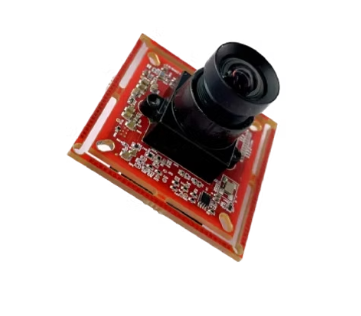
Product Overview
The Bolt-234CGS is a Full HD-capable global shutter module built on the Onsemi AR0234 sensor and validated with NVIDIA Jetson AGX Orin. As a 2MP MIPI CSI-2 Camera, it is built for AGX Orin-based systems that need undistorted frames and consistent color from a compact board. The module combines the sensor, an on-board ISP, and an S-Mount (M12) lens holder with a 74 DFOV lens, and it connects over a 2-lane or 4-lane adapter board. As an AR0234 AGX Orin Global Shutter Camera, it sends finished YUV frames to the platform, and as an AR0234 On-board ISP MIPI Camera, it applies debayering, color correction, denoising, auto exposure, and auto white balance before the frame leaves the module. The 2MP Global Shutter MIPI Camera designation confirms simultaneous exposure across the full frame. It also serves as a 2MP Color MIPI Camera and a 2MP AGX Orin MIPI CSI-2 Camera for designs that need finished color output.
Key Capabilities of the Onsemi AR0234 Global Shutter MIPI CSI-2 Camera for Jetson AGX Orin
Key specs: 2MP (1920 x 1200) Max Resolution | Onsemi AR0234 1/2.6 inch Sensor Format | 3.0 micron Pixel | Color with Global Shutter | 2 Lane and 4 Lane MIPI CSI-2 Interface | S-Mount (M12 Standard) Fixed Focus Optics with 74 DFOV Lens
2MP Global Shutter MIPI Camera Exposure Without Motion Distortion
A global shutter exposes every pixel at the same instant, so a moving subject keeps its shape. Warehouse robots, doorways, and moving vehicles produce motion that would skew a rolling shutter image. As a 2MP Global Shutter MIPI Camera, the Bolt-234CGS delivers geometrically faithful frames to the AGX Orin, so detection, tracking, and measurement work from accurate positions. Large 3.0-micron pixels also gather more light, which helps when exposure must stay short to freeze motion in dim scenes. Teams can confirm the result by recording a moving target at the intended mounting position.
NVIDIA Jetson AGX Orin Compatibility for a 2MP AGX Orin MIPI CSI-2 Camera
Vadzo has validated the module with NVIDIA Jetson AGX Orin, so it works as a 2MP AGX Orin MIPI CSI-2 Camera from the first day of evaluation. The module has also been integrated with Raspberry Pi, NVIDIA Jetson Orin Nano, and NVIDIA Jetson Orin NX-based solutions, which lets teams prototype on familiar hardware and move to AGX Orin without changing the camera. Because the output is finished YUV, the AGX Orin treats the module as a video source, and the platform 's GPU and accelerators are free for perception. Teams should confirm the carrier board connector and choose the matching adapter. Prototyping on a familiar development kit first often shortens the path to a working AGX Orin design.
On-Board ISP Performing Debayering, Demosaicing, and Corrections
The on-board image signal processor finishes the image inside the module. It performs debayering and demosaicing, color correction, contrast correction, gamma correction, denoising, and lens corrections, and the result is an image that looks the same on any host. For an AR0234 On-board ISP MIPI CSI-2 Camera, this means no host ISP profile has to be built or tuned, which saves weeks of engineering effort. The host receives YUV422 frames at 8-bit or 10-bit depth, ready for encoding or inference. Integrators who want to adjust processing can use the available camera controls, including denoising, sharpness, and gamma.
Auto Exposure and Auto White Balance for an AR0234 AE AWB MIPI Camera
Warehouses, stores, and outdoor sites change their lighting through the day, and manual settings cannot follow. Auto exposure adjusts exposure and gain to keep brightness suitable, and auto white balance keeps whites neutral under mixed lighting. As a 2MP Auto White Balance MIPI Camera and an AR0234 AE AWB MIPI Camera, the module applies both inside the ISP, and manual control remains available through software. The controls also include denoising and LED flicker mitigation, which help in spaces lit by LED fixtures. Anti-flicker settings for 50Hz and 60Hz lighting add further protection against banding.
2 Lane and 4 Lane MIPI CSI-2 Adapter Board Variants
The module is a two-board solution, and the adapter board comes in two variants. The 2-lane variant connects directly to Raspberry Pi and NVIDIA Jetson development kits and keeps wiring simple. The 4-lane variant carries more data, which allows faster frame rates, with Full HD at 60 frames per second and VGA at 120 frames per second. Teams choose the variant that matches their carrier board connector and the frame rate they need, and they can change it later without changing the camera board, which protects the investment in lens and enclosure design. The datasheet frame rates apply to the 4-lane variant, so teams that need the highest rates should plan for it.
Compact, Wide Temperature 2MP Color MIPI Camera for OEM Designs
The module measures 38 mm by 38 mm, convertible to 32 mm by 32 mm, weighs 13 grams without the lens, and operates from minus 40 degrees C to 85 degrees C. That range suits robots, outdoor poles, and enclosed retail equipment. As a 2MP Color MIPI Camera with finished output, it supports lens matching, firmware customization, and enclosure design assistance from Vadzo, and teams moving from evaluation to volume can keep the same module and documentation. A wide temperature range also reduces the need for extra thermal protection in many enclosures.
"Jetson AGX Orin gives teams a great deal of compute, and the camera should not waste it. A rolling shutter skews moving subjects, and a raw module adds a tuning job to every project. The Bolt-234CGS was validated to remove both problems. The global shutter exposes the whole frame at once, and the on-board ISP delivers a finished image with auto exposure and auto white balance, so the Orin can spend its power on perception. We are also direct about the trade-off. Tuning lives in the module, so teams that want raw access should talk to us about a raw sensor option. For most warehouse, surveillance, and retail projects, a clean finished image is the faster path. " - Alwin Vincent, Product Manager, Vadzo Imaging.
Application Specific Sections: Global Shutter MIPI Camera Systems in Practice
Warehouse Robotics MIPI Camera and Global Shutter Robotics MIPI Camera Applications
Warehouse robots scan objects and documents, read labels with OCR, and detect obstacles while they move. The Bolt-234CGS works as a Warehouse Robotics MIPI Camera whose global shutter keeps labels and shelf edges straight during motion, and as a Global Shutter Robotics MIPI Camera, it gives navigation and detection software accurate geometry. The same module serves a 2MP Warehouse Robotics Camera role for compact robots with several camera positions around one AGX Orin. Because the lens is fixed focus, the working distance should be matched to the task during evaluation. Robots that need to read at several distances may pair modules with different lenses.
Smart Surveillance MIPI Camera and Global Shutter Smart Surveillance Camera Applications
Smart surveillance covers day and night video recording, smart parking, pedestrian safety, and facial recognition. The module serves as a Smart Surveillance MIPI Camera that records vehicles and people without motion skew, and as a Global Shutter Smart Surveillance Camera, it keeps fast subjects such as passing vehicles undistorted. As a 2MP Smart Surveillance MIPI Camera, it fits AGX Orin recording and analytics nodes, and the wide temperature range suits outdoor installations. Night scenes and recognition at a distance may need supplementary lighting and an optics review. Recorded footage also benefits from the steady color that automatic white balance provides across the day.
Retail Analytics MIPI Camera and Retail Automation MIPI Camera Applications
Retail systems monitor inventory, verify age, analyze demographics, watch shelves, and support self-checkout. The module works as a Retail Analytics MIPI Camera and a Retail Automation MIPI Camera that keeps shoppers and products undistorted as they move, with automatic exposure and white balance that hold color steady under mixed store lighting. As a Global Shutter Retail Analytics Camera, it supports multi-camera shelf and checkout views on one AGX Orin. Age verification and demographic analysis involve privacy rules and consent requirements that belong to the solution provider and the retailer. Inventory and shelf monitoring need no such analysis and rely mainly on image quality.
Frequently Asked Questions About Global Shutter MIPI Camera Systems
Q: What is the difference between a global shutter and a rolling shutter camera?
A:Vadzo Imaging explains it simply: a rolling shutter reads the image row by row, so a fast-moving subject can look skewed, while a global shutter exposes every pixel at the same instant, so moving subjects keep their shape. A 2MP Global Shutter MIPI Camera suits robots, vehicles, and shoppers in motion. A rolling shutter can still be a good choice for slow or still scenes, and Vadzo Imaging offers both so customers can match the shutter to the application, with guidance from its engineers.
Q: Does a MIPI camera with an on-board ISP bypass the NVIDIA Jetson ISP?
A:Yes. A camera with an on-board ISP sends finished YUV frames, so the Jetson treats it as a video source and does not run its own ISP on raw data. That saves the effort of building and tuning an ISP profile and keeps color the same on any host. Teams that want raw access and custom tuning can ask Vadzo Imaging about raw sensor modules, which use the host ISP instead. Either path is valid, and the right one depends on how much control a team wants.
Q: Can one NVIDIA Jetson AGX Orin system run several MIPI camera modules?
A:The platform supports multiple camera inputs, and the number that is available depends on the carrier board and its connectors. A 2MP AGX Orin MIPI Camera needs the adapter board that matches each connector, in either the 2-lane or the 4-lane variant. Vadzo Imaging recommends confirming the lane count, the connectors, and the total bandwidth on the real carrier before planning a multi-camera design. A short bench test with two modules usually reveals any limit quickly.
Q: Is a global shutter worth it for retail analytics and warehouse robots?
A:It is worth it when subjects or camera units move. A Global Shutter Retail Analytics Camera keeps shoppers and products undistorted, and a Global Shutter Robotics MIPI Camera keeps labels and edges straight while a robot moves, so measurements and detections stay accurate. For slow or still scenes, the benefit is smaller. Vadzo Imaging suggests testing with the real motion in the target scene before choosing, since the benefit depends on how fast the scene moves.
Q: Why should OEMs choose Vadzo Imaging as their supplier of AGX Orin compatible camera modules?
A:Vadzo Imaging offers more than a camera module built around a capable sensor. OEMs working with Vadzo Imaging receive a global shutter module with a documented on-board ISP, two adapter board variants, validated integration across Jetson and Raspberry Pi platforms, and honest guidance on when a raw sensor module is the better fit, plus engineering support for lens selection, firmware customization, and enclosure design. Vadzo Imaging maintains evaluation kits with no minimum order requirement, so teams can test on their own carrier boards before committing to volume production.
Availability
The Bolt-234CGS 2MP Color MIPI CSI-2 Camera built on the Onsemi AR0234 sensor is available now for evaluation and production orders. Evaluation kits include the camera module, the 2-lane or 4-lane adapter board, and platform documentation, with no minimum order requirement. Engineering teams can confirm streaming on their own AGX Orin carrier board, check motion handling in their own scenes, and test the on-board ISP controls before committing to a production bill of materials, which tells them more than a datasheet comparison alone. Teams that need a different lens or adapter configuration can ask Vadzo to review the setup. Evaluation also lets teams compare the module 's finished color against their own reference scenes, which is the quickest way to decide between finished and raw output. Browse the full range of MIPI camera options at Vadzo 's website or contact Vadzo at support@vadzoimaging.com to request an evaluation unit or discuss OEM integration requirements for warehouse robotics, smart surveillance, and retail analytics and automation programs.
About Vadzo Imaging
Vadzo Imaging is a global provider of embedded vision solutions and delivers high-performance camera technologies and imaging platforms for applications in robotics, industrial automation, UAVs, edge AI, and medical systems. Its products are designed for seamless integration with leading embedded platforms including NVIDIA Jetson, Rockchip, Raspberry Pi, and NXP i.MX. Vadzo supports customers through hardware customization, firmware development, and module-level drivers, enabling faster development and deployment of vision-based systems across MIPI, USB, GigE, Wi-Fi, and SerDes camera interfaces.
Media Contact
Alwin Vincent
Vadzo Imaging
Email: alwin@vadzoimaging.com
LinkedIn: Vadzo Imaging
YouTube: Vadzo Imaging
X: Vadzo Imaging
SOURCE: Vadzo Imaging
View the original press release on ACCESS Newswire
© 2026 ACCESS Newswire. All Rights Reserved.