



Recreational Fishing Groups Must Stop Blaming Menhaden Fishing for Striped Bass Problems
WASHINGTON, D.C. / ACCESS Newswire / October 21, 2026 /Eight fishing organizations and businesses have filed a petition with U.S. Commerce Secretary Howard Lutnick seeking an immediate emergency prohibition on menhaden reduction fishing in the New York-New Jersey Bight and a permanent seasonal closure from May 1 through December 31 each year.
The Forage Fish Campaign published the petition and an accompanying October 21 press release on its website, with the campaign 's spokesperson named as the media contact. The petition, submitted by Roger Fleming of Blue Planet Strategies, seeks sweeping restrictions on an American commercial fishery without demonstrating that reduction fishing caused the problems alleged or that the proposed closure would remedy them.
The petition 's claim of an imminent October fishing emergency relies partly on reports from organizations opposed to the reduction fishery. On petition page 26, the authors allege increased fleet activity indicating preparations to return to Bight waters. The supporting footnotes cite Facebook posts attributed to Chesapeake Bay Defenders, most linked posts inaccessible to the public, and personal communications with Menhaden Defenders. The petition supplies no verified October landings or documented fishing plans establishing the predicted surge in harvest.
Ben Landry, spokesperson for Ocean Harvesters, said: "We have only fished above Atlantic City one day during the 2026 fishing season." On that occasion, reduction vessels traveled as far as Ambrose Channel while remaining in federal waters. Spotter aircraft routinely survey fish migrations; their presence is not proof that harvesting has occurred or is imminent. The fleet has not found fishable concentrations north of Atlantic City.
Fluctuations in local menhaden availability are a recognized feature of the fishery. The ASMFC recognizes this reality and defines episodic events as times and places where Atlantic menhaden are more abundant than usual and has established a management program to accommodate such occurrences, including in New York waters. Variations in where menhaden appear do not establish that fishing caused a reported local shortage.
The petitioners seek emergency action under circumstances that do not demonstrate an imminent conservation crisis. NOAA Fisheries ' Policy Guidelines for the Use of Emergency Rules require recent, unforeseen events or newly discovered circumstances, a serious conservation or management problem, and immediate benefits sufficient to outweigh the normal public rulemaking process. NOAA 's own explanation of those criteria and the underlying Federal Register guidance (62 FR 44421-44422) make clear that an emergency finding requires an evidentiary record. Their supposed October emergency rests on conjecture about fishing that has not been documented, not evidence of the immediate harm asserted. The emergency they describe appears to exist only in the petitioners ' minds.
The Atlantic States Marine Fisheries Commission (the ASMFC) has determined that Atlantic menhaden are not overfished and overfishing is not occurring. Since 2020, menhaden harvest has been managed using ecological reference points that account for the forage needs of predators, particularly striped bass. Ospreys are also included in the supporting ecosystem model.
The ASMFC 's conclusion directly contradicts the petition 's central premise: Even ending all menhaden fishing would not, by itself, rebuild striped bass to their biomass target. The agency identifies sustainable recreational and commercial striped bass fishing mortality as essential to rebuilding.
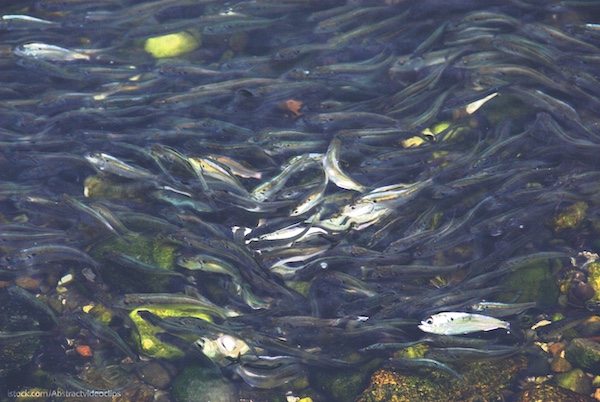
Nor does the evidence support claims that Atlantic menhaden are disappearing. Figure 12 of the ASMFC 's 2025 stock assessment shows that estimated coastwide menhaden biomass in 2023 was roughly twice what it was 50 years ago.
The latest Maryland survey provides further evidence. The Maryland Department of Natural Resources ' October 19, 2026 juvenile striped bass survey documented another year of abundant juvenile Atlantic menhaden. Analysis of the agency 's historical data shows that 2023-2026 produced the strongest four-year average of juvenile menhaden abundance since 1988-1991, even as striped bass spawning success remained below average for the eighth consecutive year.
Meanwhile, recreational fishermen continue to account for most striped bass fishing mortality. According to the ASMFC 's latest figures, recreational fishing accounted for approximately 82% of all striped bass removals in 2025. The ASMFC describes recreational striped bass fishing as predominantly catch-and-release and states: "In 2025, recreational anglers released alive an estimated 11.6 million fish, of which 1.0 million are assumed to have died."
Recreational fishing groups and the recreational fishing industry need to stop blaming the menhaden fishery for striped bass problems that years of excessive fishing mortality helped create. Striped bass remain overfished, and recreational fishing continues to account for most removals. Yet in October 2025, the ASMFC declined to adopt a proposed 12% reduction in commercial and recreational striped bass removals. The Board cited sharply divided public comments and other management considerations. Recreational fishing interests demanding new restrictions on menhaden should explain why they have opposed reducing mortality in the still-overfished striped bass fishery.
American fishermen, union workers, processing employees and coastal communities depend on the menhaden fishery. Their livelihoods should not be jeopardized by unsupported allegations and speculative promises of ecological benefits.
The petitioners need to address the documented mortality in their own fishery before demanding new restrictions on another.
The petition was filed on behalf of the Jersey Coast Anglers Association, Hudson River Fishermen 's Association, Hi-Mar Striped Bass Club, Tackle Box Fishing Company, Karen Ann Charters, My Joyce Fishing Charters, Captain Ron 's Fishermen and Moran 's Dockside.
About the American Small Pelagics Network
The American Small Pelagics Network represents fishermen, processors, suppliers, and coastal communities connected to fisheries such as menhaden, mackerel, herring, squid, and butterfish. ASPN supports sustainable fisheries management that supports critical fish species, while maintaining economic opportunities for fishermen and fishing communities.
Press Contact
Stove Boat Communications
(202) 595-1212
contact@smallpelagics.com
SOURCE: American Small Pelagics Network
View the original press release on ACCESS Newswire
© 2026 ACCESS Newswire. All Rights Reserved.