



DEA Burden of Proof, Missing Rulebooks, and Expert Witness Admissions Threaten Marijuana Rescheduling
WASHINGTON, D.C. / ACCESS Newswire / October 23, 2026 /MMJ International Holdings, Inc. (MMJIH) today called attention to two developments in the federal marijuana rescheduling ALJ proceeding that point to the same problem. The government 's own scientific staff testified that marijuana does not meet the standard DEA applied for more than 30 years. And the government 's own watchdog found that the agencies have no written procedures governing how that standard, or its replacement, is chosen and applied.
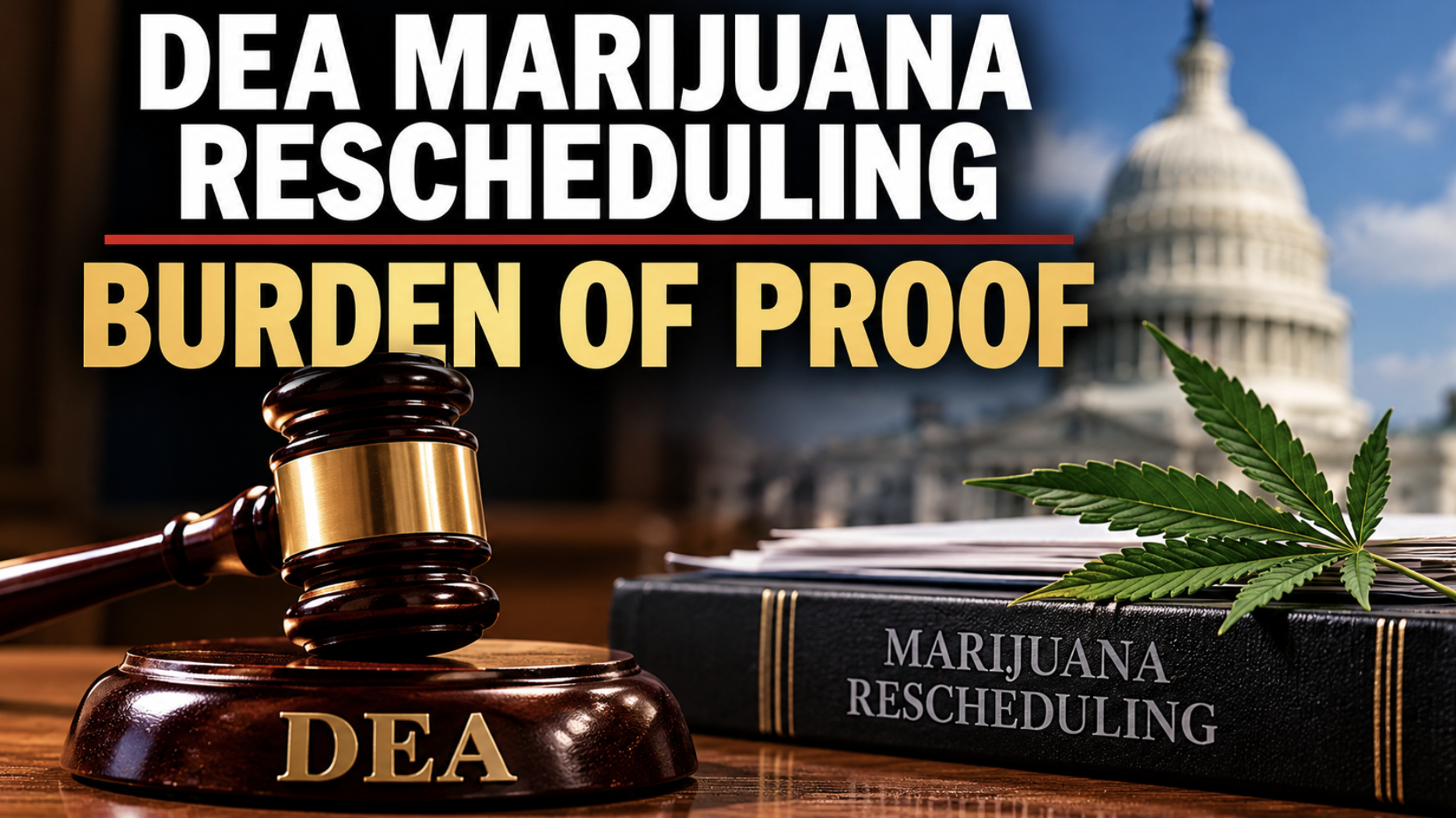
The burden of proof is on the government
Under the Administrative Procedure Act, "the proponent of a rule or order has the burden of proof" (5 U.S.C. § 556(d)). In the hearing before DEA Chief Administrative Law Judge Derek C. Julius (DEA Docket No. 1362, Hearing Docket No. 26-96), the proponent is the Drug Enforcement Administration. The opposing parties do not have to prove that marijuana belongs in Schedule I. DEA has to prove that it does not.
GAO Report: no written rulebook
On September 23, 2026, the Government Accountability Officereleased Drug Scheduling: While DEA Decisions Have Aligned with Recent HHS Recommendations, Both Need Comprehensive Policies (GAO-26-108623). It found:
- DEA does not have policies identifying roles, responsibilities, and procedures for scheduling.
- FDA does not have policies or procedures specifying how its staff conduct evaluations or develop recommendations.
GAO recommended that FDA develop "the criteria and process for determining a substance 's ‘potential for abuse. '" It warned that written procedures matter "especially if key personnel with longstanding subject matter expertise depart." DEA, FDA, and NIH concurred with all three recommendations.
On October 22, Judge Julius admitted the GAO report into the hearing record. Supplemental briefs on its weight are due October 29, and replies are due November 5.
What the absence of written procedures looked like in practice
The hearing transcript shows what happened in the marijuana evaluation when no written procedure governed the choice of standard.
Dr. Dominic Chiapperino, Director of FDA 's Controlled Substance Staff, supervised the scientific evaluation and was called by the government as a witness. He testified that FDA began its work in October or November 2022, before the two-part test existed (Tr. Day 2 at 411:8-18). The new test was "directed" by the Assistant Secretary for Health, formally in July 2023, about two months before the evaluation was finished (Tr. Day 2 at 411:19-413:3). Asked whether the decision to apply it was an FDA determination, he said it was not (Tr. Day 2 at 441:21-442:1). "We are not part of creating either of the tests," he said (Tr. Day 2 at 439:8-11).
He described FDA 's unwritten practice for choosing among methods this way: "If one seems like a better likelihood of reaching CAMU, we would use that test and not worry about the other" (Tr. Day 2 at 414:24-415:1). CAMU is the "currently accepted medical use" finding that a substance needs to leave Schedule I. (CAMU -current accepted medical use)
That is the gap GAO report identified. The standard was changed mid-evaluation, by direction from outside the scientific staff, under a practice that was never written down.
FDA 's supervising scientist: "Would not have passed"
On cross-examination, Dr. Chiapperino was asked whether marijuana would have passed the traditional five-part test, which he has applied in 127 scheduling evaluations (Tr. Day 2 at 416:10-15). He answered: "On the basis of the first element alone, without even consideration of the other two, I do believe that it would have been difficult for marijuana to pass the five part test." Asked to confirm, "Would not have passed, correct?", he replied: "Would not have passed. Sure." (Tr. Day 2 at 436:12-437:14.)
The first element is known, reproducible chemistry. On the first day of the hearing, he agreed with FDA 's finding that "marijuana is not a single chemical with a consistent and reproducible chemical profile or predictable and consistent clinical effects" (Tr. Day 1 at 212:1-8).
He also testified that:
- FDA never completed a five-part analysis (Tr. Day 2 at 426:11-13).
- The clinical studies considered "were not large enough to pass an FDA approval as an adequate, well controlled study" (Tr. Day 2 at 436:16-21).
- The replacement test "is not as rigorous in the standard of evidence" (Tr. Day 2 at 411:1-2).
The government objected to the five-part question as outside the Touhy authorization it had issued for his testimony. Judge Julius allowed it. The government did not move to strike the answer.
A DEA pharmacologist reached the same conclusion
Dr. Luli Akinfiresoye, a pharmacologist in DEA 's Drug & Chemical Evaluation Section, testified under restrictions DEA imposed to limit her cross-examination. She stated that marijuana "is not a substance" as the Controlled Substances Act evaluates drugs. She agreed that it "failed the third factor" of the medical-use analysis. Asked whether the two-part approach made scientific sense to her as a pharmacologist, she answered: "Scientifically, no." (Tr. Day 6 at 1359:19-1360:16; 1365:11-1373:23.)
The road test didn 't change. They just stopped giving it.
"Every driver earns a license the same way: a written test and a road test," said Duane Boise, President and CEO of MMJ International Holdings. "Imagine the DMV dropping the road test halfway through your exam, with no written rule saying it could. Then it issues your license based on how many people are already driving without one. That 's what happened here. GAO found there was no written rulebook. FDA 's own scientist testified the new test came from outside his office, two months before the work was done, and that marijuana would not have passed the old one. The burden is on the government, and its own record can 't carry it. MMJ is not anti-marijuana. We are anti-bad science and anti-fake process."
What GAO did and did not find
GAO reviewed scheduling actions from 2020 through 2025. It found that DEA 's final decisions aligned with HHS recommendations in all 84 cases with a published final rule. GAO did not evaluate the scientific merits of the marijuana recommendation, and it did not find any scheduling decision invalid. Its finding is institutional: the agencies lack written procedures to ensure consistency.
The hearing record shows why that matters in this case.
Where the proceeding stands
During the hearing, Judge Julius questioned on the record whether the Office of Legal Counsel opinion endorsing the two-part test binds the tribunal: "I don 't know that it 's 100 percent settled that OLC opinions or - or orders are binding on this tribunal." (Tr. Day 2 at 442:19-443:6.)
After supplemental briefing closes on November 5, the judge will issue a recommended decision to the DEA Administrator, who makes the final determination. MMJIH is not a party to the administrative hearing. It is a petitioner in consolidated D.C. Circuit litigation challenging the April 2026 rescheduling order (Nos. 26-1106, 26-1130, 26-1136).
About MMJ International Holdings
MMJ International Holdings, Inc. is a pharmaceutical company developing cannabinoid-based medicines exclusively through federal regulatory pathways. MMJ holds two active Investigational New Drug applications, for Huntington 's disease and multiple sclerosis, and FDA Orphan Drug Designation for its Huntington 's disease program. It also holds a DEA Schedule I analytical laboratory registration and has a bulk manufacturing registration application pending with DEA since 2018.
MMJ 's drug product is a finished soft-gel capsule in final dosage form. It is reproducible and stable, and it was manufactured for use in clinical trials. MMJ is seeking to demonstrate its safety and efficacy through FDA-regulated clinical investigation.
Media Contact:
Madison Hisey
mhisey@mmjih.com
203-231-8583
SOURCE:MMJ International Holdings
View the original press release on ACCESS Newswire
© 2026 ACCESS Newswire. All Rights Reserved.