



Vadzo Imaging Validates Onboard ISP on Falcon-521CRS: Onsemi AR0521 Color 5MP Low-Noise USB 3.2 Gen1 Camera for On Camera Image Processing
FORT WORTH, TX / ACCESS Newswire / October 27, 2026 /Vadzo Imaging, a provider of embedded vision camera products for OEMs and system integrators, today announces validation of the on-board ISP on the Falcon-521CRS 5MP Low-Noise USB 3.2 Gen1 Camera for on-camera image processing. Built on the Onsemi AR0521 sensor and part of Vadzo 's USB camera portfolio, the Falcon-521CRS combines low-noise imaging, a high-performance ISP, anti-flicker control, auto exposure, auto white balance, and a choice of video and still formats in a UVC-compliant module. With this validation, Vadzo presents a 5MP Low-Noise Color USB Camera for security and surveillance, retail automation, and medical device programs, together with guidance on what an on-camera ISP does, how to tune it, and what it saves the host.
Why On-Camera Image Processing Matters in a 5MP Low-Noise USB 3.2 Gen1 Camera
Every camera has to turn raw sensor data into a usable picture, and the way it does so affects the whole product. The raw data from a color sensor carries one color value per pixel, arranged in a pattern. Making a full color image from it requires interpolating the missing values, correcting colors so that whites look white and skin looks natural, adjusting contrast and gamma for the display, reducing the noise that appears in dim scenes, and correcting the distortions of the lens. Exposure and white balance must also follow the scene, which changes with the hour and the weather. Each of these steps is a place where a poorly tuned pipeline loses quality.
When this work is left to the host computer, every host becomes part of the image quality. A small computer must find the processing capacity, and the processing must be tuned for the particular sensor and lens. Two products built on different hosts, or on different versions of the same software, can produce visibly different pictures from the same sensor. Teams that lack imaging expertise often accept noisier or less accurate pictures than the sensor can deliver, and teams that have it spend engineering weeks on tuning instead of on the product. A Host Offload Image Processing Camera moves that effort into the camera, where it is done once and delivered the same way to every host. Fleets that mix hosts and operating systems benefit most from that consistency, since one set of settings serves every unit and every platform.
Light adds its own difficulty. Fluorescent and LED lamps flicker at twice the mains frequency, and a camera with the wrong exposure time shows dark bands rolling through the picture. Mains frequency differs between regions, so a product shipped worldwide needs both settings. Scenes also mix bright and dark regions, so exposure and white balance must adapt continuously. An Embedded Image Processing USB Camera that handles these tasks in hardware keeps the picture steady while the host runs its application. Installers also avoid the site visits that exposure and flicker problems often cause.
Formats and stills complete the list. Video can be delivered uncompressed, which keeps every detail and uses a great deal of bandwidth, or compressed, which saves bandwidth and adds artifacts. Stills for records and review need their own formats. Teams that discover these choices only after integration must revisit the pipeline, which costs time on every product variant. A clear decision on formats at the start of a project avoids that rework.
How a 5MP Low-Noise USB 3.2 Gen1 Camera Processes Images Onboard
The Falcon-521CRS is built on the Onsemi AR0521, a 5MP (2592 x 1944) color rolling shutter sensor with a 1/2.5 inch optical format and 2.2 micron pixels. Pixel size is the first lever on noise. A larger pixel collects more photons in a given exposure, and in dim scenes the arrival of photons is itself a source of noise that improves as the signal grows. The sensor also uses a back-illuminated pixel structure that improves light collection further. This makes the module an AR0521 Low Noise USB Camera and an AR0521 5MP Low Noise USB Camera that starts from a stronger signal, which is the most effective way to reduce noise before any processing. A 5MP frame on 2.2-micron pixels is also a deliberate balance, since far more pixels of the same size would need a larger and costlier sensor.
The on-board ISP does the rest. It performs debayering, demosaicing, color correction, contrast correction, gamma correction, denoising, and lens corrections, and it supports automatic exposure and automatic white balance. In this form the module is an AR0521 On-board ISP USB 3.2 Gen 1 Camera and a 5MP On-board ISP Camera, and it is also an AR0521 On-board ISP USB Camera for teams that search by that name. The ISP is also tunable. UVC controls expose brightness, exposure, contrast, sharpness, saturation, gamma, gain, white balance, and denoising, so a team can adjust the look from application software, which makes the module an On-Camera Image Tuning USB Camera without any change to the host pipeline. Teams can start from the defaults and adjust one control at a time while watching the real scene.
A little arithmetic shows why the module offers both uncompressed and compressed video. UYVY uses two bytes per pixel. A 1080p frame is about 4.1 megabytes, so 60 frames per second needs about 249 megabytes per second, or about 2 gigabits per second. A full 5MP frame is about 10.1 megabytes, so 30 frames per second needs about 302 megabytes per second, or about 2.4 gigabits per second. USB 3.2 Gen1 has a nominal rate of 5 gigabits per second and a lower practical throughput, so these uncompressed streams fit, and faster 5MP rates would not. MJPEG compresses each frame, which cuts the data rate several times over and leaves room for other devices on the bus, at the cost of some compression artifacts. Teams choose the format that suits the analysis and the link. Recording the same scene in both formats takes only a few minutes and often settles the question.
Anti-flicker is the other control worth explaining. Mains lighting flickers at twice the supply frequency, which is 100Hz on a 50Hz supply and 120Hz on a 60Hz supply, so the flicker period is 10 milliseconds or about 8.3 milliseconds. Setting the exposure time to a multiple of that period averages the flicker away and removes banding. The ISP applies the right setting for either supply, and teams set the region in software. The sensor reads the image row by row, so the module uses a rolling shutter, which suits most scenes and can show slight skew on fast motion. The module is UVC compliant, enumerates on Windows, Linux, and macOS without a proprietary driver, and uses a fixed-focus S-Mount (M12) lens holder. Because the lens is fixed focus, the working distance should be chosen and verified during evaluation.
Consistency across units deserves a closer look, because it is the main practical benefit of an on-camera ISP. Two modules from the same production lot share the same sensor, the same ISP, and the same default settings, so their output matches closely, and a team that tunes the look once can apply the same settings to every unit. A host-side pipeline offers no such guarantee, since each host adds its own version of the software and its own load. For a retailer with hundreds of stores or a clinic group with many instruments, matching pictures make review easier and make analytics more predictable. The trade-off is that the tuning lives in the module and in its UVC controls, so teams that want unusual processing, such as a custom color matrix, should discuss their needs with Vadzo early, either to use the controls creatively or to choose a raw sensor module that leaves the processing open.
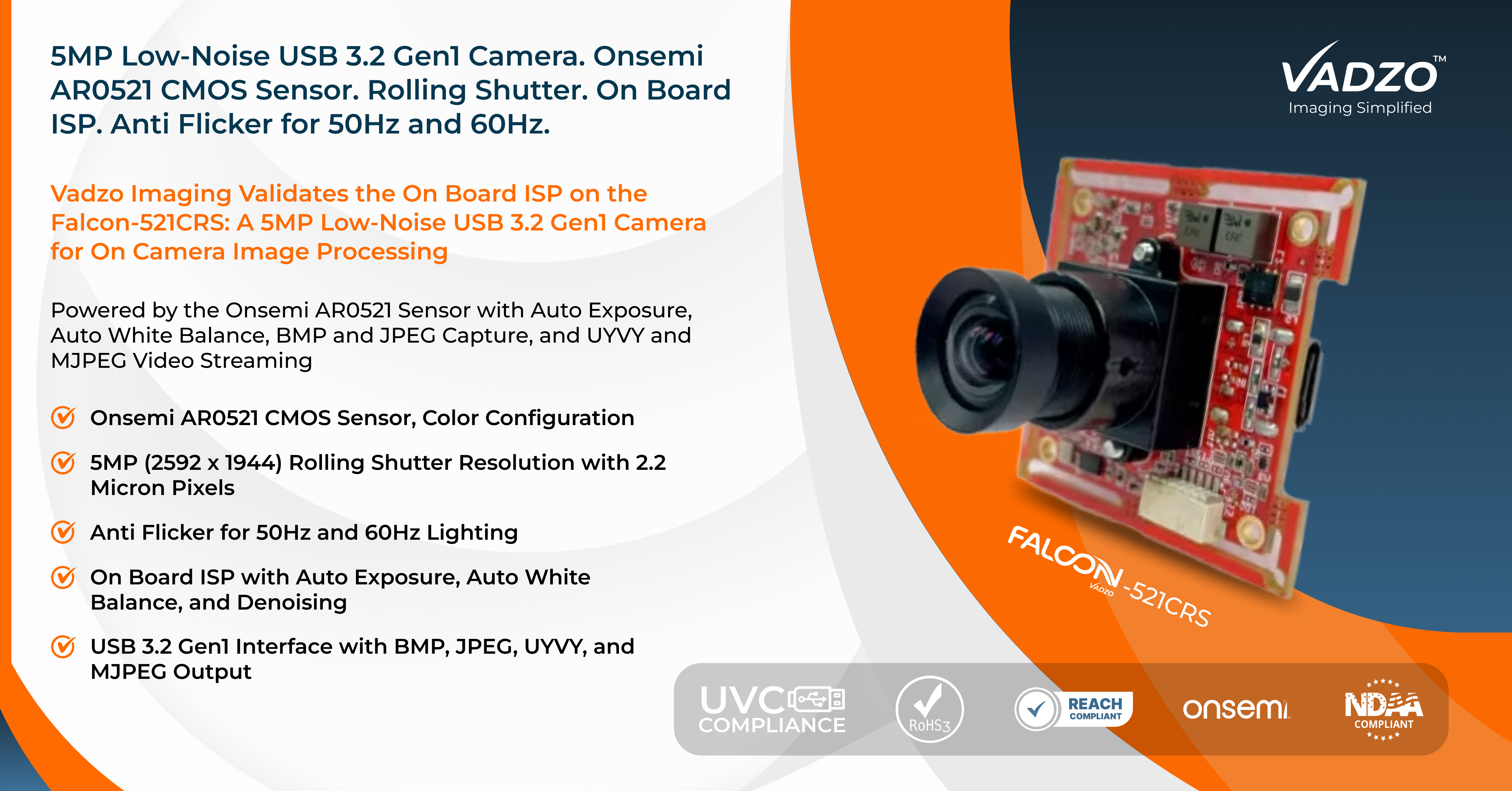
Product Overview
The Falcon-521CRS is a 5MP color USB module built on the Onsemi AR0521 sensor and validated for on-camera image processing. As an AR0521 Low Noise USB Camera, it starts with large pixels and low noise, and as an AR0521 5MP Low Noise USB Camera, it delivers the full 2592 x 1944 frame. The 5MP Onboard ISP USB Camera designation covers the finished image processing inside the module, and the 5MP USB 3.2 Gen 1 Camera designation covers its standard USB interface. The module combines the sensor, the ISP, and a USB 3.2 Gen1 controller with an S-Mount (M12) lens holder. It also serves as an AR0521 5MP Color USB Camera, an AR0521 Color Low Noise USB Camera, an AR0521 Color USB 3.2 Gen 1 Camera, and an AR0521 Rolling Shutter USB Camera for designs that need a standard interface.
Key specs: 5MP (2592 x 1944) Max Resolution | Onsemi AR0521 1/2.5-inch Sensor Format | 2.2-micron Pixel | Color with Rolling Shutter | USB 3.2 Gen1 Interface | S-Mount (M12) Fixed Focus Optics
Key Capabilities of the 5MP Low-Noise USB 3.2 Gen1 Camera
Rolling Shutter Performance and Motion Considerations
The sensor reads the image row by row, which gives high resolution and good low-light sensitivity at reasonable cost. For most scenes, including people at a counter, shelves, and instruments at rest, the effect is invisible. Fast-moving subjects can show slight skew, and short exposures reduce it. Vadzo offers global shutter modules in its portfolio for scenes where fast continuous motion is the main concern, and teams can compare the two on their own footage. Many shops, counters, and instruments do not need that, and the rolling shutter serves them well.
Onboard ISP for Image Processing and Tuning
The image signal processor turns raw sensor data into a finished color image inside the module. It performs debayering, demosaicing, color correction, contrast correction, gamma correction, denoising, and lens corrections. A 5MP Onboard ISP Camera of this kind delivers the same look on every unit and every host, which keeps a fleet consistent. Teams that need raw data and custom tuning should discuss a raw sensor module with Vadzo instead, and for most projects a finished image shortens the path to a working product. Teams that tune the look through the UVC controls can still reach the picture they want without touching the pipeline.
Anti-Flicker Control for 50Hz and 60Hz Lighting
Fluorescent and LED lamps flicker at twice the supply frequency, and a mismatched exposure shows dark bands rolling through the picture. The ISP offers anti-flicker settings for 50Hz and 60Hz supplies, so one hardware design serves every region. Products that ship worldwide set the frequency in software, and installers do not need to change hardware. A short recording under the real lamps confirms that the bands are gone. The setting can be changed in software if a unit moves to a region with a different supply.
Automatic Exposure and White Balance Control
Scenes change with the hour, the weather, and the lamps. Auto exposure adjusts exposure and gain so brightness stays suitable, and auto white balance keeps whites neutral under daylight, LED, and mixed lighting. As a 5MP AE AWB USB Camera, the module applies both inside the ISP, and an AR0521 AE AWB USB Camera keeps a site looking consistent through the day. The same logic makes it an AR0521 Auto Exposure Camera, a 5MP Auto Exposure USB 3.2 Gen 1 Camera, an AR0521 Auto White Balance Camera, and a 5MP AWB USB 3.2 Gen 1 Camera. Manual control remains available for fixed lighting. Starting with the automatic settings is usually the quickest route to a working prototype.
BMP and JPEG Still Image Capture
Records and reviews often need a single frame, not a video. The module captures stills in BMP and JPEG. BMP preserves every pixel without compression, which suits measurement and archiving, and JPEG compresses the image to a much smaller file, which suits review, sharing, and storage. Teams choose the format that suits the task, and many capture BMP for the record and JPEG for the preview. The capture is triggered from software, so applications can take a still at the exact moment they need it, such as when a sensor trips, a customer scans an item, or an operator presses a key.
UYVY and MJPEG Video Streaming Options
The module streams video in YUYV and in MJPEG. UYVY is uncompressed, so every pixel reaches the host intact, which suits analysis that depends on fine detail and uses more bandwidth. MJPEG compresses each frame, which saves bandwidth and storage and suits recording and live viewing, with some artifacts. A short comparison on the real scene with the real software shows whether the artifacts matter. Systems that analyze fine detail usually prefer YUYV, and systems that record for long periods usually prefer MJPEG.
Full HD and 5MP Resolution Modes
Many applications run at Full HD, because it gives enough detail for most analysis while keeping data and processing manageable. As a Full HD USB Camera Module and a 1080p Full HD USB Camera Module, the Falcon-521CRS streams Full HD and also offers the full 5MP frame for work that needs more detail. As an AR0521 USB Camera Manufacturer, Vadzo supports lens matching, firmware customization, and enclosure design for volume programs. Teams moving from evaluation to production keep the same module and documentation throughout, and the same controls carry over from the first prototype to the final product.
"Every camera processes its images somewhere. The question is who does the work and how consistently it is done. The Falcon-521CRS was validated with a capable ISP inside the module, so color, exposure, noise reduction, and anti-flicker are handled the same way on every unit and every host. The UVC controls let customers tune the look from their own software, and the BMP, JPEG, YUYV, and MJPEG formats let them choose the right balance of detail and bandwidth. We are also clear about the limits. A rolling shutter suits most scenes, and teams that want raw data and their own tuning should talk to us about a raw sensor module. " - Alwin Vincent, Product Manager, Vadzo Imaging.
Consistent Image Processing Application
Security Monitoring with Consistent Color and Exposure
Security systems run many camera units on many hosts, and consistent pictures make review and analytics easier. The Falcon-521CRS works as a 5MP AE AWB USB Camera that keeps exposure and color steady from afternoon to night, with anti-flicker settings that remove banding under fluorescent and LED lighting. Low-noise imaging helps recorded video compress into smaller files, and the ISP 's consistency means a site looks uniform across positions, even when units are installed in different phases. Reviewers then compare footage from different units without adjusting for differences in color or brightness.
Retail Imaging for Shelf Monitoring and Product Recognition
Stores mix daylight, LED fixtures, and bright displays, and product colors must look right. The module serves as an AR0521 Auto White Balance Camera that keeps colors neutral under mixed lighting and keeps exposure steady as the light changes. Anti-flicker settings suit stores in any region, and a clean, correctly exposed picture also helps shelf analytics tell products apart. A small computer at the shelf or counter is spared the cost of color and exposure processing. Chains that standardize on one module also simplify spares and training across stores.
Low-Noise Imaging for Medical and Laboratory Devices
Medical and laboratory devices need clean, consistent color from small and often dim subjects. The module functions as an AR0521 Color Low Noise USB Camera in instruments such as digital microscopes and handheld imaging devices, with BMP stills for records and a finished image that looks the same on every host. Device makers remain responsible for illumination, performance claims, and the regulatory pathway of the finished device. Fixed illumination around the subject helps keep color steady between captures.
Frequently Asked Questions
Q: What is on-camera image processing, and why does it matter?
A:Vadzo Imaging explains it simply: raw sensor data is not a picture, and turning it into one takes color correction, noise reduction, exposure control, and white balance. When the camera 's ISP does that work, the result is the same on every unit and every host, and the computer does not have to be tuned for the sensor. An Onboard Image Processing Camera therefore saves integration effort and keeps a fleet of camera units consistent. An Embedded Image Processing USB Camera of this kind also lets a small computer spend its capacity on the application instead.
Q: Does an on-board ISP reduce the load on the host computer?
A:It reduces the work the host must do on raw data, because the host receives finished frames. The host still decodes compressed video if MJPEG is used, and YUYV needs no decoding at all. Vadzo Imaging recommends measuring processor use on the real host with the real format, since the result depends on both. A Host Offload Image Processing Camera helps most on small computers with limited capacity, and a short test shows how much headroom the team gains.
Q: What does anti-flicker do at 50Hz and 60Hz?
A:Mains-powered lights flicker at twice the supply frequency, which is 100Hz on a 50Hz supply and 120Hz on a 60Hz supply. A camera whose exposure does not match shows dark bands rolling through the picture. Anti-flicker sets the exposure time to a multiple of the flicker period, which averages the flicker away. Vadzo Imaging recommends setting the frequency in software, so one product can serve every region without a hardware change.
Q: Which still format should a team capture, BMP or JPEG?
A:It depends on the task. BMP stores every pixel without compression, which suits measurement and archives, and produces large files. JPEG compresses the image to a much smaller file, which suits review, sharing, and storage, with some loss of detail. Many teams capture BMP for the record and JPEG for the preview. Vadzo Imaging suggests testing both with the real subject before choosing, since the best format depends on how the images are used.
Q: Why should integrators choose Vadzo Imaging as their 5MP USB 3.2 Gen 1 Camera manufacturer?
A:Vadzo Imaging offers more than a camera module built around a capable sensor. Integrators working with Vadzo Imaging receive a module with a tunable on-board ISP, anti-flicker control, and four video and still formats, along with candid guidance on what on-camera processing does and does not change, plus engineering support for lens selection, firmware customization, and enclosure design. Vadzo Imaging maintains evaluation kits with no minimum order requirement, so teams can test on their own host before committing to volume production.
Availability
The Falcon-521CRS 5MP Low-Noise USB 3.2 Gen1 Camera built on the Onsemi AR0521 sensor is available now for evaluation and production orders. Evaluation kits include the camera module, S-Mount fixed focus lens, USB 3.2 Gen1 cable, and platform documentation, with no minimum order requirement, so a team can place a unit at the real position and run it for a full working day. Teams can tune the ISP controls from their own software, compare YUYV and MJPEG with their own analysis, and confirm anti-flicker under their own lamps before committing to a production bill of materials, which tells them more than a datasheet comparison alone. Teams that need a different lens can ask Vadzo to review the configuration. Browse the full range of USB camera options at Vadzo 's website or discuss OEM integration requirements for security, retail, and medical device programs.
About Vadzo Imaging
Vadzo Imaging is a global provider of embedded vision solutions and delivers high-performance camera technologies and imaging platforms for applications in robotics, industrial automation, UAVs, edge AI, and medical systems. Its products are designed for seamless integration with leading embedded platforms. Vadzo supports customers through hardware customization, firmware development, and module-level drivers, enabling faster development and deployment of vision-based systems across USB, MIPI, GigE, Wi-Fi, and SerDes camera interfaces.
Media Contact
Alwin Vincent
Vadzo Imaging
Email: alwin@vadzoimaging.com
LinkedIn: Vadzo Imaging
YouTube: Vadzo Imaging
X: Vadzo Imaging
SOURCE: Vadzo Imaging
View the original press release on ACCESS Newswire
© 2026 ACCESS Newswire. All Rights Reserved.