



e2e-assure Sets Out a Maturity Test for AI SOCs and Argues Most of the Market Is Stuck at Stage One
Oxfordshire, United Kingdom--(Newsfile Corp. - August 21, 2026) - SOC-as-a-service provider e2e-assure has published a maturity framework for artificial intelligence security operations centres, arguing that the term "AI SOC" has been applied so broadly that it no longer tells a buyer anything useful about capability. The company sets out three stages, reactive, proactive and predictive, and contends that most platforms marketed as AI SOCs today sit at the first stage.
The framework arrives as security leaders face a market where the AI SOC label is attached to products that do very different things beneath the surface, from tools that only summarise alerts to services that hunt on a customer's own exposure. e2e-assure argues that the useful question is not whether a provider uses AI, but what the AI actually does, how its conclusions are checked, and who remains accountable for the decision.
The three stages
The framework separates AI SOCs by the question each one can answer:
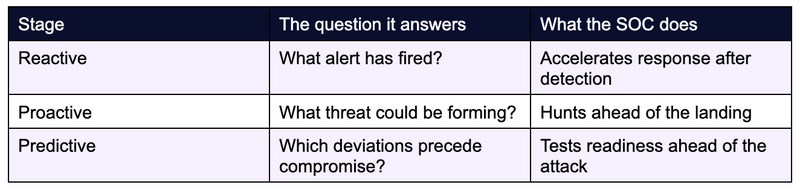
e2e-assure Sets Out a Maturity Test for AI SOCs and Argues Most of the Market Is Stuck at Stage One
To view an enhanced version of this graphic, please visit:
https://images.newsfilecorp.com/files/8814/310759_6a116465c46478ee_002full.jpg
A reactive AI SOC accelerates what happens after detection: enriching alerts, summarising evidence, cutting false positives and recommending next steps. e2e-assure says this is already ahead of manual triage, but the model remains event-driven and answers an attack only after it has started.
A proactive AI SOC does not wait for a high-confidence alert. It generates hypotheses from new intelligence and the customer's own exposure, enriches weak signals and validates detection coverage, shifting the question from what alert has fired to what threat could be forming.
A predictive AI SOC, the company is careful to note, does not claim to predict breaches. It uses estate-specific baselines, cross-domain correlation and digital twin simulation to identify deviations from known-good behaviour and emerging attack paths that precede compromise, then tests readiness against them before production is at risk.
Rob Demain, Chief Executive Officer and Founder of e2e-assure, said:
"Almost everyone in this market now says AI SOC, and the operating models underneath differ wildly. A tool that summarises alerts is reactive, whatever the label on the box says. A service that hunts on your own exposure is proactive. A model trained on your environment that simulates attack paths before they are exploited is predictive. Our honest reading is that most of the market is still at stage one. We published the curve so buyers can ask a provider where they sit, and demand the evidence that backs the answer."
Rob Demain added:
"The framework applies to us as much as anyone. We are not asking security leaders to take a claim on trust. We are asking them to insist on proof, from every provider they consider, including us. AI creates speed. Human judgement creates accountability. A credible AI SOC is built on both, and it should be able to show you which is which."
Speed with accountability, and a sovereignty line
e2e-assure frames the AI SOC as an operating-model question rather than a tooling one. In its model, AI performs the first pass on every signal, correlating data, filtering noise, scoring threats and assembling evidence, while human analysts confirm the incident, decide the response and take accountability. A verification step checks AI conclusions against deterministic evidence before an analyst sees them, so a confident but unsupported claim is flagged, qualified or suppressed.
The company also draws a line on data sovereignty, noting that security telemetry is among the most sensitive data an organisation produces and that many AI security platforms move it offshore at some point in the pipeline. For regulated sectors and critical national infrastructure, e2e-assure argues, sovereign or local models are increasingly the requirement rather than the premium option, and it runs its own AI on UK-based infrastructure for that reason.
The full framework is set out in the company's guide, AI SOC Explained: From Reactive Monitoring to Predictive Cyber Defence, at https://e2e-assure.com/ai-soc/.
About e2e-assure
e2e-assure is a UK-sovereign managed security operations provider specialising in threat detection and response across IT and operational technology environments. The company delivers 24/7 SOC services staffed exclusively by SC-cleared, UK-based analysts, powered by its proprietary AI SOC platform, CUMULO. e2e-assure supports operators of critical national infrastructure and organisations in regulated sectors, helping them meet frameworks including NIS2, the Cyber Assessment Framework, and IEC 62443. Learn more at https://e2e-assure.com.
To view the source version of this press release, please visit https://www.newsfilecorp.com/release/310759
Source: Plentisoft
© 2026 Newsfile Corp. All rights reserved.