



Scotia Metals Identifies Five Spodumene Boulder Trains Grading Up to 3.40% Li2O at its Acadia Lithium Project, Less Than 8 Kilometres Up-Ice of the Brazil Lake Deposit
Highlights
Scotia Metals has identified 32 high-grade spodumene boulders assaying 1.0% to 3.40% Li₂O, including seven samples between 2.00% and 3.40% Li₂O across five discrete boulder trains defined over an area of approximately 3 km by 1 km at the Acadia Project's Green Wolf target.
The Company controls the majority of ground to the North and South of Brazil Lake, Nova Scotia's only known spodumene deposit.The Acadia Project comprises 43 exploration licences covering 37,268 hectares and 2,320 mineral claims, spanning more than 80 kilometres of prospective LCT (lithium, cesium, tantalum) pegmatite strike on trend to the north and south of Brazil Lake.
Scotia's team believes the up-ice arithmetic points to a local source.Documented glacial transport distances of spodumene boulders at the Brazil Lake deposit are typically from 50m away to <1 kilometre (700m). Green Wolf spodumene boulders are located less than 8 kilometres up-ice of Brazil Lake, indicative of a potential new LCT pegmatite swarm. The boulders are angular, fresh and largely unweathered, with fresh coarse-grained spodumene crystals showing salmon-pink UV fluorescence, characteristics interpreted to potentially indicate proximal bedrock sources within the Company's licences.
The Acadia Project has excellent access to infrastructure, making it among the best-served lithium projects in North America.Shelburne Port (13m draft) is one hour by paved highway; Yarmouth Port is 15 minutes; grid power runs within approximately 14 kilometres of the project; water is readily available across the Project; the temperate coastal climate permits year-round drilling. Halifax is approximately 300 kilometres away.
Highly experienced leadership team.Scotia's directors and officers have significant successful track records in mining exploration and development and have built or implemented hard-rock lithium operations on four continents.
48,582,740 shares outstanding on a fully diluted basis. A concurrent financing of $5.8 million was completed on listing. The Company is funded through completion of the current target-definition program.
Lithium prices have recovered sharply. Lithium 6% Li₂O concentrate traded at US$2,240/t on 18 August 2026, with prices sustaining an upward trend above US$1,800/t since January 2026.
Hard-rock spodumene offers an established and scalable development pathway. Hard rock lithium projects use conventional mining and processing methods, provide directly measurable grades, and are not dependent on evaporation or climate conditions for lithium recovery.
Vancouver, British Columbia--(Newsfile Corp. - August 27, 2026) - Scotia Metals Corp. (CSE: SMET) ("Scotia" or the "Company") today reported results of first-pass prospecting at its 100%-owned Acadia Lithium Project in southwestern Nova Scotia, where five high-grade spodumene boulder trains grading up to 3.40% Li₂O have been identified less than 8 kilometres up-ice of Brazil Lake, the only proven spodumene deposit in the province.
"The Acadia Project shows the same geological signature I have seen on other projects I was involved in, particularly at Grota do Cirilo and Bandeira. Coarse, angular spodumene in surface float has been the first evidence of pegmatite swarms that later supported operating mines at systems I have worked on. What matters at Green Wolf is the behaviour right next door: glacial transport at Brazil Lake is documented from as far as 50 metres to less than a kilometre, and Green Wolf's boulders sit less than eight kilometres up-ice, on the same regional trend as Brazil Lake, in five separate aligned trains rather than one. It points to multiple bedrock sources, typical of LCT pegmatite swarms, and it points to them being on our ground. Detailed till sampling and geophysics will tell us where to put the first hole."
— Brian Talbot, Chairman, Scotia Metals Corp.
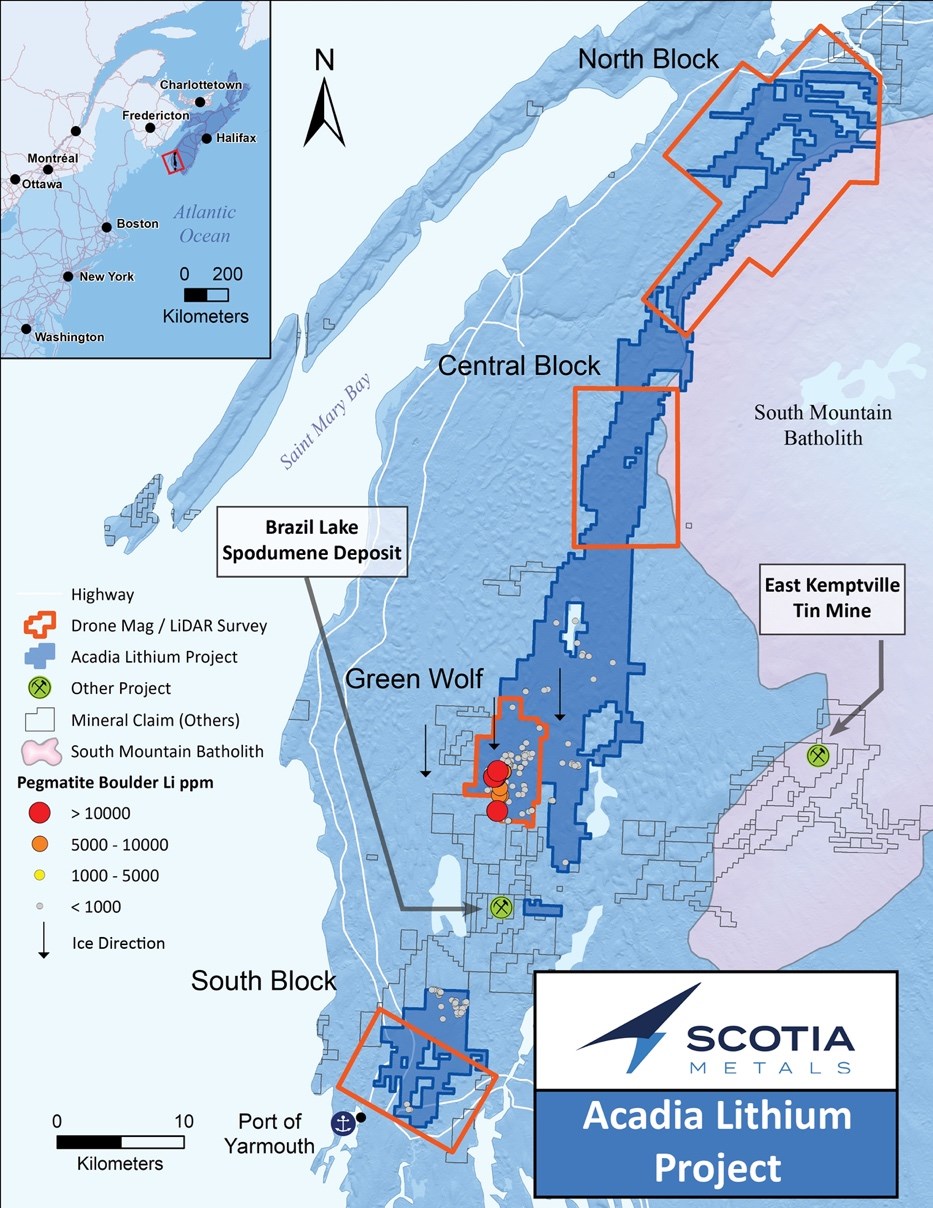
Fig 1: Scotia Metals' Acadia Project comprises 43 exploration licences covering 37,268 hectares and 2,320 mineral claims, spanning more than 80 kilometres of prospective LCT (lithium, cesium, tantalum) pegmatite strike on trend to the north and south of the Brazil Lake Lithium Deposit.
To view an enhanced version of this graphic, please visit:
https://images.newsfilecorp.com/files/7276/311748_2bb25478b4333960_002full.jpg
Priority Target: Green Wolf
Multiple spodumene-bearing boulder trains have been identified at Green Wolf through first-pass prospecting. At least five trains have been defined over an approximately 3 km by 1 km area, comprising 32 samples grading 1.0% to 3.40% Li₂O, of which seven returned between 2% and 3.40% Li₂O. Individual spodumene crystals show salmon-pink UV fluorescence, consistent with fresh, largely unweathered, high-grade spodumene.
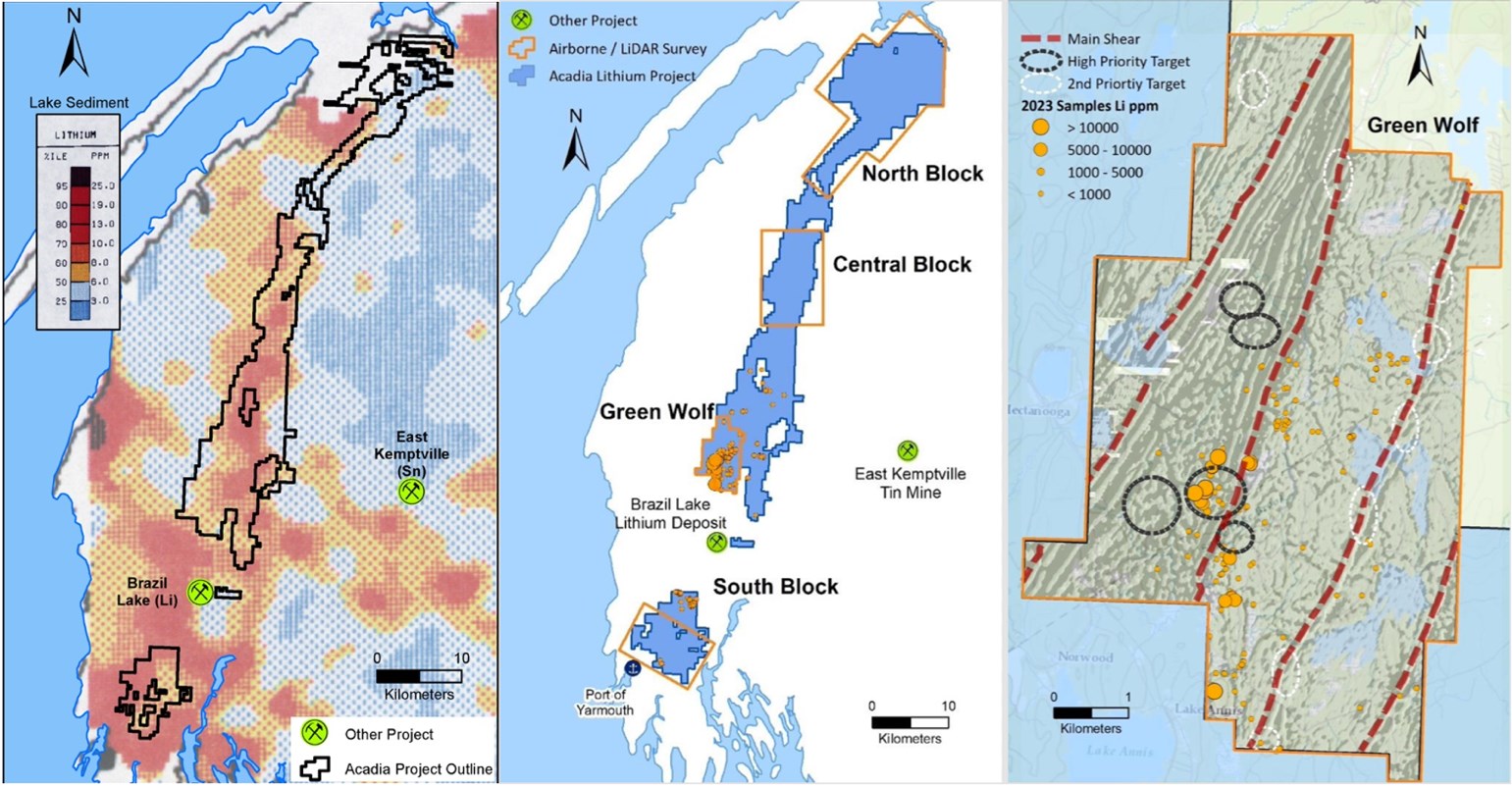
Fig 2: Far left: Government lake-sediment geochemistry, geophysical structure and geophysics targets across the Acadia Project. Middle & Right: First-pass prospecting at the Green Wolf target identified at least 5 spodumene-bearing boulder trains, with samples grading up to 3.4% Li2O.
To view an enhanced version of this graphic, please visit:
https://images.newsfilecorp.com/files/7276/311748_2bb25478b4333960_003full.jpg
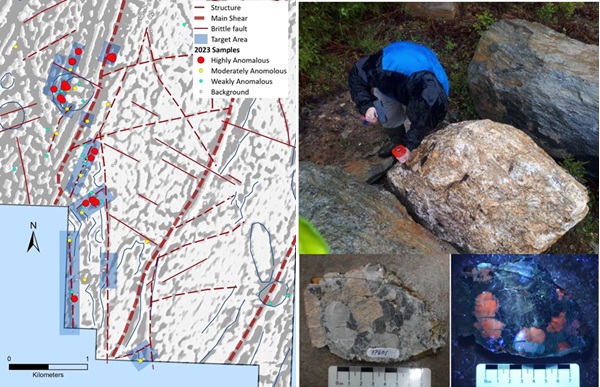
Fig 3 (Left): Boulder trains identified at the Green Wolf target aligned along and coincident with north to northeast striking structural trends, which are similar to the Brazil Lake pegmatite trend. (Right, above): A large, angular spodumene boulder discovered at the Green Wolf target. (Right, bottom): Green Wolf spodumene-bearing boulder sample exposed to UV light (spodumene glows salmon pink under UV light).
To view an enhanced version of this graphic, please visit:
https://images.newsfilecorp.com/files/7276/311748_scotia1.jpg
Most boulder trains are aligned along and coincident with north-northeast structural trends which match both the regional structural fabric and the Brazil Lake pegmatite trend. Documented glacial transport distances of spodumene boulders at the Brazil Lake deposit are typically from 50m away to <1 kilometre (700m). Green Wolf lies less than 8 kilometres up-ice of that deposit, indicative of potential new LCT pegmatite sources. Taken together with the angular, unweathered character of many of the boulders, the Company interprets the source LCT pegmatites could potentially lie within the Acadia Project's land package. Glaciation is why the target exists: the ice sheet stripped and dispersed the bedrock, leaving a debris trail that could point back to its source.
Independent datasets, including government lake-sediment geochemistry, geophysical structural and radiometric anomalies, high-resolution LiDAR, and till sampling, converge on the same area, defining multiple first- and second-order targets at Green Wolf, none of which has been drill tested.
The District: One Proven Spodumene Deposit, 80 Kilometres of Untested Strike
Nova Scotia has historically been explored for gold and tin, with minimal modern lithium exploration. The Brazil Lake deposit is the only known spodumene deposit in the region, and the Company believes it could potentially be part of a larger provincial system that is fertile and capable of hosting multiple sources of economic lithium mineralization. Brazil Lake hosts three known spodumene-rich dykes (part of a larger swarm), in a setting consistent with other major global LCT pegmatite Provinces.
Scotia controls most of the claims along strike of Brazil Lake to both the north and south, sharing the same host-rock geology and structural architecture. The Company's land package spans more than 80 kilometres of prospective strike across 43 licences, 37,268 hectares and 2,320 mineral claims, and is located on the U.S. East Coast EV and battery supply-chain corridor.
Infrastructure: Established Port, Power and Paved Road
Most emerging hard-rock lithium districts share one major economic hurdle: the ore body lacks adequate infrastructure and sits far from port, so the deposit itself must fund that infrastructure. That requirement raises the tonnage, and grade a project must prove up before it can be financed, and it lengthens the path from discovery to a construction decision.
Acadia has excellent access to infrastructure. Shelburne Port, a one-hour drive from the Project, offers a 13-metre draft suitable for deep-water vessels and barges; Yarmouth Port is a 15-minute drive away; and Halifax Port, approximately 312 kilometres away, offers a 17-metre draft with year-round ice-free operation and global shipping and rail connectivity. The Project is served by Halifax International Airport and Yarmouth Airport, an extensive paved road network crossing the Project and right next to Green Wolf, ample water, and a major transmission line approximately 14 kilometres from the Project. The temperate coastal climate permits drilling twelve months a year.
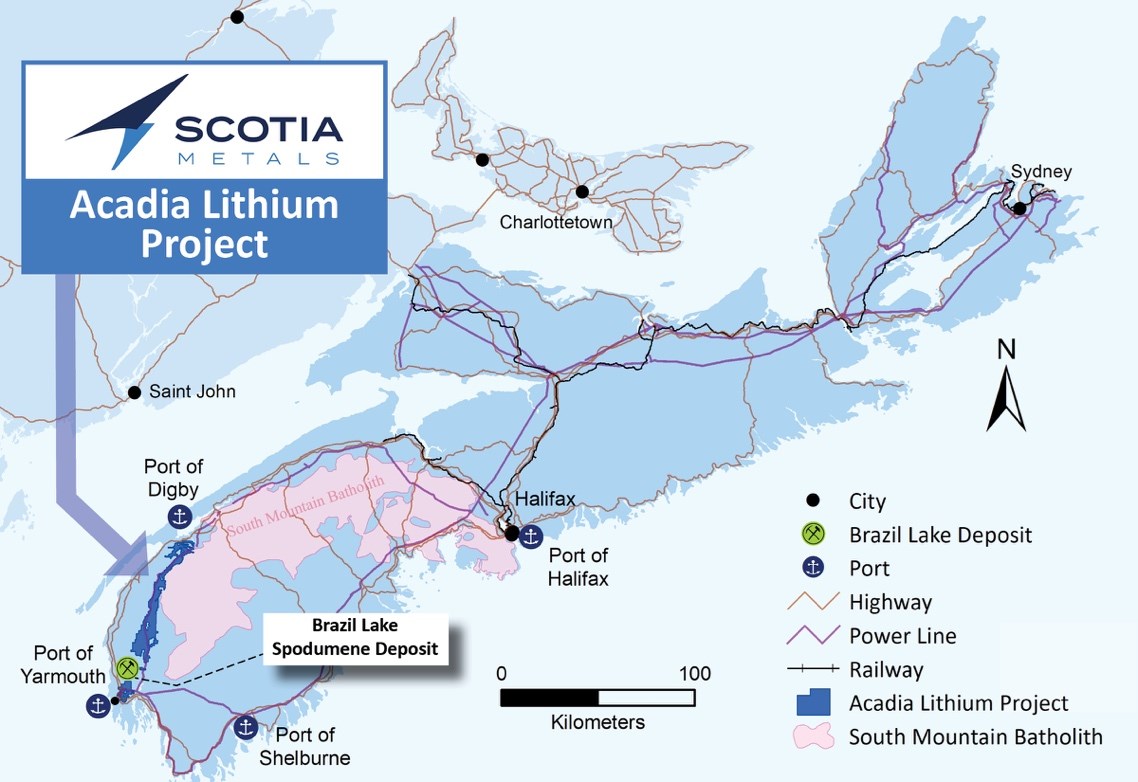
Fig 4: The Acadia Project offers a rare combination of exploration upside and development-ready logistics in a Tier-1 jurisdiction ~300 km from the City of Halifax
To view an enhanced version of this graphic, please visit:
https://images.newsfilecorp.com/files/7276/311748_2bb25478b4333960_006full.jpg
Nova Scotia has identified critical minerals as a priority sector, and supports the industry through the NovaMINE permitting portal, the Mineral Resources Development Fund, and the provincial Capital Investment Tax Credit.
"Brazil Lake has one proven spodumene deposit, and we own the ground on both sides of it. Our task over the next few months is a clear one: turn the boulder trains into ranked bedrock targets using till sampling and geophysics, before we spend a dollar on a rig. This team has built lithium operations on four continents and has taken juniors to acquisitions, and we would rather be measured on what we deliver than on what we describe."
— Rodrigo Roso, Chief Executive Officer and Director, Scotia Metals Corp.
Leadership Team: A Proven Track Record
Brian Talbot, Chairman — senior operating leadership at Galaxy Resources through its US$6 billion merger with Orocobre, which created Allkem, subsequently merged with Livent to form Arcadium Lithium and acquired by Rio Tinto; was responsible for the implementation of Grota do Cirilo (Sigma), Highbury (South Africa Lithium), Bandeira (Lithium Ionic); and had leading positions at Bikita (Sinomine), among other projects; director of RTEK International.
Rodrigo Roso, Chief Executive Officer and Director — 20 years in M&A and greenfield project delivery, with in-house and advisory roles at Sigma Lithium, Lithium Ionic, Mosaic, Vale and Yamana; Americas Managing Partner of RTEK International.
Nick Rowley, Director — structured offtake and financing for Bandeira, Grota do Cirilo and Highbury; former Director of Corporate Development at Galaxy Resources through the Galaxy-Orocobre merger; CEO of RTEK International.
James Abson, VP Exploration — 30 years of LCT pegmatite exploration and resource evaluation, as well as mine grade-control, including at Manono, Bikita, Arcadia, Kamativi, Neves, Bandeira and Salinas; including former high-level technical roles at Oceana Lithium and Atlas Lithium.
Shawn Khunkhun, Director — led Dolly Varden Silver from a market capitalisation of approximately C$20 million to its 2026 merger into Contango at a greater than $700mm valuation; has participated in over US$3 billion of capital raised across multiple commodity cycles.
Darryl Cardey, Director — co-founder of Northern Empire Resources (acquired by Coeur Mining), Underworld Resources (acquired by Kinross Gold) and K92; CPA and principal of CDM Capital Partners.
Alan Sye, Chief Financial Officer— CPA; former senior finance roles at BHP and South32.
Next Steps: Sampling and Geophysics to Establish and Prioritize Drill Targets
At Green Wolf, detailed till sampling is underway across all five boulder trains, followed by ground geophysics to build and rank drill targets. The Company expects to complete target definition and publish a ranked first-order drill target inventory, together with the design and timing of the initial scout programme, on completion of that work.
Regionally, Scotia is currently working on infilling high-resolution geophysics and interpreting results across the North, Central and South Blocks, completing first-pass mapping and prospecting at a regional scale to identify additional spodumene-bearing pegmatite districts, and conducting regional till sampling to define new lithium target corridors ahead of the next wave of drill targets.
Grant of Restricted Share Units
Additionally, the Company announces that it has granted 2,500,000 restricted share units ("RSUs") to directors, officers and consultants of the Company in accordance with the Company's omnibus incentive plan which will vest over a two-year term. The RSUs are subject to a four month hold period in accordance with applicable CSE requirements.
Sampling, Analytical Method and Quality Control
The results reported in this news release are from selective grab samples of boulders collected during first-pass prospecting. Grab samples are selective by nature and the results reported may not be representative of the grade, style or continuity of mineralization on the property. Boulder samples do not, on their own, demonstrate the presence of bedrock mineralization.
Adjacent Property Disclosure
Scotia Metals has no interest in, or rights to, the Brazil Lake property. Information in this news release regarding Brazil Lake has been sourced from public disclosure by third parties and has not been verified by a Qualified Person on behalf of the Company.
A report prepared for the Brazil Lake project under the JORC Code (2012) reported 10.01 million tonnes at 1.20% Li₂O at a cut-off grade of 0.33% Li₂O. Readers are cautioned that the JORC estimates apply a different cut-off grade than the NI 43-101 estimate.
The historical estimates referenced above were prepared by third parties and have not been verified by a qualified person for the Company under NI 43-101. A qualified person has not done sufficient work to classify these historical estimates as current mineral resources, and the Company is not treating them as current mineral resources. Readers are further cautioned that mineral resources are not mineral reserves and do not have demonstrated economic viability, and that exploration results and mineralization on adjacent or nearby properties, including Brazil Lake, are not necessarily indicative of mineralization on the Company's properties.
Qualified Person
The scientific and technical information contained in this news release has been reviewed and approved by James Abson, VP Exploration of Scotia Metals Corp. and a Qualified Person as defined by NI 43-101. Mr. Abson is not independent of the Company.
About Scotia Metals Corp.
Scotia Metals Corp. (CSE: SMET) is a mineral exploration company focused on the acquisition and advancement of lithium and battery-metals projects. Its principal asset is the 100%-owned Acadia Lithium Project (formerly known as the L3 Lithium Project) in southwestern Nova Scotia, Canada, comprising 43 exploration licences covering 37,268 hectares and 2,320 mineral claims, the largest lithium land package in Atlantic Canada, and spanning more than 80 kilometres of prospective LCT pegmatite strike on trend with the Brazil Lake spodumene deposit. The Project benefits from deep-water port access, grid power, paved road and airport infrastructure, and year-round operating conditions.
For more information, please visit www.scotiametals.com.
Cautionary Note Regarding Forward-Looking Statements
This news release contains "forward-looking information" and "forward-looking statements" within the meaning of applicable Canadian securities legislation (collectively, "forward-looking statements"). Forward-looking statements are frequently characterised by words such as "plan", "expect", "intend", "project", "anticipate", "believe", "target", "potential", "will", "may", "would" and similar expressions, or statements that certain events or conditions "may", "will" or "could" occur.
Forward-looking statements in this news release include, but are not limited to, statements regarding: the interpretation that the source of the spodumene boulders at Green Wolf lies within the Company's land package; the presence, location, extent, continuity or grade of any bedrock mineralization; the prospectivity of the Company's land package and of the geological continuation of the Brazil Lake system; the timing, scope, cost and results of the Company's planned till sampling, geophysical, mapping and drilling programmes; the Company's ability to define drill targets; the sufficiency of the Company's funding to complete the current target-definition programme; the availability and adequacy of infrastructure; expectations regarding lithium market conditions, prices and critical-minerals policy; and the Company's future plans and objectives.
Forward-looking statements are based on a number of assumptions that management considers reasonable, including that exploration results will be consistent with management's expectations; that glacial transport distances and structural trends interpreted from third-party and government data are applicable to the Company's land package; that the Company will be able to obtain the personnel, equipment, permits, surface access and financing required to execute its programmes on schedule and on budget; and that general economic, market and commodity price conditions will remain stable.
Forward-looking statements are subject to known and unknown risks, uncertainties and other factors that may cause actual results to differ materially, including: the inherent uncertainty and high failure rate of mineral exploration; the risk that no bedrock source of the boulder mineralization is located within the Company's licences or at all; the risk that grab and boulder sample results are not representative and are not reproduced in bedrock; the risk that adjacent-property information is not indicative of the Company's properties; volatility in lithium and equity market prices; risks relating to the availability of financing on acceptable terms or at all, and resulting dilution to shareholders; permitting, surface access, environmental, community and Indigenous consultation risks; the loss of key personnel; and changes in government policy and regulation.
Readers are cautioned not to place undue reliance on forward-looking statements. The Company undertakes no obligation to update or revise any forward-looking statement, whether as a result of new information, future events or otherwise, except as required by applicable securities laws.
Neither the Canadian Securities Exchange nor its Market Regulator (as that term is defined in the policies of the Canadian Securities Exchange) accepts responsibility for the adequacy or accuracy of this release.
On behalf of the Board of Directors of SCOTIA METALS CORP.
References
Brazil Lake Lithium Project maiden JORC (2012) mineral resource estimate, Lithium Springs Limited, reported August 6, 2023; prepared by JP Geoconsulting Services.

To view the source version of this press release, please visit https://www.newsfilecorp.com/release/311748
Source: Scotia Metals Corp.
© 2026 Newsfile Corp. All rights reserved.