



Altamira Gold Drills 134m @ 0.5 g/t Gold and Trenches 114m @ 0.7 g/t Gold at the Maria Bonita Gold Deposit, Cajueiro Gold District, Brazil
Vancouver, British Columbia--(Newsfile Corp. - October 8, 2026) - Altamira Gold Corp. (TSXV: ALTA) (FSE: T6UP) (OTCQB: EQTRF) ("Altamira" or the "Company") is pleased to provide an update on trenching and drilling results at the recently expanded Maria Bonita Mineral Resource.
Highlights:
- Drill hole MBA045 returned three broad intervals of mineralization including 87m @ 0.4g/t goldfrom surface, 52m @ 0.3g/t gold from 155m downhole and 134m @ 0.5g/t gold from 215m to the bottom of the hole at 349m. The lower interval remains open at depth.
- Trench TCMBA05, on the same drill section returned: 114m @ 0.7g/t gold including 36m @ 1.3g/t gold, highlighting the potential to expand near-surface mineralization of higher grade.
- Drill hole MBA045 and trench TCMBA05, located along the same section in the western part of the newly expanded Mineral Resource3, returned wide intervals of gold mineralization. These results were not available at the closing date for the recent revised estimation of the Mineral Resource (see press release dated September 21, 2026), however they lie within the new optimised pit footprint.
- Drilling is currently in progress to the west of the known mineralized body with the objective of identifying the western limit to the Maria Bonita gold deposit.
President & CEO Michael Bennett commented: "These drill and trench results, which were received after the cut-off date for our recent Mineral Resource update, further highlight the potential to expand the current resources at Maria Bonita. The trench results are particularly promising for the delineation of wide zones of higher-grade mineralization at-or-near surface. Moreover, drill hole MBA045 ended in mineralization with a broad (100+m) interval of above average grade for the current Mineral Resource, indicating the potential to further enhance the existing gold resources through future infill drilling. We are now drilling to test the western extension of the Maria Bonita mineralized system and, in particular, the recently discovered Maria Bonita West porphyry system."
CAJUEIRO DISTRICT
The Cajueiro district is located approximately 75km NW of the town of Alta Floresta in the state of Mato Grosso (Figure 1) in central western Brazil. The project is easily accessible by road, lies on open farmland and has grid power and a local water supply. Cajueiro is the most advanced of the key projects that Altamira controls in the region (Figure 1).
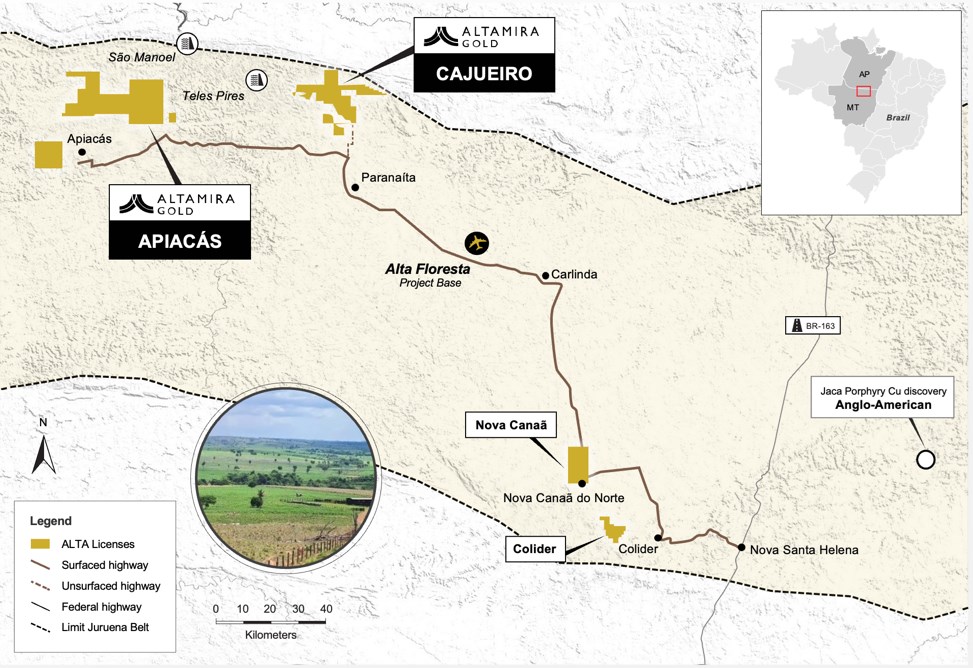
Figure 1: Location of Altamira Gold's projects in the Alta Floresta Belt.
To view an enhanced version of this graphic, please visit:
https://images.newsfilecorp.com/files/4500/318072_16553ccd24d748ad_001full.jpg
The Cajueiro district contains independently estimated mineral resources at Cajueiro Central and Maria Bonita, together with eight additional exploration targets within 8 km of Cajueiro Central that have yet to be drill tested (Figure 2).
The Cajueiro Central area has a current open pit resource1 of 5.66Mt @ 1.02 g/t gold containing 185,000 oz in the Indicated Resource category and 12.66Mt @ 1.26 g/t gold (515,000 oz) in the Inferred Resource category (estimated using a cut-off grade of 0.25g/t Au and a gold price of US$1,500/oz)1.
The Maria Bonita open-pit resource consists of Indicated Resources estimated as 25Mt @ 0.50g/t (403,877oz) and Inferred Resources of 70Mt @ 0.41g/t (908,477 oz). These resources include near-surface saprolite Indicated Resources of 1.49Mt @ 0.65g/t (30,899oz) and Inferred Resources of 1.42Mt @ 0.38g/t (17,172oz). The resources were calculated using a cut-off of 0.24 g/t gold and a gold price of US$3,300 per ounce (press release September 21, 2026)3.
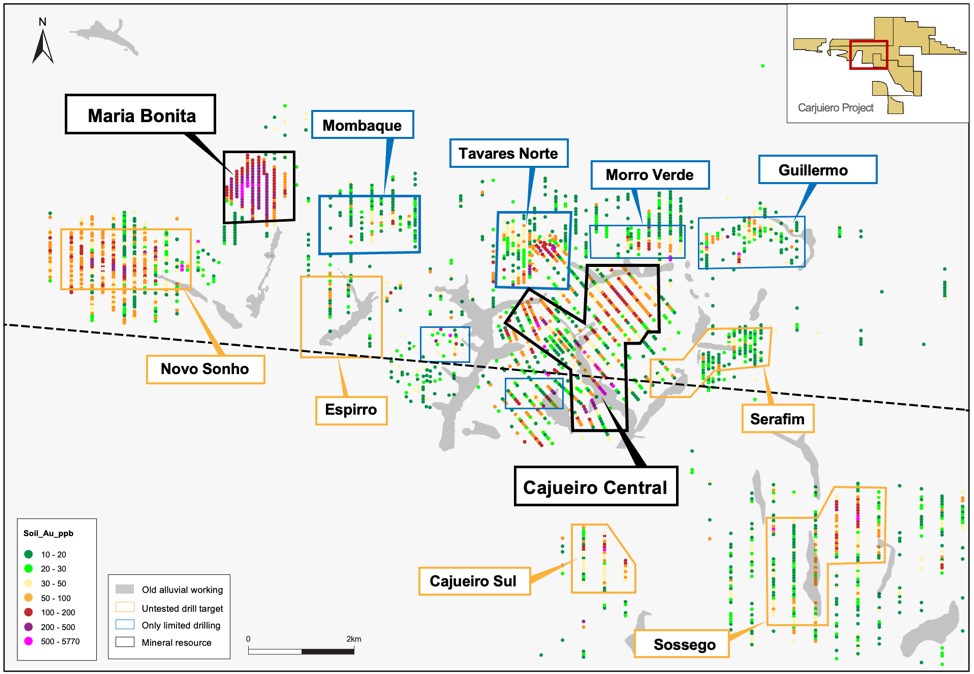
Figure 2: Location of the two Mineral Resources at Maria Bonita and Cajueiro Central in relation to soil geochemistry and prior alluvial mining areas.
To view an enhanced version of this graphic, please visit:
https://images.newsfilecorp.com/files/4500/318072_16553ccd24d748ad_002full.jpg
Maria Bonita Drilling and Trenching Results
Recent trenching and drilling activities successfully identified a new porphyry body to the west of the discovery area ("Western Porphyry"), and drilling is now underway to continue tracing the Western Porphyry body further to the west (press releases August 19 and 25, 2026).
As bedrock is not exposed across the current Mineral Resource area, five deep bulldozer trenches were excavated across the northern and western portions of the porphyry system, both within and adjacent to the current Mineral Resource footprint (Figure 3). The trenches were developed with the objective of better defining the distribution of gold mineralization within the porphyry bodies and the adjacent quartz-veined tuff wall rocks. Assay results have been received for the first four trenches (Table 1), while results for TCMBA06 remain pending.
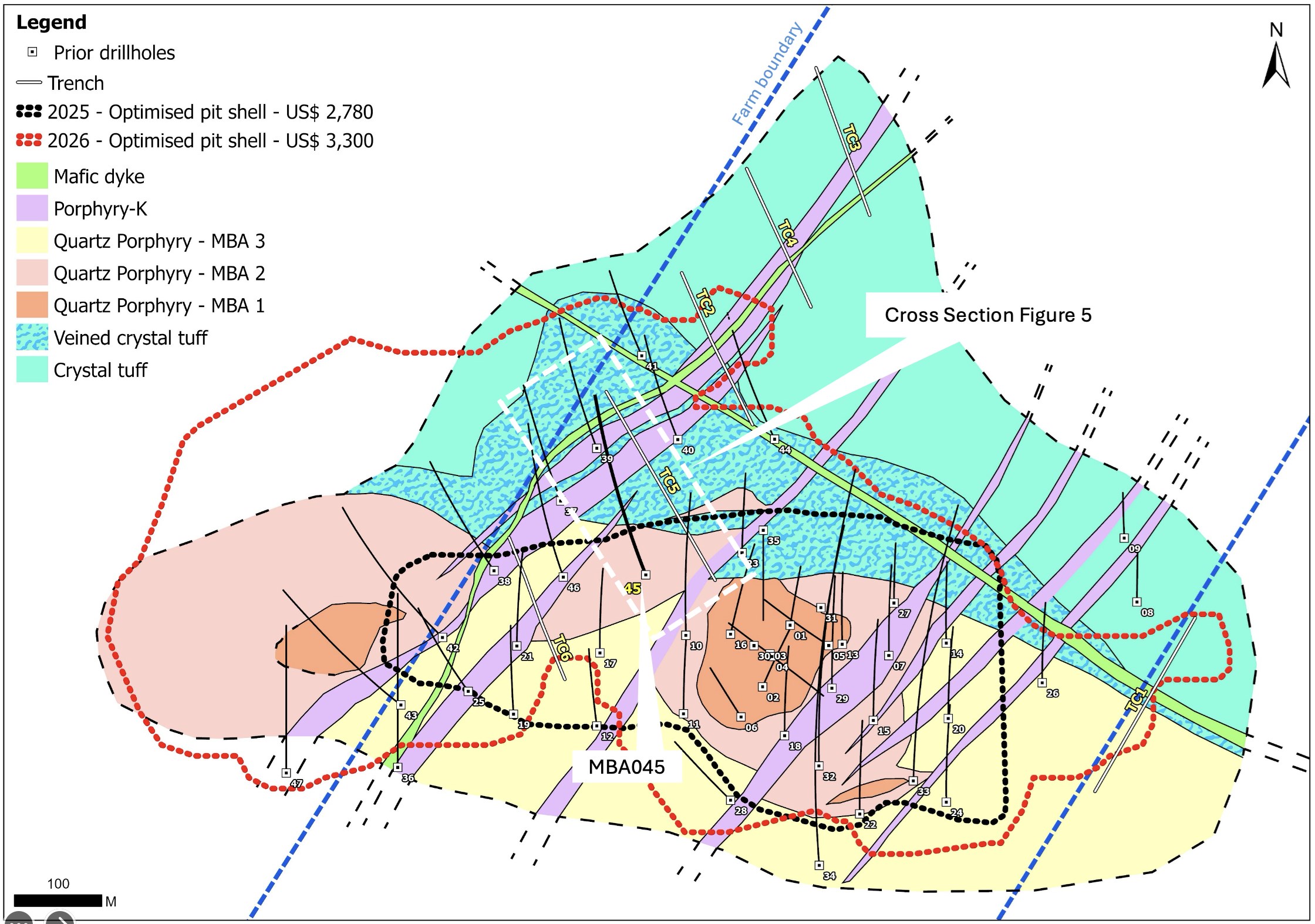
Figure 3: Geological map showing trench locations and locations of DDH MBA045 and TCMBA01-5 in relation to the optimised pit outlines of the Maiden Resource2 and recently enlarged Mineral Resource3. Gold mineralization is found within the porphyry body (reds and yellow) and in the northern contact zone with wall-rock tuffs where quartz veining with gold mineralization is found in an extensive halo shown in variegated green.
To view an enhanced version of this graphic, please visit:
https://images.newsfilecorp.com/files/4500/318072_16553ccd24d748ad_003full.jpg
The results from these trenches are presented in Table 1.
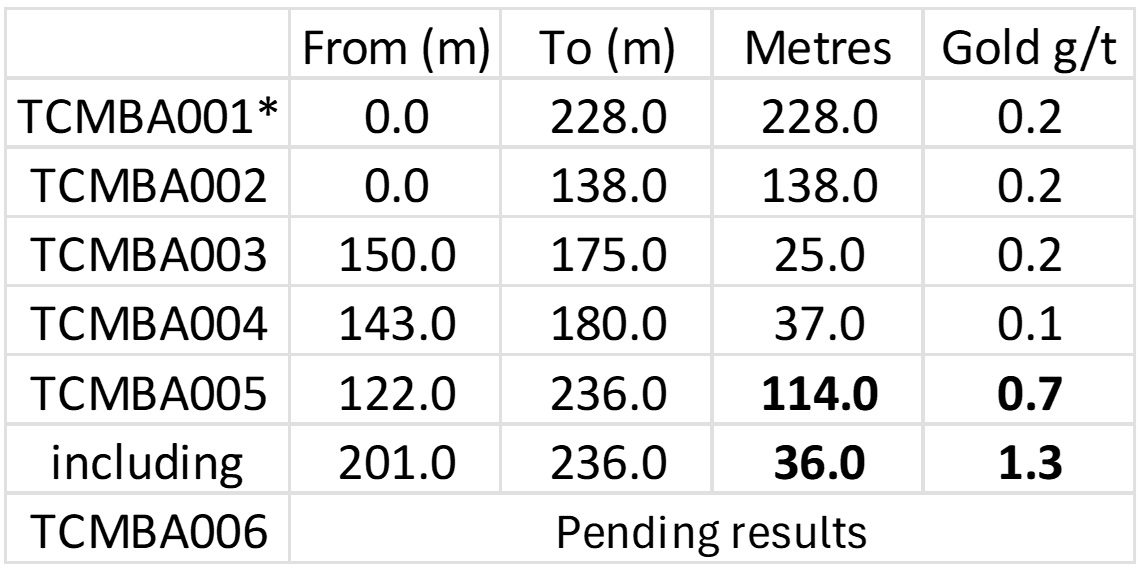
Table 1: Summary results from trenches TCMBA01-5. *TCMBA001 is located to the east of the Mineral Resource Estimate.
To view an enhanced version of this graphic, please visit:
https://images.newsfilecorp.com/files/4500/318072_altamira1en.jpg
Trench TCMBA05 was excavated within the Mineral Resource footprint and returned a broad mineralized interval of 114m at 0.7 g/t gold, including 36m at 1.3 g/t gold. This demonstrates the potential for at-or-near-surface oxide mineralization within the optimized pit outline. Results are pending for TCMBA06, also located within the resource footprint. Additional trenching and shallow reverse circulation drilling are planned to further define the distribution and continuity of this readily accessible oxide mineralization.
The northern and eastern trenches, located largely outside the current Mineral Resource footprint and the porphyry, confirm the interpreted orientation of the late-stage feldspar porphyry dykes separating the two early porphyry bodies (Figure 3). Trenches TCMBA03 and TCMBA04 returned generally low gold values, while TCMBA02 shows a modest improvement in gold tenor due to its proximity to the porphyry. TCMBA01 is located to the east of the Mineral Resource.
At the cut-off date for the recent Mineral Resource update, assay results from three drill holes (MBA044-MBA046) were pending and were therefore not included in the estimate. Results for drill holes MBA044 and MBA045 have now been received and are presented below in Table 2. Assay results for MBA046 remain pending.
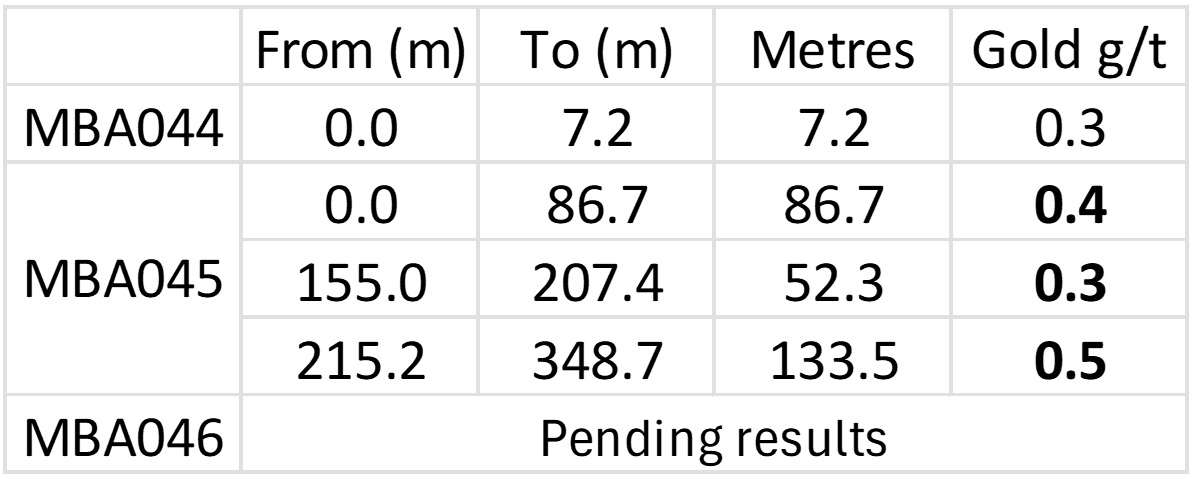
Table 2: Summary drill results from drill holes MBA044-045.
To view an enhanced version of this graphic, please visit:
https://images.newsfilecorp.com/files/4500/318072_altamira2en.jpg
Drill hole MBA044 tested the northern extent of mineralization within the wall-rock tuffs, beyond the interpreted porphyry margin. The vein zone returned generally weak gold values, predominantly below the Mineral Resource cut-off grade of 0.24 g/t gold. The best result was obtained from the oxidized zone, which returned 7.2m @ 0.3 g/t gold.
Drill hole MBA045, located within the updated Mineral Resource footprint, intersected three mineralized zones with a combined downhole extent of 272m including 87m @ 0.4g/t goldfrom surface, 52m @ 0.3g/t gold from 155m downhole and 134m @ 0.5g/t gold from 215m to the bottom of the hole at 349m, separated by barren post-mineral dykes. The hole ended in mineralization. Assay results for drill hole MBA046 remain pending.
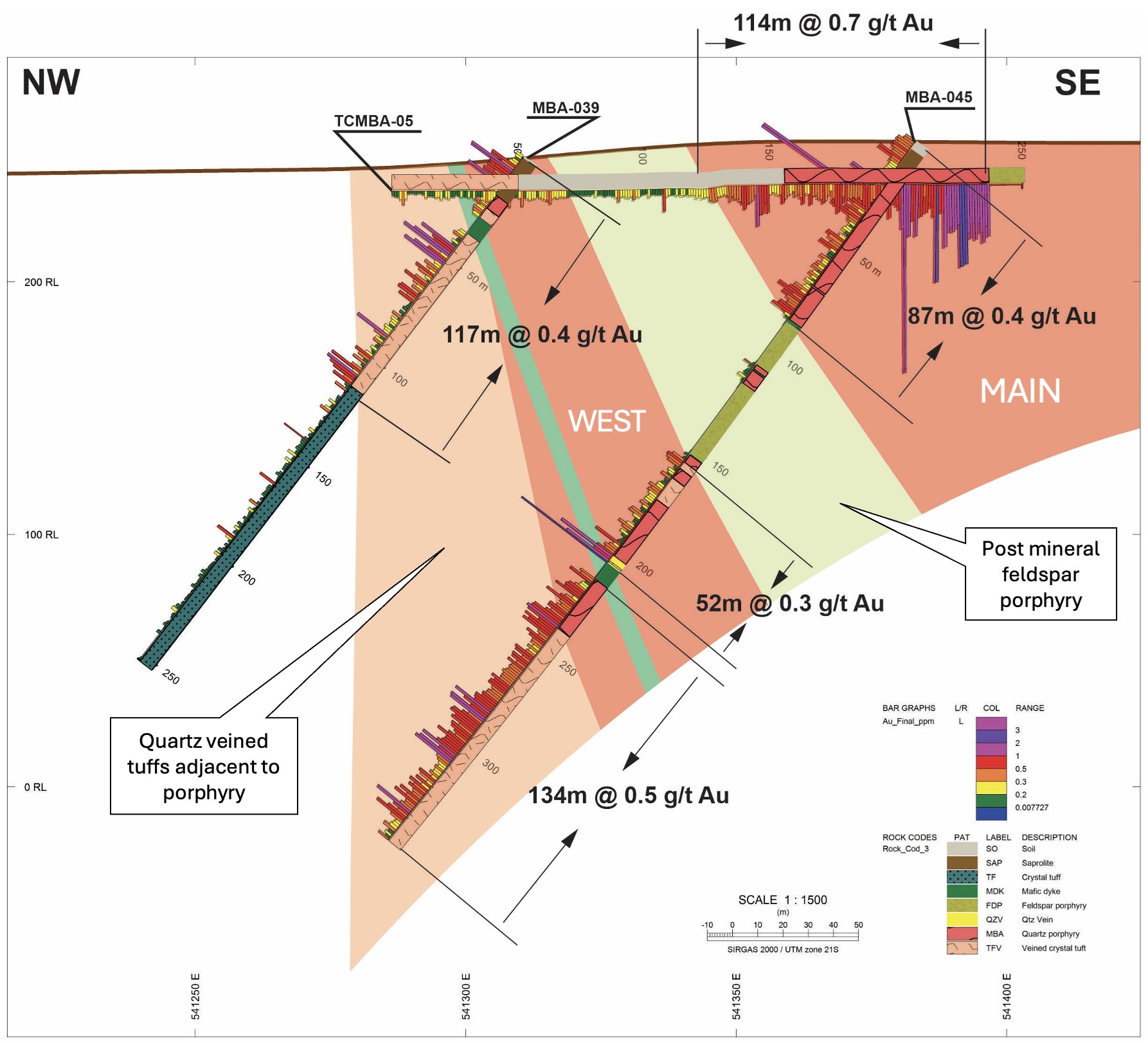
Figure 4: Drill section along MBA045 and trench TCMBA05 showing a strong correlation between wide zones of gold in the trench with the upper drill hole intersection and the projection of the lower (open) drill hole intersection in hole MBA045.
To view an enhanced version of this graphic, please visit:
https://images.newsfilecorp.com/files/4500/318072_16553ccd24d748ad_006full.jpg
Figure 4 shows the interpretation of the mineralized Main (eastern) and West porphyry bodies separated by the fault zone, occupied by post mineral felspar porphyry dykes.
The lowermost mineralized interval in MBA045 (133.5m at 0.5 g/t gold) lies west of the principal post-mineral feldspar porphyry dyke corridor and is predominantly hosted in veined tuffs adjacent to the interpreted Western Porphyry. Its position and mineralization style are spatially consistent with the broad mineralized intervals previously intersected in the Western Porphyry area, as summarized in Table 3.
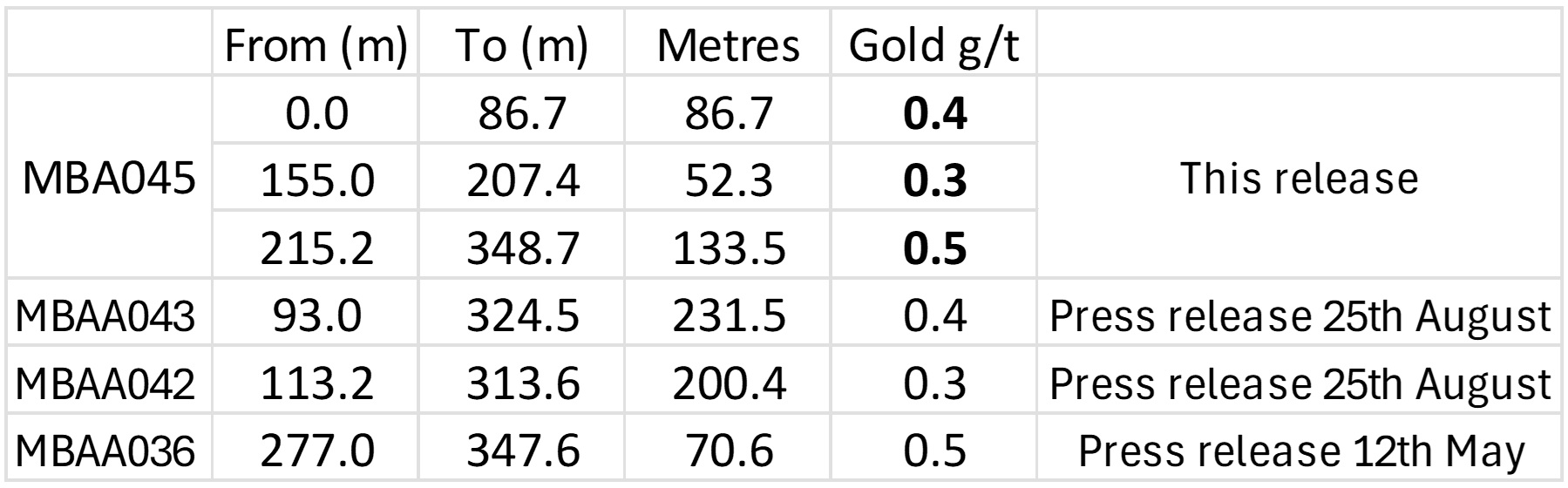
Table 3: Current drill intersections interpreted as associated with the Western Porphyry. All intercepts are hosted in porphyry, except for the lowermost intercept in MBA045, which is predominantly in veined tuffs adjacent to the interpreted Western Porphyry (Figure 4).
To view an enhanced version of this graphic, please visit:
https://images.newsfilecorp.com/files/4500/318072_altamira3en.jpg
To date, the Western Porphyry is associated with broad intervals of consistent gold mineralization, both within porphyry host rocks and in the adjacent tuff wall rock. The mineralization hosted in tuff in MBA045 extends 129m downhole outside the porphyry and is open at depth.
Future Work
Drilling is now underway on the adjacent property to the west to further extend the Mineral Resource in the Western Porphyry to the west. Results from the recent soil sampling program are pending and once received, will be integrated with the drone magnetic data to guide ongoing and future drill hole locations.
Prospecting and district-scale soil sampling is underway to provide a first pass evaluation of the newly accessible 58km2on the adjacent property to the west of Maria Bonita.
AGM Results
The Company announces that all resolutions were passed at its annual general meeting of shareholders (the "AGM") held in Vancouver on October 1, 2026.
All of the nominees for election as directors of the Company listed in the Company's information circular dated August 17, 2026, were re-elected for the ensuing year and the number of directors was fixed at five. Accordingly, Alan Carter, Michael Bennett, Ian Talbot, Pieter Le Roux, and Otavio Da Costa were all elected as directors of the Company.
DeVisser Gray LLP, Chartered Professional Accountants, were re-appointed as auditors for the Company for the ensuing year.
The Company's omnibus equity compensation plan (the "Omnibus Plan") was also approved at the AGM. The Omnibus Plan includes the ability to issue stock options ("Options"), restricted share units ("RSUs"), performance share units ("PSUs"), and deferred share units ("DSUs", and together with Options, RSUs, PSUs, the "Awards"). The maximum number of common shares which may be issued in respect of Options will not exceed 10% of the total number of issued common shares at the time an Option is granted and the aggregate number of common shares which may be issued in respect of RSUs, PSUs, and DSUs (collectively, the "Performance Based Awards") will not exceed 29,665,805. The Omnibus Plan has a "rolling" limit in connection with Option grants as the number of common shares reserved for issuance pursuant to the grant of Options will automatically increase as the Company's issued and outstanding share capital increases. Once approved by the TSX Venture Exchange, the Omnibus Plan will replace the Company's existing stock option plan. Any Options currently issued and outstanding pursuant to the Company's existing stock option plan will continue to be exercisable but will be governed by the Omnibus Plan. The Company does not have any Performance Based Awards issued and outstanding.
A copy of the Omnibus Plan and further details are included in the Company's management information circular prepared for the AGM and filed under the Company's SEDAR+ profile at www.sedarplus.com.
Qualified Person
Fernando Benegas, FAusIMM, a consultant to the Company as well as a Qualified Person as defined by National Instrument 43-101, supervised and approved the preparation of the technical information in this news release.
About Altamira Gold Corp.
The Company is focused on the exploration and development of gold projects within western central Brazil, strategically advancing four projects spanning over 90,000 hectares within the prolific Juruena Gold Belt, an area that has historically yielded over 6 million ounces of placer gold3. The Company's advanced Cajueiro project contains two gold deposits. Ongoing exploration and fieldwork at Cajueiro indicate the presence of multiple hard rock gold occurrences, traceable from historical alluvial gold production, highlighting the region's exceptional gold endowment and potential scalability. With two independently established mineral resources, a highly prospective geological setting and a track record of significant discoveries, the Company is well-positioned to unlock further value across its extensive land package.
1 NI 43-101 Technical Report, Cajueiro Project, Mineral Resource Estimate: Global Resource Engineering, Denver Colorado USA, 10thOctober 2019; Authors K. Gunesch, PE; H. Samari, QP-MMSA; T. Harvey, QP-MMSA
2 NI43-101 Technical Report, Mineral Resource for the Maria Bonita Prospect: VMG Consultoria, Belo Horizonte, Minas Gerais, Brazil. 12thJune 2025; Author V. Myadzel
3 NI43-101 Technical Report, Mineral Resource for the Maria Bonita Prospect: VMG Consultoria, Belo Horizonte, Minas Gerais, Brazil. 16thSeptember 2026; Author V. Myadzel
4 Juliani, C. et al; Gold in Paleoproterozoic (2.1 to 1.77 Ga) Continental Magmatic Arcs at the Tapajós and Juruena Mineral Provinces (Amazonian Craton, Brazil): A New Frontier for the Exploration of Epithermal-Porphyry and Related Deposits. Minerals 2021, 11, 714.https://doi.org/10.3390/min11070714
Neither TSX Venture Exchange nor its Regulation Services Provider (as that term is defined in policies of the TSX Venture Exchange) accepts responsibility for the adequacy or accuracy of this release.
The securities described herein have not been registered under the U.S. Securities Act or any state securities laws and may not be offered or sold in the United States absent registration or an applicable exemption from registration requirements under the U.S. Securities Act and any applicable state securities laws.
Forward-looking Statements
Certain information contained herein constitutes "forward-looking information" under Canadian securities legislation. Forward-looking information includes, but is not limited to, statements regarding the Company's planned exploration activities west of Maria Bonita, including soil sampling, geological mapping, geophysical interpretation, trenching, drill-target definition and future drilling; the timing and scope of such programs; the interpretation of geological, geochemical and geophysical features; the potential identification of primary gold sources and intrusion-related mineralization across the western exploration area; the potential western extension of the Maria Bonita porphyry system and current Mineral Resource; and the Company's ability to obtain or maintain necessary surface access, permits and regulatory approvals. Generally, forward-looking information can be identified by terminology such as "will", "plans", "expects", "intends", "may" or variations of such words and phrases. Forward-looking statements are based on management's opinions and estimates as of the date made and are subject to known and unknown risks, uncertainties and other factors that may cause actual results to differ materially. There can be no assurance that such statements will prove accurate. Readers should not place undue reliance on forward-looking statements. The Company will not update forward-looking information except as required by applicable securities laws.
Quality Assurance/Quality Control
Drill holes commence in HQ diameter (63.5mm) and proceed to the base of weathering where core diameter is reduced to NQ (47.6mm). Logging and sampling are completed at a secure Company facility located on site. Drill core is cut in half on site by a saw cut or slicer (in soft saprolite). Until dispatch, samples are stored under the supervision the Company's exploration office. The samples are couriered to the assay laboratory using a commercial contractor. Pulps are returned to the Company and archived.
For all drilling, half core is submitted to SGS Geosol, a leading commercial laboratory in Brazil, and analysed for gold by 50 g fire assay, together with a suite of additional elements using standard laboratory procedures. Soil and rock-chip samples are submitted under Company custody and analysed for gold using the applicable laboratory preparation and analytical protocols.
Quality control of drill hole assays follows normal industry procedures and includes the insertion of field duplicates, independent certified reference materials and blank samples within submitted batches. Selected sample pulps are periodically resubmitted to an independent third-party laboratory to assess precision and accuracy. Drill hole results are reported as down-hole, length-weighted intersections; true widths have not been determined.
Additional information regarding the Company data verification processes is set out in the NI 43-101 Technical Report, Maria Bonita Prospect, June 2025,which can be found on the Company's website.

To view the source version of this press release, please visit https://www.newsfilecorp.com/release/318072
Source: Altamira Gold Corp.
© 2026 Newsfile Corp. All rights reserved.