



Ginkgo Bioworks' Autonomous Laboratory Driven by OpenAI's GPT-5 Achieves 40% Improvement Over State-of-the-Art Scientific Benchmark
Ginkgo Bioworks' Autonomous Laboratory Driven by OpenAI's GPT-5 Achieves 40% Improvement Over State-of-the-Art Scientific Benchmark |
| [05-February-2026] |
BOSTON, Feb. 5, 2026 /PRNewswire/ -- Ginkgo Bioworks (NYSE: DNA) today announced it has demonstrated, in collaboration with OpenAI, an AI system that autonomously designed, executed, and learned from biological experiments with minimal human involvement. In a new preprint, the company reports the system reduced cell-free protein synthesis reaction costs by 40% relative to state of the art, while running 36,000 experimental conditions across six iterative cycles.
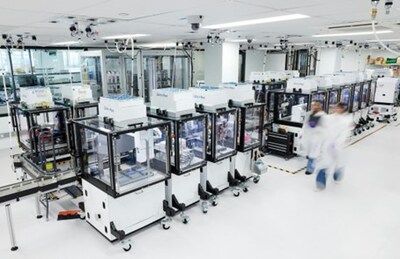
The study represents a real-world scientific application of Ginkgo's autonomous lab. The collaborators combined OpenAI's GPT-5 reasoning model with Ginkgo's cloud laboratory infrastructure, built from its reconfigurable automation carts (RAC) technology and Catalyst automation software, to design, execute, and analyze experiments in an iterative, closed-loop workflow. GPT-5 was given internet access, a computer with data analysis packages, experimental (meta)data from prior iterations, and a preprint describing state of the art, and was able to operate like an experimental scientist – designing experiments, analyzing results, and refining its approach in response. In six rounds of experiments over the course of six months, it was able to design lower cost cell-free protein synthesis reaction compositions than had been shown in the scientific literature previously. "By pairing a frontier large language model with an autonomous lab, we found reaction compositions that are notably cheaper than prior state of the art," said Reshma Shetty, co-founder of Ginkgo Bioworks and co-author of the study. "We expect more and more experiments to be run on autonomous labs where reagent and consumables costs dominate the cost of an experiment. Lower cost reagents for protein production enable more data generation and thus more scientific progress per dollar spent." The autonomous lab achieved production of a standard benchmark protein, superfolder green fluorescent protein (sfGFP), at $422 per gram of protein in total reaction component costs, compared to a previously reported state of the art of $698 per gram, representing a 40% reduction under the experimental conditions described. Cell-free protein synthesis is widely used in biological research but has been limited by high material costs and complex optimization, making it an ideal stress test for autonomous experimentation. "At OpenAI, this was the first time we were able to interface a frontier model with an autonomous lab to carry out experimentation at a very large scale," said Joy Jiao, life sciences research lead at OpenAI and co-corresponding author of the study. "This success points to how AI systems can augment the experimental workflow, contributing to hypothesis generation, testing, and refinement based on real-world data." The autonomous lab executed more than 580 384-well plates, tested 36,000 reaction compositions, and generated nearly 150,000 experimental data points. Human involvement was primarily limited to reagent preparation, loading and unloading and system oversight, while experimental design, execution data interpretation, and hypothesis generation were handled by the GPT-5-driven autonomous lab. Notably, the model also proposed and prioritized new reagents to test, some of which independently anticipated findings from published research it had not been given access to. To preclude the AI from proposing impractical, invalid, or hallucinatory experiments, every design was validated against a Pydantic model before execution, including checking plate layout, standards, controls, replication, reagent availability, and volume constraints. Only experiments that passed validation were eligible to run. Additional scoring prioritized scientific rigor and consideration of prior results. GPT-5 generated human-readable lab notebook entries documenting its analysis, observations, and rationale, providing transparency into its reasoning. "This is AI doing real experimental science: designing experiments, running them, and learning from the results," said Jason Kelly, co-founder and CEO of Ginkgo Bioworks. "AI combined with autonomous labs is needed to keep the United States competitive in science worldwide – the recently announced Genesis Mission led by the U.S. Department of Energy to bring AI into science is leading the way here and I'm excited that our results with OpenAI show this approach is working." The Pydantic model is being released open source and the AI-improved cell-free reaction mix can be ordered by the scientific community at https://reagents.ginkgo.bio/ About the Preprint About Ginkgo Bioworks Forward-Looking Statements of Ginkgo Bioworks Contacts Ginkgo Bioworks investor contact: Ginkgo Bioworks media contact:
SOURCE Ginkgo Bioworks | ||
Company Codes: NYSE:DNA |
 View original content to download multimedia: