


GRAIL Reports Full Results From NHS-Galleri Trial Demonstrating Substantial Reduction in Stage IV Cancer Diagnoses at 2026 ASCO Annual Meeting
GRAIL Reports Full Results From NHS-Galleri Trial Demonstrating Substantial Reduction in Stage IV Cancer Diagnoses at 2026 ASCO Annual Meeting |
| [30-May-2026] |
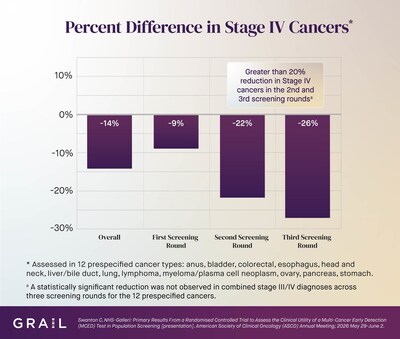
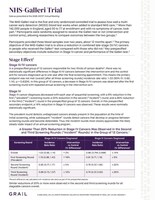
No Reduction Observed in Combined Primary Endpoint of Stage III/IV Cancers in Aggregate; However, Decreases Observed Beyond the Prevalent Screening Round Annual Galleri®Blood Test Reduced Stage IV Diagnoses of 12 Prespecified Cancers by 22% and 26% in the Second and Third Screening Rounds, Respectively Galleri Increased Cancer Detection Rate by Four-Fold When Added to Standard of Care Screening and Reduced Cancer Diagnosis Through Emergency Presentation by 25% Annual Testing With Galleri Increased Stage I-II Cancer Diagnoses by 16% When Added to Standard of Care GRAIL to Host Analyst Call From 2026 ASCO Annual Meeting MENLO PARK, Calif., May 30, 2026 /PRNewswire/ -- GRAIL, Inc. (Nasdaq: GRAL), a healthcare company whose mission is to detect cancer early when it can be cured, today announced detailed clinical utility, performance and safety results from its landmark NHS-Galleri trial in an oral presentation at the 2026 American Society of Clinical Oncology (ASCO) Annual Meeting1. The NHS-Galleri trial is the first and only randomized, controlled trial of a multi-cancer early detection (MCED) test and evaluated annual screening with the Galleri ® test in England's National Health Service (NHS) over three years in 142,250 demographically representative participants aged 50 to 77 at enrollment. GRAIL collaborated with NHS England on the objectives of this study, based on NHS priorities to reduce Stage III and IV cancers. "The goal of multi-cancer early detection is to find more cancers earlier, when they are more treatable and potentially curable, so that patients have the chance of living longer and more productive lives," said Josh Ofman, MD, MSHS, President and CEO-Elect at GRAIL. "The NHS-Galleri trial provides a wealth of data that support the use of the Galleri test to reduce the burden of metastatic Stage IV cancer and increase the number of cancers found earlier through screening at population scale. Importantly, Galleri found more Stage I and II cancers than all cancers found through NHS' existing single cancer screenings combined. By the third round of screening in this trial, Stage IV cancer diagnoses fell by more than a quarter, when treatment with curative intent may be possible." Finding Cancers Earlier Sir Harpal Kumar, Chief Scientific Officer and President, Global Clinical and Medical Affairs at GRAIL, explained the reasons behind the Stage III and IV result: "We saw a substantial decrease in Stage IV cancers, but this was outweighed by an overall increase in the number of Stage III cancers, particularly in the prevalent screening round. We believe the Stage III increase was driven in part by a number of Stage IV cancers being shifted to earlier stages, including at Stage III, and the fact that many more cancers overall were found earlier through screening in the intervention arm, while the equivalent cancers may not yet have been diagnosed in the control arm. We would expect to see more of these as yet undiagnosed late stage cancers being found in the control arm with longer follow up. In addition, the trial has revealed just how much undiagnosed and uninvestigated Stage III cancer is already prevalent in the population before any screening commences. Finding these cancers earlier means we can start treating those patients with the urgency needed and, in many cases, with the opportunity of curative intent." One of the aims of screening is to reduce the incidence of metastatic late stage cancer. In the Galleri arm, Stage IV cancer diagnoses decreased with each year of sequential screening, with a 9% reduction in the first ("prevalent") screening round, a 22% reduction in the second round, and a 26% reduction in the third round in the pre-specified group of 12 cancers. The prevalent round detects undiagnosed cancers already present in the population at the time of initial screening, while subsequent "incident" rounds detect cancers that develop or progress between screening rounds and become detectable. Thus, the incident rounds most closely approximate the likely steady-state impact of an annual screening program. Overall, in this pre-specified secondary endpoint, a 14% reduction in Stage IV cancers was observed. These results were nominally statistically significant. Similar reductions of 20% or more were observed in the second and third screening rounds for all stageable cancers. "As a lung cancer doctor, I see the clinical importance of diagnosing cancer at an earlier stage, when treatment is more likely to be curative," said Professor Charles Swanton, thoracic medical oncologist at University College London Hospital, and one of the NHS-Galleri trial's chief investigators. "The NHS-Galleri trial tested whether adding the Galleri blood test to NHS screening could reduce the combined number of cancers diagnosed at Stage III or IV over three years. The primary endpoint was not met. However, a pre-specified secondary endpoint did show a greater than 20% reduction in Stage IV cancers, with the effect strengthening by the third year of screening. The Stage IV reduction is clinically meaningful because for many cancers there is a real gulf in outlook between a Stage IV diagnosis and one caught earlier. The hope is that for more patients the conversation can be about treating cancer with curative intent rather than managing it palliatively." Within the overall trend of Stage IV reduction, in an exploratory analysis, meaningful reductions in Stage IV diagnoses were observed in cancer types where 5-year survival is substantially higher when diagnosed at Stage III versus IV. For example, Stage IV diagnoses were reduced by 57.1% in esophageal cancer and 34.4% in colorectal cancer in the incident rounds. The five-year survival rates in England are significantly higher in Stage III than Stage IV for each of these cancers: 24.7% vs 6.2% for esophageal cancer, 64.2% vs 11.0% for colorectal cancer. "For most cancer patients, there is a real difference between being diagnosed and being treated with a possibility of a cure versus being diagnosed at Stage IV and only being offered treatment that could manage symptoms and side effects or potentially prolong life for months or a few years. This is why it is critical to detect cancer at earlier stages, especially before distant metastases. Patients live longer when they are diagnosed before their cancer spreads to other parts of the body," said Sally Werner, RN, BSN, MSHA, Chief Executive Officer at Cancer Support Community, a global nonprofit advocacy organization. "The Galleri study results show promise and bring hope to people concerned about cancer that it might be detected earlier, improving patient outcomes and allowing more patients treatment options that offer potential cures. The fact that this screening is available with a simple blood test that could be done at any healthcare visit could make this a game changer in increased screening and earlier diagnosis, which could reduce a large portion of the persistent cancer disparities we see." Relative Incidence Rate of Combined Stage III/IV Cancers Decreased After the First Round of Screening in the Pre-Specified Group of 12 Cancers; Relative Incidence Rate of Stage IV Cancers Decreased Each Screening Round.
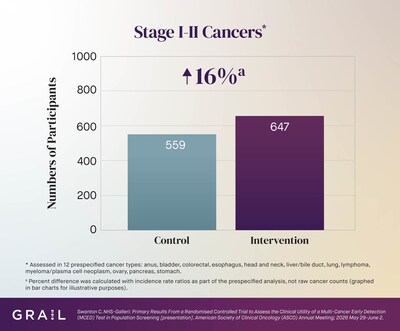
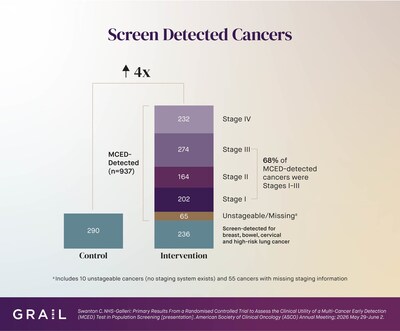
Along with the decrease in Stage IV cancer incidence, Stage I and II cancers diagnosed increased by 16% for the 12 prespecified cancer types after three rounds of screening, including large increases in many types typically diagnosed late, such as ovarian, esophageal, pancreatic and liver cancers. Nigel, 70, from the North East of England, took part in the NHS-Galleri trial and was diagnosed with Stage I head and neck cancer after receiving a cancer signal detected Galleri test result. "The fact that the cancer was Stage I meant it had likely been caught much earlier than would have otherwise been the case," Nigel said. "The surgery was less invasive, so that aided my recovery. And the horror stories I was presented with about the number of days in hospital and having to learn to drink and eat again - luckily none of that happened in my case." Finding More Cancers With Robust Performance and Favorable Safety Eric Sue, M.D., a primary care physician of internal medicine at the Sue Medical Group in Los Angeles, noted: "There is a distinct difference between the objectives of a therapeutic drug trial and those of a cancer screening trial, where the totality of the data must be carefully considered. In the NHS-Galleri trial, the observed greater than 20% reduction in stage IV cancer diagnoses and the four-fold increase in cancer detection compared with standard screening alone are both highly compelling findings. Shifting cancers away from metastatic presentation toward earlier-stage detection—while identifying substantially more cancers overall—creates more opportunities to intervene when curative treatment may still be possible and, most importantly, where the opportunity to reduce cancer mortality may be greatest." The Galleri test's performance – positive predictive value (PPV), specificity and Cancer Signal of Origin (CSO) accuracy – was consistent with the range previously reported from GRAIL's North American studies. Over three screening rounds, 1,801 participants (0.91%) had a positive MCED test result and 937 were diagnosed with cancer, for a cancer detection rate of 0.48%. PPV was 52.0% overall and 58.0% in the first screening round. Specificity was 99.55%, resulting in a low false positive rate of 0.45%. CSO accuracy was 92.5%. Episode sensitivity – the ability to detect cancers that were diagnosed within 12 months after each Galleri screening blood draw - was 54.7% for the 12 prespecified cancer types and 30.7% across all cancer types. "Our current recommended screening tests only find around 14% of newly diagnosed cancers each year in the US and around 6% in England. In finding four times as many cancers compared to the standard screening programs combined, we are identifying many more asymptomatic patients with undiagnosed disease months or even years earlier than currently possible," said Kumar. "Galleri represents a potential transformational shift in cancer detection, moving us to a more comprehensive proactive approach. As treatment options continue to advance, screening frameworks must evolve in parallel. Multi-cancer early detection provides an opportunity to reshape screening around an evolving goal: detecting more cancers when there is an opportunity for cure." There were no serious related adverse events reported in the trial, reaffirming the safety profile of the test. The results of the NHS-Galleri trial will be submitted for publication in a peer-reviewed medical journal. "We are deeply grateful to the more than 142,000 participants who took part in this study, as well as to the NHS, The Cancer Prevention Trials Unit at Queen Mary University of London, Cancer Alliances, investigators, and clinical teams whose dedication made this landmark trial possible," said Professor Richard Neal, Professor of Primary Care at University of Exeter, General Practitioner, St. Leonard's Practice, and one of the NHS-Galleri trial's chief investigators. GRAIL to Host Analyst Call From 2026 ASCO Annual Meeting A link to the live webcast and recorded replay will be available at the investor relations section of GRAIL's website at investors.grail.com. Please register for the live event at https://grail-asco-2026-analyst-call.open-exchange.net/. About the NHS-Galleri Trial (NCT05611632; ISRCTN91431511) About GRAIL For more information, visit grail.com. About Galleri® For more information, visit galleri.com. **A statistically significant reduction was not observed in combined stage III–IV diagnoses across three screening rounds for the 12 deadly cancers. **Test performance metrics do not represent results of a head-to-head comparative study. Separate studies have different designs, objectives, and participant populations, which limits the ability to draw conclusions about comparative performance. Important Galleri Safety Information Results should be interpreted by a healthcare provider in the context of medical history, clinical signs, and symptoms. A test result of No Cancer Signal Detected does not rule out cancer. A test result of Cancer Signal Detected requires confirmatory diagnostic evaluation by medically established procedures (e.g., imaging) to confirm cancer. Laboratory/Test Information GRAIL Forward Looking Statements These statements are only predictions based on our current expectations and projections about future events and trends. There are important factors that could cause our actual results, level of activity, performance, or achievements to differ materially and adversely from those expressed or implied by the forward-looking statements, including those factors and numerous associated risks discussed under the section entitled "Risk Factors" in our Annual Report on Form 10-K for the period ended December 31, 2025. Moreover, we operate in a dynamic and rapidly changing environment. New risks emerge from time to time. It is not possible for our management to predict all risks, nor can we assess the impact of all factors on our business or the extent to which any factor, or combination of factors, may cause actual results, level of activity, performance, or achievements to differ materially and adversely from those contained in any forward-looking statements we may make. Forward-looking statements relate to the future and, accordingly, are subject to inherent uncertainties, risks, and changes in circumstances that are difficult to predict and many of which are outside of our control. Although we believe the expectations and projections expressed or implied by the forward-looking statements are reasonable, we cannot guarantee future results, level of activity, performance, or achievements. Our actual results, financial condition and success in our business strategies and operations may differ materially from those indicated in the forward-looking statements. Except to the extent required by law, we undertake no obligation to update any of these forward-looking statements after the date of this press release to conform our prior statements to actual results or revised expectations or to reflect new information or the occurrence of unanticipated events. 1 Swanton C. NHS-Galleri: Primary Results From a Randomised Controlled Trial to Assess the Clinical Utility of a Multi-Cancer Early Detection (MCED) Test in Population Screening [presentation]. American Society of Clinical Oncology (ASCO) Annual Meeting; 2026 May 29-June 2.
SOURCE GRAIL, Inc. | ||||||||||||||||||||||||||||||||
Company Codes: NASDAQ-NMS:GRAL,NASDAQ:GRAL | ||||||||||||||||||||||||||||||||

 View original content to download multimedia: