



Equifax National Market Pulse Data Shows U.S. Consumer Top-Line Debt Stabilizing at $18.25 Trillion in Q2 2026 With Delinquencies Improving Across Categories
Equifax National Market Pulse Data Shows U.S. Consumer Top-Line Debt Stabilizing at $18.25 Trillion in Q2 2026 With Delinquencies Improving Across Categories |
| [11-August-2026] |
Credit Card and Auto Debt Balance Growth Outpaces Student Loans Amid Broad Delinquency Relief Highlights:
ATLANTA, Aug. 11, 2026 /PRNewswire/ -- Equifax® (NYSE: EFX) has released its Market Pulse Second Quarter U.S. Consumer Credit Trends, which includes U.S. national consumer credit data and trends through June 2026 sourced from Equifax proprietary data. While consumer debt balances reached $18.25 trillion in June, driven by increases in mortgage and revolving consumer bank card debt, the data signaled a stabilization period for consumers with only a 0.32% increase from the first quarter of 2026. The data also highlights a consistent improvement in delinquencies in all categories.
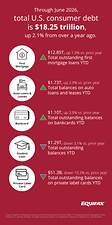
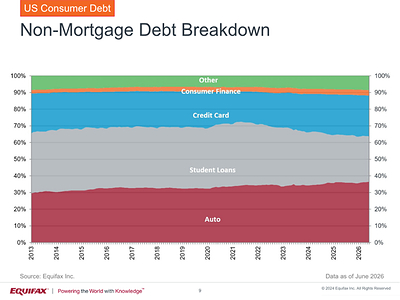
Continued Annual Debt Growth Driven by Mortgage and Revolving Card Debt Total U.S. consumer debt climbed to $18.25 trillion by the end of Q2 2026, a 2.1% year-over-year increase, which represented a growth of nearly $400 billion in a 12-month span. This expansion was primarily driven by mortgage debt, which accounted for roughly 74% of all consumer debt, as first mortgage and HELOC balances were up 1.9% and 12.5% year-over-year. "We are witnessing a period where top-line consumer data suggests retail and mortgage credit is stabilizing," said Emmaline Aliff, Advisory Leader at Equifax. "Total consumer debt only increased slightly in the second quarter of 2026, heavily anchored by first mortgages and a renewed reliance on credit cards. Although consumers accumulated seasonal credit card debt last November and December and paid the balances down in the first quarter, they took on more debt in the second quarter, though mortgage debt remains the majority of total consumer debt obligations." Structural Shifts in Non-Mortgage Portfolios as Auto and Card Balances Stand to Eclipse Student Loan Debt While auto loans, student loans, and bankcards continue to dominate roughly 90% of all non-mortgage debt, the composition of this debt has fundamentally shifted over the last three years. Bankcard debt, which was around $1.02 trillion in June 2024, and has grown by 8.2% to land at $1.1 trillion in the second quarter of 2026. This growth outpaces inflation over this same time period, which was about 6.5%. "Historically, total student loan debt balances were consistently higher than auto debt and almost twice as much as bankcard debt," said Aliff. "The changing proportions of the non-mortgage categories reflect a macro shift, where student loan stabilization is being offset by further reliance on credit to manage the budgetary pressures of rising household and vehicle costs." Delinquencies Broadly Stabilized Across Consumer Portfolios as Mortgage Delinquencies Improve from May Delinquency rates across automotive, bankcard, and unsecured personal loan portfolios all registered measurable downward trajectories on both a month-over-month and year-over-year basis. This broader stabilization also extended to the mortgage sector. Though first mortgage 90+ days past due (DPD) delinquencies rose 40.6% year-over-year from historic mid-2025 lows, they have improved, dropping 3.6% since May 2026, and suggesting a normalization of delinquencies and alleviation of pressure for some homeowners. Month-Over-Month and Year-Over-Year Results Total Consumer Debt Balances
First Mortgage Balances
Home Equity Lines of Credit (HELOC) Balances
Auto Loan Balances
Bankcard Balances
Student Loans Balances
Equifax has been tracking U.S. National Consumer Credit Trends for more than 20 years. Monthly reports can be found on Equifax.com. These reports track originations, balances and delinquencies on U.S. consumer mortgages, auto loans and leases, student loans, bankcards and private label credit cards, and personal loans. To explore Equifax tools that deliver U.S. National Consumer Credit Trends data and key market metrics click here. ABOUT EQUIFAX INC. At Equifax (NYSE: EFX), we believe knowledge drives progress. As a global data, analytics, and technology company, we play an essential role in the global economy by helping financial institutions, companies, employers, and government agencies make critical decisions with greater confidence. Our unique blend of differentiated data, analytics, and cloud technology drives insights to power decisions to move people forward. Headquartered in Atlanta and supported by nearly 15,000 employees worldwide, Equifax operates or has investments in 24 countries in North America, Central and South America, Europe, and the Asia Pacific region. For more information, visit Equifax.com. FOR MORE INFORMATION:
SOURCE Equifax Inc. | ||||||||||||||||||||||||||||||||||||||||||||||||||||||||||||||||||||||||||||||||||||||||||||||||||
Company Codes: NYSE:EFX |

 View original content to download multimedia: