| Scoping Study outlines staged, capital-efficient brownfields option to unlock additional Meekatharra ore supply and improve future cash generation PERTH, Western Australia, Aug. 25, 2026 /CNW/ -- Westgold Resources Limited (ASX: WGX) (TSX: WGX), Westgold or the Company) is pleased to report the results of a Scoping Study assessing a brownfields expansion of processing capacity at the Meekatharra hub from 1.8Mtpa to 2.9Mtpa (Meekatharra Expansion Plan or MXP). The study outlines a potential capital-efficient pathway to process additional emerging ore supply, lift future gold production, reduce processing unit costs and improve cash generation, subject to completion of feasibility-level technical, economic and approvals work. MXP is being advanced as a low-capital-intensity, brownfields expansion option that leverages Westgold's existing Meekatharra infrastructure and long-lead equipment already procured. The preferred pathway is intended to remove an emerging processing constraint and create a larger, more flexible platform for the Murchison ore base, without the cost, risk or timeframe of constructing a new standalone processing plant. Processing Expansion to 2.9Mtpa The MXP Scoping Study outlines a capital-efficient pathway to increase Meekatharra hub throughput capacity from 1.8Mtpa to 2.9Mtpa in FY28, potentially adding approximately 47kozpa of gold production once commissioned. The MXP comprises installation of a parallel crushing and single-stage SAG milling circuit integrated with the existing downstream leach, adsorption and gold recovery infrastructure. The MXP is predicated upon the increasing volume of ore supply available to Westgold at Meekatharra. Increasing outputs from the nearby Bluebird–South Junction underground and a range of open pits being developed across Westgold's Murchison Open Pit program is diversifying baseload ore sources and lifting plant utilisation, throughputs and metallurgical recovery from this processing hub. Value Uplift The MXP is a capital-efficient option to convert more of Westgold's existing and future Meekatharra mineral resources into mill feed, lower processing unit costs and strengthen Group free cash flow across its strategic outlook. Its value will be progressively confirmed through feasibility-level work, ore source validation, capital estimate refinement and execution planning now underway. Highlights MXP expands Meekatharra hub throughput from 1.8Mtpa to 2.9Mtpa - ~61% increase in processing capacity in FY28
MXP adds ≈ 47kozpa to baseline production once commissioned for total gold production of 1.6Moz over 10 years (an increase of 424koz) - Supported by existing hub infrastructure and processing scale benefits
Brownfields resource definition drilling and open pit optimisations commenced – opportunities proximate to Meekatharra hub support the expansion case - Polar Star Lode (within Bluebird-South Junction mine)
- Nannine and Paddy's Flat (near Meekatharra)
Key MXP Scoping Study outputs include: - Indicative Capital of approximately $100M – with target commissioning in FY28
- Representing the upper end of the Scoping Study range of $65M–$100M
- Payback period of 9 months
- MXP Life of Mine (LoM) gold production – 1.5 – 1.8 Moz
- At All in Sustaining Cost (AISC) range of $1,968 - $2,406/oz
- Project NPV improves by ~$1.1B at a gold price of $5,500/oz
- Increases to ~$1.6B at spot gold price of $6,000/oz
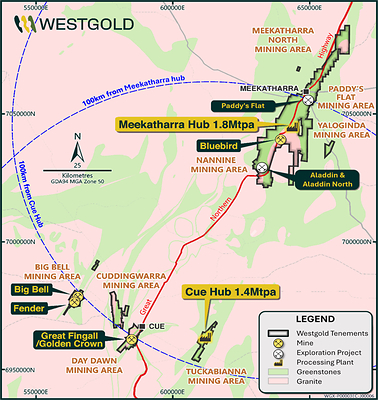
Cautionary Statement The Scoping Study referred to in this report is based on low-level technical and economic assessments and is insufficient to support estimation of Ore Reserves or to provide assurance of an economic development case at this stage, or to provide certainty that the conclusions of the Scoping Study will be realised. The information in this announcement relating to processing expansion concepts, study outcomes, resource definition work, potential brownfields opportunities and indicative financial metrics is based on preliminary internal and consultant study work. The MXP study is at Scoping Study level and associated capital estimates are described as having estimate accuracy of ±35%. The expansion study is also preliminary in nature. The financial metrics presented in this announcement are indicative study-stage ranges only, are provided to illustrate the potential scale of the opportunities under internal development scenarios and should not be interpreted as a Final Investment Decision or an Ore Reserve statement. Any future public reporting of Mineral Resources, Ore Reserves or forecast financial information will be made in accordance with the ASX Listing Rules and the JORC Code (2012), where applicable. The Scoping Study is based on the material assumptions outlined below. These include assumptions about the availability of funding. While Westgold considers all of the material assumptions to be based on reasonable grounds, there is no certainty that they will prove to be correct or that the range of outcomes indicated by the Scoping Study will be achieved. The Meekatharra hub Production Target comprises 31% Ore Reserves, 44% Measured and Indicated Mineral Resources, 14% Inferred Mineral Resources and 11% third-party production. Third-party ore is supported by existing binding ore purchase agreements. No unclassified Westgold material is included in the Production Target. Inferred Mineral Resources are not scheduled until FY35, after forecast recovery of the expansion capital. Mining areas within the production target are available for ongoing resource definition and eventual mining. The forecast capital payback period of approximately nine months occurs before any scheduled processing of Inferred Mineral Resources. Recovery of the expansion capital is therefore supported by Ore Reserves, Measured and Indicated Mineral Resources, existing stockpiles and contracted third-party ore included in the initial production schedule. Westgold considers that it has reasonable grounds for the forecast payback period and associated financial information based on the material assumptions disclosed in this announcement. Westgold confirms that the MXP remains financially viable at Scoping Study accuracy when Inferred Mineral Resources are excluded from the production schedule. The Company therefore considers that it has reasonable grounds for the production target and forecast financial information, having regard to the material assumptions disclosed in this announcement. There is a low level of geological confidence associated with Inferred Mineral Resources, and there is no certainty that further exploration work will result in the determination of Indicated Mineral Resources for the current Inferred portion, or that the production target itself will be realised. While Westgold considers all the material assumptions used in the Scoping Study to be based on reasonable grounds, there is no certainty that they will prove to be correct or that the range of outcomes indicated by the Scoping Study will be achieved. To achieve the range of outcomes indicated in the Scoping Study, funding in the order of $100M will likely be required. Investors should note that there is no certainty that Westgold will be able to raise that amount of funding when needed. The Company as at 30 June 2026 had $939M of cash, bullion and liquid investments (refer ASX – 22 July 2026, June 2026 Quarterly Report). Additionally, Westgold announced it had executed a commitment letter with its existing lenders to increase its Syndicated Facility Agreement to $600M. Given the uncertainties involved, investors should not make any investment decisions based solely on the results of the Scoping Study. Westgold Managing Director and CEO Wayne Bramwell commented: "Meekatharra is the growth engine of Westgold's Murchison business. As Bluebird–South Junction continues to expand and the Murchison open pit program ramps up, the hub is increasingly moving from being mine-constrained to processing-constrained. The MXP is a capital-efficient brownfields expansion option to address this emerging constraint. It utilises existing infrastructure and long-lead equipment already procured to increase processing capacity from 1.8Mtpa to 2.9Mtpa, without the capital intensity, execution risk or timeframe of building a new plant. The MXP provides a pathway to unlock emerging ore supply, increase gold production, reduce processing unit costs and lift free cash flow. Westgold will now commence feasibility-level work to confirm the engineering, capital estimate, delivery schedule and ore source assumptions ahead of a potential MXP investment decision in late FY27." Meekatharra Expansion Project (MXP) – 1.8Mtpa to 2.9Mtpa Meekatharra is reaching an important strategic inflection point, with the ramp-up of Bluebird-South Junction, the restart of the Murchison open pit program and ongoing brownfields evaluation strengthening the future ore supply base and increasing the importance of available processing capacity. MXP has been designed to address this emerging constraint by increasing installed processing capacity at Meekatharra from 1.8Mtpa to 2.9Mtpa. The preferred pathway is a brownfields expansion comprising a parallel crushing and single-stage SAG milling circuit integrated with the existing downstream leach, adsorption and gold recovery infrastructure. This configuration is expected to maximise the use of existing plant, services and infrastructure, while reducing the capital intensity, execution complexity and development timeline associated with constructing a new processing plant. The preferred configuration also utilises long-lead equipment previously procured for the Higginsville Expansion, which is now being reviewed as a larger-scale, single-stage expansion1. The MXP would establish a larger and more flexible processing platform capable of accommodating a broader blend of underground, open pit and supplementary ore sources from across the Meekatharra region (Figure 1). __________________________________ | 1 Refer to ASX announcement titled "1.1Moz Maiden Fletcher Ore Reserve", dated 18 August 2026. |
MXP Scoping Study Summary Note that all Scoping Study values represented are mid-point. Ranges are provided in Table 1. - Average annual gold production of approximately 168koz (an increase of 47koz) - for total gold production of 1.6Moz (an increase of 424koz).
- Processing underpinned by the long-life (>10 years) Bluebird underground mine - with supplementary open pit feed from the Murchison Open Pit Program and ongoing regional resource definition.
- Scoping Study assumes an upgrade of the current Meekatharra 1.8Mtpa plant to 2.9Mtpa - for a capital cost of $100M (upper range).
- LoM AISC of approximately $2,187/oz.
- Pre-tax undiscounted cashflow of approximately $3.2B at a gold price of $5,500/oz - increasing to $4.0B at Spot Gold Price ($6,000/oz).
- Net Present Value (NPV) of approximately $1.9B at a gold price of $5,500/oz - increasing to $2.4B at Spot Gold Price ($6,000/oz).
An indicative comparison between the midpoints of the MXP and current operating plan (without MXP case) is shown below in Table 1 (gold price $5,500/oz). This highlights the substantially improved economics and processing capability within the region at only a slight reduction in grade. Metric | Units | Current | MXP | Mined Tonnes | Mt | 18.2 | 27.6 | Mined Grade | g/t | 2.2 | 2.0 | Mined Ounces | Moz | 1.3 | 1.8 | Recovered Ounces | Moz | 1.2 | 1.6 | Free Cashflow | $B | 1.3 | 3.2 | NPV | $B | 0.8 | 1.9 |
Table 1: Comparison between MXP and Current Milling Arrangement (no MXP) Preliminary Financial Overview The key physical and financial metrics in Table 2 and 3 below are presented as indicative study stage ranges reflecting the preliminary nature of the current work, including scoping-level estimate accuracy, study assumptions and internal scenario sensitivity. They are shown to illustrate the potential scale of value creation from the expansion pathway and should not be interpreted as a Final Investment Decision. The production targets outlined in Table 2 below are at a Scoping Study level and should be read together with the cautionary statements in this announcement. Table 2: Key Physical Assumptions Metric | Units | MXP | Life of Mine | Years | 10 | Installed Throughput | Mtpa | 2.9 | Mine Output | Material Mined | Mt | 24.9 – 30.4 | Au Grade | g/t | 1.8 – 2.2 | Au Ounces | Moz | 1.6 – 2.0 | Processing Physicals | Material Processed | Mt | 24.9 – 30.4 | Au Grade | g/t | 1.8 – 2.2 | Au Ounces | Moz | 1.6 – 2.0 | Payable Metal (post recovery) | Moz | 1.5 – 1.8 |
A gold price of $5,500/oz has been used to assess the indicative economics of the MXP, which is forecast to generate a project NPV of approximately $1.9B. Table 3: Financial Results Summary Financials at 7.3% Discount Factor | Units | MXP | Gold Price | $/oz | 5,500 | Project Free Cash flow pre-tax | $B | 2.8 – 3.5 | Project NPV | $B | 1.7 – 2.1 | AISC | $/oz | 1,968 – 2,406 |
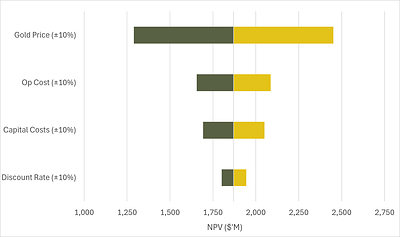
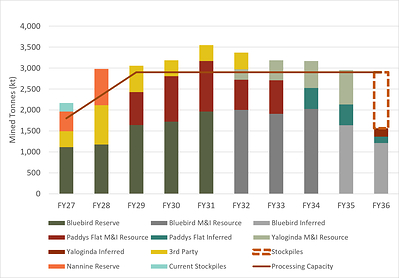
Sensitivity Analysis Figure 2 depicts sensitivity analysis for MXP. It shows that while sensitive to gold price, the project NPV is resilient to both discount rate and cost. MXP Basis for Production Target The Production Target outlined in the Scoping Study is based on a mixture of Ore Reserve and Mineral Resources across the Murchison and, as described in Figure 3, is a blend of underground, open pit, stockpile and potential supplementary ore sources across the Meekatharra hub and broader Murchison operating area. Ongoing drilling to convert the Mineral Resources into Ore Reserves is ongoing across the Murchison as part of the FY27 Resource Definition program (refer Figure 1). This program includes: - Bluebird–South Junction underground
The principal source of mill feed for MXP. Bluebird–South Junction has increased mine output from approximately 250ktpa in FY22 to an exit run-rate of more than 1.0Mtpa by the end of FY26.
Current planning assumes an exit mining rate of approximately 1.2Mtpa by the end of FY27. Subject to mine planning, development sequencing, resource conversion and operating performance, the combined Bluebird, South Junction and Polar Star mining areas are modelled to increase progressively thereafter, with annual scheduled underground ore reaching approximately 2.0Mtpa in later years of the Scoping Study production target
- Nannine
The Nannine mining centre (shown in Figure 1) houses the Aladdin and Golden Shamrock open pits. As part of the Murchison Open Pit program, the Nannine area supports a key mining zone within this program. Mining is currently six months into the program which is expected to operate within this area for another eighteen months. Albury Heath (which sits slightly outside the Nannine mining centre) is also included within this production target for ease of reference.
- Paddy's Flat
Satellite pits surrounding Paddy's Flat have been included within the current LoM schedule. This includes the Paddy's North, Magazine and Prohibition open pits. Drilling within the open pit targets is currently underway.
- Yaloginda
The Yaloginda area encompasses the region directly surrounding the Meekatharra Processing Plant. The historic Haveluck, Batavia, Rhens, and Rocklee open pits have been scheduled within the LoM. Whilst mined prior to Westgold ownership, these are less mature with respect to geological understanding and as such require further drilling post the Paddy's Flat resource definition work.
- Third party ore sources
The schedule includes indicative Westgold estimates of potential supplementary third-party feed over which Westgold have binding ore purchase agreements, including Crown Prince from New Murchison Gold and Valiant Gold's Reedy and Comet projects. These sources are not critical to the economic viability of MXP but provide additional flexibility and ore optionality to the expanded Meekatharra plant.
MXP Capital Costs The Scoping Study-level capital estimate (Table 4) for MXP has been determined at approximately $65M-$100M with estimate accuracy of ±35%, derived based on mechanical equipment lists from several sources such as quotes, and actual prices used from Westgold's current operating mines. Whilst overall contingency has been determined as a single line-item related to the total cost, additional contingency has been built into the individual cost estimates reflecting the high-level scoping nature of the study. Table 4: Capital Cost Estimate – MXP Equipment Name | Units | Cost | Primary Crushing | $M | 6.0 - 9.2 | Stockpile and Reclaim | $M | 1.6 - 2.4 | Milling | $M | 20.4 - 31.3 | Gravity | $M | 3.5 - 5.3 | Leach and Adsorption | $M | 4.6 - 7.0 | Elution | $M | 5.8 - 8.9 | Plant Air | $M | 0.4 - 0.6 | Instrument Air | $M | 0.4 - 0.6 | Total Equipment | $M | 41.6 – 64.0 | Direct Costs | $M | 2.1 - 3.0 | Indirect Costs | $M | 8.3 - 12.7 | Contingency | $M | 12.5 - 19.2 | Total Costs | $M | 65.0 – 100.0 |
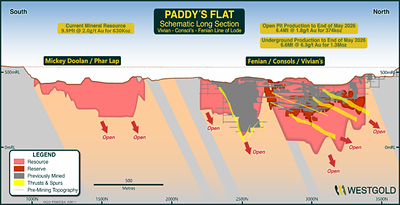
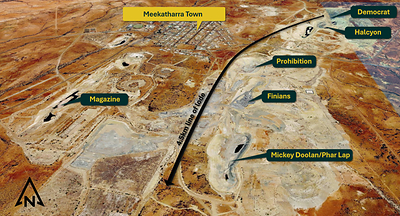
Risks, Study Maturity and Mitigation Pathway As with any processing expansion at this maturity, the Project remains subject to the risks and uncertainties typical of study-stage brownfields developments. For MXP, the principal variables include refinement of capital estimate accuracy, tie-in design, infrastructure confirmation, procurement of key secondary equipment (as the key processing equipment, the crusher and the SAG mill have already been purchased), construction scheduling and management of commissioning risk while maintaining continuity of operations. Murchison Brownfields Growth Opportunities Westgold's Murchison portfolio includes multiple mature assets that could deliver incremental open pit ore sources into existing regional operating centres. With disciplined capital allocation these opportunities will be progressively tested through resource definition, mine design and economic evaluation. These opportunities are all located within the broader Murchison operating footprint and sit within relatively short haulage distances of Westgold's Cue and Meekatharra processing hubs. Each area also benefits from historical mining activity, existing or legacy infrastructure and established geological knowledge, making them attractive brownfields targets for further evaluation. As an example, at Paddy's Flat near Meekatharra (Figure 4 and Figure 5), the current resource definition focus is on assessing historically productive corridors for remnant mineralisation, strike extensions and shallow targets that may support staged open pit cutbacks, satellite open pits or otherwise incremental ore sources for the Meekatharra production base. Drilling has begun in the Paddy's North area with the focus the northern extensions of Halcyon and Democrat pits. These phases of work will test the continuation of the Prohibition strike to the North targeting the historical Halcyon and Democrats pits which has been untested since mining ceased in the 1990s. The Halcyon pit produced approximately 500kt at 3.6g/t Au for 58koz, while the historical Democrat pit produced approximately 192kt at 3.3g/t Au for 20koz. Following completion of drilling along the Big Bell South line of lode at Cue, the drill rigs are expected to be mobilised to the broader Paddy's Flat area. Next Steps MXP and the Murchison brownfields resource definition program together provide a capital-efficient pathway to grow the Meekatharra hub. Lifting installed capacity from 1.8Mtpa to 2.9Mtpa in FY28 through existing infrastructure is expected to deliver higher gold production, lower processing unit costs and improved free cash flow, without the capital intensity or execution timeline of a new plant. Next-stage work will focus on detailed feasibility study and front-end engineering design, procurement planning, vendor engagement and execution sequencing, including shutdown scheduling and securing long-lead items where appropriate. Study maturity will continue to be advanced ahead of any investment decision. Westgold will also continue its brownfields resource definition program, testing potential future ore sources against haulage distance, mine design, processing fit and capital intensity to support sustained utilisation of the expanded plant. Westgold expects to incorporate MXP as part of its next strategic outlook, with FY28 currently used as the indicative production timing for planning purposes. This timing is preliminary and remains subject to feasibility-level studies, capital estimate refinement, execution planning, ore source confirmation and any required investment decision. This announcement is authorised for release to the ASX by the Board. Compliance Statements Competent/Qualified Person Statements Exploration Results and Mineral Resources Estimates The information in this release that relates to Exploration results and Mineral Resource Estimates is compiled by Westgold technical employees and contractors under the supervision of Mr. Jake Russell B.Sc. (Hons), who is a member of the Australian Institute of Geoscientists and who has verified, reviewed and approved such information. Mr Russell is a full-time employee of the Company and has sufficient experience which is relevant to the styles of mineralisation and types of deposit under consideration and to the activities which he is undertaking to qualify as a Competent Person as defined in the 2012 Edition of the Australasian Code for Reporting of Exploration Results, Mineral Resources and Ore Reserves (the "JORC Code") and as a Qualified Person as defined in the CIM Guidelines and National Instrument 43-101 – Standards of Disclosure for Mineral Projects ("NI 43-101"). Mr. Russell is an employee of the Company and, accordingly, is not independent for purposes of NI 43-101. Mr Russell consents to and approves the inclusion in this release of the matters based on his information in the form and context in which it appears. Mr Russell is eligible to participate in short- and long-term incentive plans of the company. Ore Reserves The information in this release that relates to Ore Reserve is based on information compiled by Mr. Leigh Devlin B.Eng. FAusIMM, who has verified, reviewed and approved such information. Mr. Devlin has sufficient experience which is relevant to the styles of mineralisation and types of deposit under consideration and to the activities which they are undertaking to qualify as a Competent Person as defined in the JORC Code and as a Qualified Person as defined in the CIM Guidelines and NI 43-101. Mr. Devlin is an employee of the Company and, accordingly, is not independent for purposes of NI 43-101. Mr. Devlin consents to and approves the inclusion in this release of the matters based on his information in the form and context in which it appears. Mr. Devlin is a full-time senior executive of the Company and is eligible to and may participate in short-term and long-term incentive plans of the Company as disclosed in its annual reports and disclosure documents. General Mineral Resources, Ore Reserve Estimates and Exploration Targets and Results are calculated in accordance with the JORC Code. Investors outside Australia should note that while Ore Reserve and Mineral Resource estimates of the Company in this announcement comply with the JORC Code (such JORC Code-compliant Ore Reserves and Mineral Resources being "Ore Reserves" and "Mineral Resources" respectively), they may not comply with the relevant guidelines in other countries. The JORC Code is an acceptable foreign code under NI 43-101. Information contained in this release describing mineral deposits may not be comparable to similar information made public by companies subject to the reporting and disclosure requirements of US securities laws, including Item 1300 of Regulation S-K. All technical and scientific information in this release has been prepared in accordance with the Canadian regulatory requirements set out in NI 43-101 and has been reviewed on behalf of the Company by Qualified Persons, as set forth above. This release contains references to estimates of Mineral Resources and Ore Reserves. The estimation of Mineral Resources is inherently uncertain and involves subjective judgments about many relevant factors. Mineral Resources that are not Ore Reserves do not have demonstrated economic viability. The accuracy of any such estimates is a function of the quantity and quality of available data, and of the assumptions made and judgments used in engineering and geological interpretation, which may prove to be unreliable and depend, to a certain extent, upon the analysis of drilling results and statistical inferences that may ultimately prove to be inaccurate. Mineral Resource estimates may require re-estimation based on, among other things: (i) fluctuations in the price of gold; (ii) results of drilling; (iii) results of metallurgical testing, process and other studies; (iv) changes to proposed mine plans; (v) the evaluation of mine plans subsequent to the date of any estimates; and (vi) the possible failure to receive required permits, approvals and licenses. Forward Looking Statements These materials prepared by Westgold Resources Limited include forward looking statements. Often, but not always, forward looking statements can generally be identified by the use of forward looking words such as "may", "will", "expect", "intend", "believe", "forecast", "predict", "plan", "estimate", "anticipate", "continue", and "guidance", or other similar words and may include, without limitation, statements regarding the Company's 3YO, including estimates of gold production, grades, recoveries and its expectations regarding AISC, the timing of updates to Mineral Resource estimates or Ore Reserves, plans, strategies and objectives of management, anticipated production or construction commencement dates and expected costs or production outputs. Forward looking statements inherently involve known and unknown risks, uncertainties and other factors that may cause the Company's actual results, performance and achievements to differ materially from any future results, performance or achievements. Relevant factors may include, but are not limited to, changes in commodity prices, foreign exchange fluctuations and general economic conditions, increased costs and demand for production inputs, the speculative nature of exploration and project development, including the risks of obtaining necessary licenses and permits and diminishing quantities or grades of reserves, political and social risks, changes to the regulatory framework within which the Company operates or may in the future operate, environmental conditions including extreme weather conditions, recruitment and retention of personnel, industrial relations issues and litigation. Forward looking statements are based on the Company's and its management's good faith assumptions relating to the financial, market, regulatory and other relevant environments that will exist and affect the Company's business and operations in the future. The Company does not give any assurance that the assumptions on which forward looking statements are based will prove to be correct, or that the Company's business or operations will not be affected in any material manner by these or other factors not foreseen or foreseeable by the Company or management or beyond the Company's control. Although the Company attempts and has attempted to identify factors that would cause actual actions, events or results to differ materially from those disclosed in forward looking statements, there may be other factors that could cause actual results, performance, achievements or events not to be as anticipated, estimated or intended, and many events are beyond the reasonable control of the Company. In addition, the Company's actual results could differ materially from those anticipated in these forward looking statements as a result of the factors outlined in the "Risk Factors" section of the Company's continuous disclosure filings available on SEDAR+ or the ASX, including, in the Company's current annual report, half year report or most recent management discussion and analysis. Accordingly, readers are cautioned not to place undue reliance on forward looking statements. Forward looking statements in these materials speak only at the date of issue. Subject to any continuing obligations under applicable law or any relevant stock exchange listing rules, in providing this information the Company does not undertake any obligation to publicly update or revise any of the forward-looking statements or to advise of any change in events, conditions or circumstances. Appendix 1: Mineral Resource Basis The Mineral Resource and Ore Reserve based on MXP is shown below. This is based on the current statement provided by Westgold on 20 August 2026 – 2026 Mineral Resource Estimate and Ore Reserves. Table 5: Ore Reserve Statement Ore Reserve Statement at 30/06/2026 |
|
| Proven | Probable | Total | Operating Mine | Tonnes
('000) | Grade
(g/t) | Ounces
('000) | Tonnes
('000) | Grade
(g/t) | Ounces
('000) | Tonnes
('000) | Grade
(g/t) | Ounces
('000) | Meekatharra North | 0 | 0.00 | 0 | 0 | 0.00 | 0 | 0 | 0.00 | 0 | Nannine | 0 | 0.00 | 0 | 761 | 1.28 | 31 | 761 | 1.28 | 31 | Paddy's Flat | 48 | 4.10 | 6 | 435 | 3.86 | 54 | 483 | 3.88 | 60 | Yaloginda District | 0 | 0.00 | 0 | 240 | 1.34 | 10 | 240 | 1.34 | 10 | Bluebird Stockpiles | 137 | 2.89 | 13 | 29 | 0.91 | 1 | 167 | 2.54 | 14 | Bluebird Group UG | 1,195 | 2.37 | 91 | 4,979 | 2.67 | 428 | 6,174 | 2.62 | 519 |
|
|
|
|
|
|
|
|
|
|
|
Table 6: Mineral Resource Statement Mineral Resource Statement at 30/06/2026 |
| Measured | Indicated | Inferred | Total | Project | Tonnes
('000) | Grade
(g/t) | Ounces
('000) | Tonnes
('000) | Grade
(g/t) | Ounces
('000) | Tonnes
('000) | Grade
(g/t) | Ounces
('000) | Tonnes
('000) | Grade
(g/t) | Ounces
('000) |
| Meekatharra
North | 0 | 0.00 | 0 | 97 | 1.98 | 6 | 75 | 2.11 | 5 | 172 | 2.04 | 11 |
| Nannine | 74 | 2.42 | 6 | 1,120 | 1.85 | 67 | 355 | 2.22 | 25 | 1,548 | 1.96 | 98 |
| Paddy's Flat | 376 | 3.67 | 44 | 7,125 | 1.88 | 431 | 2,401 | 2.00 | 154 | 9,902 | 1.98 | 630 |
| Yaloginda
District | 54 | 2.69 | 5 | 4,300 | 1.47 | 204 | 5,842 | 1.38 | 259 | 10,196 | 1.43 | 467 |
| Bluebird
Stockpiles | 137 | 2.89 | 13 | 29 | 0.91 | 1 | 0 | 0.00 | 0 | 167 | 2.54 | 14 |
| Bluebird
Group UG | 1,292 | 3.11 | 129 | 8,203 | 2.93 | 773 | 6,489 | 2.53 | 528 | 15,984 | 2.78 | 1,430 |
|
Appendix 2: MXP Technical Detail and Assumptions The process design basis for MXP is built around Westgold's established Meekatharra processing plant. The existing plant configuration comprises primary and secondary crushing, stockpile and reclaim, conventional SAG milling with recycle pebble crushing, parallel ball mills in closed circuit with cyclone classification, gravity recovery, leach and adsorption, elution and gold recovery, carbon regeneration and final tailings disposal. The MXP philosophy has therefore been to add incremental comminution capacity and selected downstream debottlenecking while preserving as much of this installed base as possible. The key equipment selection includes: - Primary Crushing – C130 Jaw Crusher, 185kW with scalped feed;
- Surge Bin – 45 minutes residence time, overflow to stockpile (~60h surge capacity) with reclaim;
- SAG Milling – Ø7.32m x 4.00m SAG Mill, 3,600kW full variable speed drive (pre-purchased);
- Classification – 12-pack of 250CVX10 Weir Cyclones;
- Gravity Circuit – QS30 Knelson concentrator and Acacia CS1000 cyanidation finish;
- Elution Circuit – replacing the existing elution circuit with an 8t elution circuit; and
- Leach & Adsorption Circuit – two additional leach tanks while maintaining six adsorption.
Under the selected concept, new ROM feed is directed to a dedicated crushing installation comprising an ore bin, apron feeder, vibrating grizzly and a primary jaw crusher. The crusher selection is based on a jaw crusher with 185kW installed power, sized for the anticipated lump feed conditions and intended to operate with scalped feed to reduce wear and improve duty continuity. Crushed ore reports to a surge bin and overflow to a dead stockpile capable of providing surge capacity. This arrangement is important from an operating standpoint as it decouples crusher duty from SAG feed continuity and provides practical resilience in a brownfields plant setting, where interruptions to one area should not immediately destabilise the entire circuit. Downstream of crushing, the new single-stage SAG circuit has been sized at approximately 1.1Mtpa and modelled to produce a P80 of around 95 microns. The selected mill duty is based on a SAG mill fitted with a 3,600kW variable speed drive. Cyclone classification is based on a 12-pack with duty and standby allocation consistent with brownfields operating reliability requirements. Notably, the selected flowsheet does not require a recycle pebble crusher at the nominated design duty, although the study materials deliberately preserve layout optionality for future installation should coarser grind targets or harder ore blends justify that addition in later years. A separate gravity stream based on a Knelson concentrator and Acacia reactor has been selected to manage gravity recoverable gold from cyclone underflow while simplifying overall operating complexity. Downstream, the combined flowsheet requires selected leach and adsorption changes, including allowances for additional tankage to preserve residence time, plus replacement or upgrade of screens and elution duties that would otherwise sit near or above their original design limits under the expanded throughput case. The main cost categories identified in the underlying study are labour, power, maintenance, reagents and consumables. Study work identifies an increase in both operations and maintenance headcount, including additional operators, gold room coverage, maintenance planners and trade support. At Meekatharra underground mining is done via longhole open stoping at Bluebird-South Junction. A significant Open Pit program has been assumed within the Scoping Study with truck and shovel mining the chosen methodology. Cut-backs on these pits have been assumed utilising current costs supplied by external operators alongside Westgold's own internal costing regime. Wall angles, bench heights, and berm widths are based on a mixture of historical mining within these pits as well as geotechnical recommendations supplied by external consultants. Dilution and ore loss aligns with historic mining within the area. Open Pit mining is currently underway at the time of writing across the Murchison region as outlined in the 3-Year Outlook. Modifying factors such as minimum mining widths, dilution, cut-off grades, stope and bench sizes and ore loss, are all included within the Scoping Study and based on current experience at the existing operating mines. Westgold has carried out processing at the Meekatharra mill since 2016. The production target identified in the Scoping Study assumes processing recoveries consistent with current achievements. It is assumed that any increase in throughput at the Meekatharra mill as determined within the Scoping Study will not adversely affect the recovery of the processed material. Appendix 3 – JORC 2012 Table 1– Gold Division SECTION 1: SAMPLING TECHNIQUES AND DATA (Criteria in this section apply to all succeeding sections.) Criteria | JORC Code Explanation | Commentary | Sampling techniques
Drilling techniques
Drill sample recovery
| - Nature and quality of sampling (e.g. cut channels, random chips, or specific specialised industry standard measurement tools appropriate to the minerals under investigation, such as down hole gamma sondes, or handheld XRF instruments, etc.). These examples should not be taken as limiting the broad meaning of sampling.
- Include reference to measures taken to ensure sample representivity and the appropriate calibration of any measurement tools or systems used.
- Aspects of the determination of mineralisation that are Material to the Public Report.
- In cases where 'industry standard' work has been done this would be relatively simple (e.g. 'reverse circulation drilling was used to obtain 1 m samples from which 3 kg was pulverised to produce a 30 g charge for fire assay'). In other cases more explanation may be required, such as where there is coarse gold that has inherent sampling problems. Unusual commodities or mineralisation types (e.g. submarine nodules) may warrant disclosure of detailed information.
- Drill type (e.g. core, reverse circulation, open-hole hammer, rotary air blast, auger, Bangka, sonic, etc.) and details (e.g. core diameter, triple or standard tube, depth of diamond tails, face-sampling bit or other type, whether core is oriented and if so, by what method, etc.).
- Method of recording and assessing core and chip sample recoveries and results assessed.
- Measures taken to maximise sample recovery and ensure representative nature of the samples.
- Whether a relationship exists between sample recovery and grade and whether sample bias may have occurred due to preferential loss/gain of fine/coarse material.
| - Diamond Drilling
A significant portion of the data used in resource calculations has been gathered from diamond core. Multiple core sizes have been used historically. This core is geologically logged and subsequently halved for sampling. Grade control holes may be whole-cored to streamline the core handling process if required. - Face Sampling
At each of the major past and current underground producers, each development face / round is chip sampled perpendicular to the mineralisation. The sampling intervals are domained by geological constraints (e.g. rock type, veining and alteration / sulphidation etc.). The majority of exposures within the orebody are sampled. - Sludge Drilling
Sludge drilling is performed with an underground production drill rig. It is an open hole drilling method using water as the flushing medium, with a 64mm (nominal) hole diameter. Sample intervals are ostensibly the length of the drill steel. Holes are drilled at sufficient angles to allow flushing of the hole with water following each interval to prevent contamination. Sludge drilling is not used to inform resource models. - RC Drilling
Drill cuttings are extracted from the RC return via cyclone. The underflow from each interval is transferred via bucket to a four-tiered riffle splitter, delivering approximately three kilograms of the recovered material into calico bags for analysis. The residual material is retained on the ground near the hole. Composite samples are obtained from the residue material for initial analysis, with the split samples remaining with the individual residual piles until required for re-split analysis or eventual disposal. Samples too wet to be split through the cone splitter are taken as grabs from the bucket and are recorded as such. - RAB / Aircore Drilling
Combined scoops from bucket dumps from cyclone for composite. Split samples taken from individual bucket dumps via scoop. RAB holes are not included in the resource estimate. - Blast Hole Drilling
Cuttings sampled via splitter tray per individual drill rod. Blast holes are not included in the resource estimate.All geology input is logged and validated by the relevant area geologists, incorporated into an assessment of sample recovery. No defined relationship exists between sample recovery and grade. Nor has sample bias due to preferential loss or gain of fine or coarse material been noted.
| Logging | - Whether core and chip samples have been geologically and geotechnically logged to a level of detail to support appropriate Mineral Resource estimation, mining studies and metallurgical studies.
- Whether logging is qualitative or quantitative in nature. Core (or costean, channel, etc.) photography.
- The total length and percentage of the relevant intersections logged
| - Westgold drill-holes are all orientated and have been logged in detail for geology, veining, alteration, mineralisation and orientated structure. Westgold underground drill-holes are logged in detail for geology, veining, alteration, mineralisation and structure. Core has been logged in enough detail to allow for the relevant mineral resource estimation techniques to be employed.
- Surface core is photographed both wet and dry and underground core is photographed wet. All photos are stored on the Company's servers, with the photographs from each hole contained within separate folders.
- Development faces are mapped geologically.
- RC, RAB and Aircore chips are geologically logged, and retained in chip trays for reference
- Sludge drilling is logged for lithology, mineralisation and vein percentage.
- Logging is both qualitative and quantitative in nature. Structure and geotechnical logging is quantitative in nature.
- 100% of drillcore is logged.
- Geotechnical logging is undertaken over all relevant areas of drill core.
| Sub-sampling techniques and sample preparation | - If core, whether cut or sawn and whether quarter, half or all core taken.
- If non-core, whether riffled, tube sampled, rotary split, etc. and whether sampled wet or dry.
- For all sample types, the nature, quality and appropriateness of the sample preparation technique.
- Quality control procedures adopted for all sub-sampling stages to maximise representivity of samples.
- Measures taken to ensure that the sampling is representative of the in-situ material collected, including for instance results for field duplicate/second-half sampling.
- Whether sample sizes are appropriate to the grain size of the material being sampled.
| - Blast holes -Sampled via splitter tray per individual drill rods.
- RAB / AC chips - Combined scoops from bucket dumps from cyclone for composite. Split samples taken from individual bucket dumps via scoop.
- RC - Three tier riffle splitter (approximately 5kg sample). Samples are generally dry.
- Face Chips - Nominally chipped across the face from left to right, sub-set via geological features as appropriate.
- Diamond Drilling - Half-core niche samples, sub-set via geological features as appropriate. Grade control holes may be whole-cored to streamline the core handling process if required.
- Chips / core chips undergo total preparation.
- At external Laboratories samples undergo fine pulverisation of the entire sample by an LM5 type mill to achieve a 75µ product prior to splitting. At the internal Bluebird Laboratory a 650g samples of 3mm sample sizing, undergoes fine pulverization by a LM2 type mill to achieve a 75µ product prior to sub splitting.
- QA/QC is currently ensured during the sub-sampling stages process via the use of the systems of an external independent NATA or internal ISO accredited laboratory contractor. A significant portion of the historical informing data has been processed internally.
- Sample representativity and possible relationship between grain size and grade are checked by re- sampling the relevant intervals and resubmitting new samples for assay.
- The sample size is considered appropriate for the grain size of the material being sampled.
- The un-sampled half of diamond core is retained for check sampling if required. For RC chips regular field duplicates are collected and analysed for significant variance to primary results.
- Sample size follows industry standard best practice and is considered appropriate for these style(s) of mineralisation.
- The Competent Person considers the sub-sampling techniques and sample preparation processes of current and historical RC and DDH drilling is appropriate for the Mineral Resource estimates (MREs).
| Quality of assay data and laboratory tests | - The nature, quality and appropriateness of the assaying and laboratory procedures used and whether the technique is considered partial or total.
- For geophysical tools, spectrometers, handheld XRF instruments, etc., the parameters used in determining the analysis including instrument make and model, reading times, calibrations factors applied and their derivation, etc.
- Nature of quality control procedures adopted (e.g. standards, blanks, duplicates, external laboratory checks) and whether acceptable levels of accuracy (i.e. lack of bias) and precision have been established.
| - All samples have been prepared and analysed via NATA accredited or AS/NZS ISO 9001:2000 compliant Laboratories, who conduct their own internal QA/QC processes.
- At the inhouse Bureau Veritas Laboratory samples are dried at 105°C for 1 to 2 hours until passing a moisture check. Samples are then crushed to <3mm in the Boyd Elite Crusher and split using a linear sample divider. A split of 650g undergoes pulverisation to 90% passing a size fraction of <75µm. This material is then split into a 300g pulp for Fire Assay analysis.
- Offsite NATA accredited Laboratory sample preparation is by way of drying and full core crushing and then pulverisation via a LM5 style mill to 90% passing a size fraction of <75µm. This material is then split into a 250g pulp for Fire Assay analysis.
- All recent samples were analysed by fire assay. A 40g sample undergoes fire assay lead collection followed by flame atomic adsorption spectrometry (0.01ppm lower detection limit). The Laboratory manages internal QAQC via the insertion of two pulp repeats, two standards and one blanks for each 50-sample batch.
- Photon Assay was introduced in 2023 for Beta Hunt grade control samples and subsequently discontinued in 2024. PhotonAssay™ technology (Chrysos Corporation Limited) is a rapid, non-destructive analysis of gold and other elements in mineral samples. Photon assay size is approximately 500 g of crushed product.
- Historical drilling has used a combination of Fire Assay, Aqua Regia and PAL analysis.
- Westgold Quality control is ensured via the use of standards, blanks and repeats.
- Standards and Blanks were used by the laboratory for all post-1990 sampling, and duplicates were routinely analysed, with check assay programs sent to an alternate laboratory on a program basis. All drilling since 2005 has used standards and certified blanks submitted to the laboratory by the Company. No evidence of analytical bias exists for drilling where acceptable standards of QC were adopted and no bias is evident between these sampling programs and those of earlier generations of drilling.
- No significant QA/QC issues have arisen in recent drilling results.
- These assay methodologies are appropriate for the resources in question.
| Verification of sampling and assaying | - The verification of significant intersections by either independent or alternative company personnel.
- The use of twinned holes.
- Documentation of primary data, data entry procedures, data verification, data storage (physical and electronic) protocols.
- Discuss any adjustment to assay data.
| - All significant intersections are verified by the Senior Geologist during the drillhole validation.
- Twinned holes (<5m separation) have been drilled in several instances across all sites with no significant issues identified. Drillhole data is routinely confirmed by development assay data in the operating environment.
- Primary data is collected utilising LogChief. The information is imported into a SQL database server and verified.
- All data used in the calculation of Mineral Resources and Ore Reserves are compiled in databases (underground and open pit) which are overseen and validated by senior geologists. Holes that do not meet Westgold quality standards are excluded prior to Mineral Resource estimation.
- No adjustments have been made to any assay data.
| Location of data points | - Accuracy and quality of surveys used to locate drill holes (collar and down-hole surveys), trenches, mine workings and other locations used in Mineral Resource estimation.
- Specification of the grid system used.
- Quality and adequacy of topographic control.
| - All data is spatially oriented by survey controls via direct pickups by the survey department. Drillholes are all surveyed downhole, deeper holes with a Gyro tool if required, the majority with single / multishot cameras. Surveys are verified during drillhole validation and poor surveys resurveyed.
- If survey data is missing or quality is suspect, then the data is excluded from estimation.
- All drilling and resource estimation is preferentially undertaken in local mine grid at the various sites.
- Topographic control is generated from a combination of remote sensing methods and ground-based surveys. This methodology is adequate for the resources in question.
- The Competent Person considers the accuracy and quality of survey data for historical RC and DDH drilling is appropriate for Mineral Resource estimates.
| Data spacing and distribution | - Data spacing for reporting of Exploration Results.
- Whether the data spacing and distribution is sufficient to establish the degree of geological and grade continuity appropriate for the Mineral Resource and Ore Reserve estimation procedure(s) and classifications applied.
- Whether sample compositing has been applied.
| - Data spacing is variable dependent upon the individual orebody under consideration. A lengthy history of mining has shown that this approach is appropriate for the Mineral Resource Estimation process and to allow for classification of the resources as they stand.
- No sample compositing has been applied to the database. For grade estimation compositing is undertaken on datasets based upon the modal sample length of each individual domain.
| Orientation of data in relation to geological structure | - Whether the orientation of sampling achieves unbiased sampling of possible structures and the extent to which this is known, considering the deposit type.
- If the relationship between the drilling orientation and the orientation of key mineralised structures is considered to have introduced a sampling bias, this should be assessed and reported if material.
| - Drillholes are designed to intersect the mineralisation as close as practical to the true thickness of the orebody subject to underground infrastructure and topography constraints.
- Development sampling is nominally undertaken normal to the various orebodies.
- Where drilling angles are sub optimal the number of samples per drill hole used in the -estimation has been limited to reduce any potential bias.
- It is not considered that drilling orientation has introduced an appreciable sampling bias.
| Sample security | - The measures taken to ensure sample security.
| - For samples assayed at on-site laboratory facilities, samples are delivered to the facility by Company staff. Upon delivery the responsibility for sample security and storage falls to the independent third-party operators of these facilities.
- For samples assayed off-site, samples are delivered to a third-party transport service, who in turn relay them to the independent laboratory contractor. Samples are stored securely until they leave site.
- Chain of custody is demonstrated by Westgold and the Bureau Veritas in the delivery and receipt of samples.
- All retained core, RC chip trays and pulp samples are currently stored onsite by Westgold and are available for verification if required.
| Audits or reviews | - The results of any audits or reviews of sampling techniques and data
| - Site generated Mineral Resources and Ore Reserves and the parent geological data is routinely reviewed by the Westgold Corporate technical team.
- In March 2025 a health check of the Company's drill databases was undertaken resulting in a process to upgrade the Datashed Database to a more recent platform.
- Routine audits of the Bureau Veritas Laboratories are undertaken by Westgold staff, to confirm compliance to process.
|
SECTION 2: REPORTING OF EXPLORATION RESULTS (Criteria listed in the preceding section also apply to this section.) Criteria | JORC Code Explanation | Commentary | Mineral tenement and land tenure status | - Type, reference name/number, location and ownership including agreements or material issues with third parties such as joint ventures, partnerships, overriding royalties, native title interests, historical sites, wilderness or national park and environmental settings.
- The security of the tenure held at the time of reporting along with any known impediments to obtaining a license to operate in the area.
| - Native title interests are recorded against several Westgold tenements.
- The CMGP tenements are held by the Big Bell Gold Operations (BBGO) of which Westgold has 100% ownership.
- Several third-party royalties exist across various tenements at CMGP, over and above the state government royalty.
- The tenure is currently in good standing.
- There are no known issues regarding security of tenure.
- There are no known impediments to continued operation.
- Westgold operates in accordance with all environmental conditions set down as conditions for grant of the leases.
| Exploration done by other parties | - Acknowledgment and appraisal of exploration by other parties
| - The CMGP tenements have an exploration and production history in excess of 100 years.
| Geology | - Deposit type, geological setting and style of mineralisation.
| MGO - MGO is located in the Achaean Murchison Province, a granite-greenstone terrane in the northwest of the Yilgarn Craton. Greenstone belts trending north-northeast are separated by granite-gneiss domes, with smaller granite plutons also present within or on the margins of the belts.
- The Paddy's Flat area is located on the western limb of a regional fold, the Polelle Syn- cline, within a sequence of mafic to ultramafic volcanics with minor interflow sediments and banded iron-formation. The sequence has also been intruded by felsic porphyry dykes prior to mineralisation. Mineralisation is located along four sub-parallel trends at Paddy's Flat which can be summarized as containing three dominant mineralisation styles:
- Sulphide replacement BIF hosted gold. Quartz vein hosted shear-related gold.
- Quartz-carbonate-sulphide stockwork vein and alteration related gold.
- The Yaloginda area which host Bluebird – South Junction, is a gold-bearing Archaean greenstone belt situated ~15km south of Meekatharra. The deposits in the area are hosted in a strained and metamorphosed volcanic sequence that consists primarily of ultramafic and high-magnesium basalt with minor komatiite, peridotite, gabbro, tholeiitic basalt and interflow sediments. The sequence was intruded by a variety of felsic porphyry and intermediate sills and dykes
| Drill hole Information | - A summary of all information material to the understanding of the exploration results including a tabulation of the following information for all Material drill holes:
- easting and northing of the drill hole collar
- elevation or RL (Reduced Level – elevation above sea level in metres) of the drill hole collar
- dip and azimuth of the hole
- down hole length and interception depth
- hole length.
- If the exclusion of this information is justified on the basis that the information is not Material and this exclusion does not detract from the understanding of the report, the Competent Person should clearly explain why this is the case.
| - Exploration results are not being reported in this release.
| Data aggregation methods | - In reporting Exploration Results, weighting averaging techniques, maximum and/or minimum grade truncations (e.g., cutting of high grades) and cut-off grades are usually Material and should be stated.
- Where aggregate intercepts incorporate short lengths of high-grade results and longer lengths of low-grade results, the procedure used for such aggregation should be stated and some typical examples of such aggregations should be shown in detail.
- The assumptions used for any reporting of metal equivalent values should be clearly stated.
| - Exploration results are not being reported in this release.
| Relationship between mineralisation widths and intercept lengths | - These relationships are particularly important in the reporting of Exploration Results.
- If the geometry of the mineralisation with respect to the drill hole angle is known, its nature should be reported.
- If it is not known and only the down hole lengths are reported, there should be a clear statement to this effect (e.g., 'down hole length, true width not known').
| - Exploration results are not being reported in this release.
| Diagrams | - Appropriate maps and sections (with scales) and tabulations of intercepts should be included for any significant discovery being reported These should include, but not be limited to a plan view of drill hole collar locations and appropriate sectional views.
| - Exploration results are not being reported in this release.
| Balanced reporting | - Where comprehensive reporting of all Exploration Results is not practicable, representative reporting of both low and high grades and/or widths should be practiced to avoid misleading reporting of Exploration Results.
| - Exploration results are not being reported in this release.
| Other substantive exploration data | - Other exploration data, if meaningful and material, should be reported including (but not limited to): geological observations; geophysical survey results; geochemical survey results; bulk samples – size and method of treatment; metallurgical test results; bulk density, groundwater, geotechnical and rock characteristics; potential deleterious or contaminating substances.
| - There is no other substantive exploration data associated with this release.
| Further work | - The nature and scale of planned further work (e.g. tests for lateral extensions or depth extensions or large-scale step-out drilling).
- Diagrams clearly highlighting the areas of possible extensions, including the main geological interpretations and future drilling areas, provided this information is not commercially sensitive.
| - Ongoing surface and underground exploration activities will be undertaken to support continuing mining activities at Westgold Gold Operations.
|
SECTION 3: ESTIMATION AND REPORTING OF MINERAL RESOURCES (Criteria listed in section 1, and where relevant in section 2, also apply to this section.) Criteria | JORC Code Explanation | Commentary | Database integrity | - Measures taken to ensure that data has not been corrupted by, for example, transcription or keying errors, between its initial collection and its use for Mineral Resource estimation purposes.
- Data validation procedures used.
| - The database used for the estimation was extracted from the Westgold DataShed database management system stored on a secure SQL server.
- As new data is acquired it passes through a validation approval system designed to pick up any significant errors before the information is loaded into the master database.
- Geological data is collected with Logchief software and uploaded digitally. The software utilises lookup tables, fixed formatting, and validation routines to ensure data integrity prior to upload to the central database.
- Westgold utilises the QAQC Reporting system within Datashed to analyse QA/QC data, and batches which do not meet passing criteria are requested to be re‐assayed. Sample grades are checked visually in three dimensions against the logged geology and geological interpretation. Drill hole collar pickups are checked against planned and/or actual collar locations.
| Site visits | - Comment on any site visits undertaken by the Competent Person and the outcome of those visits.
- If no site visits have been undertaken indicate why this is the case.
| - Mr. Russell visits Westgold Gold Operations regularly.
| Geological interpretation | - Confidence in (or conversely, the uncertainty of) the geological interpretation of the mineral deposit.
- Nature of the data used and of any assumptions made.
- The effect, if any, of alternative interpretations on Mineral Resource estimation.
- The use of geology in guiding and controlling Mineral Resource estimation.
- The factors affecting continuity both of grade and geology.
| - Mining in the Murchison and Goldfields districts has occurred since 1800's providing significant confidence in the current geological interpretation across all projects.
- For all deposits the geological interpretations have been completed in 3D using Leapfrog software. All available data has been used to help build the geological interpretation, with the integration of geological logging, mapping, structural measurements and drill hole assay data.
- Geology (lithological units, alterations, structure, veining) have been used to guide and control domain interpretation.
- Overall, there is confidence at a global (domain-level) scale of the interpretations, with the expectation that they will continue to be refined following the collection of additional data.
- No alternative interpretations are currently considered viable.
- The structural regime is the dominant control on geological and grade continuity in the Murchison and Goldfields. Lithological factors such as rheology contrast are secondary controls on grade distribution. Cross cutting relationships including barren dykes, porphyries and faults have been incorporated into the geological model and removed from estimation where known to exist
- The mineralised interpretation was based upon sampled intervals, and any drilled intervals that were not sampled have been treated as absent data.
- Low-grade stockpiles are derived from previous mining of the mineralisation styles outlined above.
- The data is considered robust due to effective database management, and validation checks to verify the quality of the data.
- Diamond drill holes have provided detailed information to assist in the development of the geological and mineralisation interpretation. The confidence in type, thickness and location of host lithologies and mineralised structures are well understood.
| Dimensions | - The extent and variability of the Mineral Resource expressed as length (along strike or otherwise), plan width, and depth below surface to the upper and lower limits of the mineral Resource.
|
MGO
- The Paddy's Flat Trend is mineralised a strike length of >3,900m, a lateral extent of up +230m and a depth of over 500m.
- Bluebird – South Junction is mineralised a strike length of >1,800m, a lateral extent of up +50m and a depth of over 500m.
STOCKPILES - Low-grade stockpiles are of various dimensions. All modelling and estimation work undertaken by Westgold is carried out in 3D via Surpac Software.
| Estimation and modelling techniques. | - The nature and appropriateness of the estimation technique(s) applied and key assumptions, including treatment of extreme grade values, domaining, interpolation parameters, maximum distance of extrapolation from data points.
- The availability of check estimates, previous estimates and/or mine production records and whether the Mineral Resource estimate takes appropriate account of such data.
- The assumptions made regarding recovery of by-products.
- Estimation of deleterious elements or other non-grade variables of economic significance (e.g. sulphur for acid mine drainage characterisation).
- In the case of block model interpolation, the block size in relation to the average sample spacing and the search employed.
- Any assumptions behind modelling of selective mining units.
- Any assumptions about correlation between variables.
- The process of validation, the checking process used, the comparison of model data to drillhole data, and use of reconciliation data if available.
| Datashed – front end to a SQL Database, Leapfrog - Drill hole validation, structural analysis and stereonets, material type, lithology, alteration and faulting wireframes, domaining and mineralisation wireframes, geophysics and regional geology. Snowden Supervisor - geostatistics, variography, declustering, top-cut, kriging neighbourhood analysis (KNA), model validation. Surpac - drill hole validation, block modelling, geostatistics, CIK, OK estimation, block model validation, classification, depletion and reporting. - Drillholes are flagged to mineralised domains and composited to provide equal support for grade estimation.
- Statistical analysis by domain is undertaken to assist with determining estimation approach, search parameters, top-cuts etc.
- Treatment of extreme grade values – Top-cuts were applied to composites within mineralised wireframes to manage the influence of extreme grade values. In selected domains, additional grade and distance restrictions were applied during interpolation to produce a more localised estimate and limit the influence of high-grade outliers.
- Top-cut analysis was carried out on the composited gold values using histograms, log probability and mean-variance plots, and where possible validated with production data.
- Kriging Neighbourhood Analysis (KNA) is undertaken to optimise the search neighbourhood used for the estimation and to test the parent block size.
- Search ellipse orientation was taken directly from the variogram orientation for each domain/sub-domain. The search ellipse sizes were based on a combination of drillhole spacing and variographic analysis where the first search ellipse range was approximately two-thirds that of the variogram. Various minimum and maximum samples were used in the first search. Three search passes are used each with increasing search ellipse sizes.
- The search ellipse and selected samples by block were viewed in three dimensions to verify the parameters. Final parameters are incorporated with observed geological and geometrical features to determine the most appropriate search parameters.
- Parent block and sub-cell sizes vary depending on orebody geometry, minimum mining units, estimation parameters and levels of informing data available. Estimation is into the parent block with full subset of points.
- Grade estimation is undertaken, with Ordinary Kriging (OK) considered as standard due to observed continuity of mineralisation, low coefficient of variation and population skew. Where sample populations are small, or domains are unable to be accurately defined, inverse distance weighting techniques are used. For poorly informed lodes, average grade is assigned.
- No selective mining units are assumed.
- Both by-product and deleterious elements are estimated at the time of primary grade estimation if required. It is assumed that by- products correlate well with gold. There are no assumptions made about the recovery of by-products.
- At Beta Hunt and Starlight gold mineralisation exhibits moderate to high grade variability with localised high-grade clusters. Internal low grade sub-domains were defined using Categorical Indicator Kriging (CIK). Gold within the high and low-grade domains are then estimated separately using OK with grade capping and distance limiting applied to manage the influence of high-grade samples.
- Densities are assigned to a base block model which includes lithology, weathering, and depletion models. The average density for each lithology is applied to each lithological unit. The regolith densities overprint the lithology where applicable.
- Block model validation is undertaken globally by comparing the mean block grade estimates to the declustered and top-cut mean of the informing composite grades on a domain basis. Local validation, via swath plots, is carried out for all domains. Local visual validation of blocks against sample data is also undertaken.
- Estimation results are routinely validated against, previous estimates, local and global mining output. All validation checks gave appropriate results and confirmed the validity of the estimation.
- Mining voids are coded in the model and used for depletion.
- Good reconciliation between mine production and mill performance has been routinely achieved, providing confidence in the estimation and modelling approach.
| Moisture | - Whether the tonnages are estimated on a dry basis or with natural moisture, and the method of determination of the moisture content.
| - Tonnage estimates are dry tonnes.
| Cut-off parameters | - The basis of the adopted cut-off grade(s) or quality parameters applied.
| - The cut-off grades used for the reporting of the Mineral Resources have been selected based on the style of mineralisation, depth from surface of the mineralisation and the most probable extraction technique and associated costs.
| Mining factors or assumptions | - Assumptions made regarding possible mining methods, minimum mining dimensions and internal (or, if applicable, external) mining dilution. It is always necessary as part of the process of determining reasonable prospects for eventual economic extraction to consider potential mining methods, but the assumptions made regarding mining methods and parameters when estimating Mineral Resources may not always be rigorous. Where this is the case, this should be reported with an explanation of the basis of the mining assumptions made.
| - Variable by deposit.
- No mining assumptions have been made during the resource wireframing or estimation process.
| Metallurgical factors or assumptions | - The basis for assumptions or predictions regarding metallurgical amenability. It is always necessary as part of the process of determining reasonable prospects for eventual economic extraction to consider potential metallurgical methods, but the assumptions regarding metallurgical treatment processes and parameters made when reporting Mineral Resources may not always be rigorous. Where this is the case, this should be reported with an explanation of the basis of the metallurgical assumptions made.
| - No metallurgical assumptions are made for the Mineral Resource.
- The current metallurgical recoveries are used in the calculation of the cut-off grade for Resource purposes.
| Environmental factors or assumptions | - Assumptions made regarding possible waste and process residue disposal options. It is always necessary as part of the process of determining reasonable prospects for eventual economic extraction to consider the potential environmental impacts of the mining and processing operation. While at this stage the determination of potential environmental impacts, particularly for a greenfields project, may not always be well advanced, the status of early consideration of these potential environmental impacts should be reported. Where these aspects have not been considered this should be reported with an explanation of the environmental assumptions made.
| - Westgold operates in accordance with all environmental conditions set down as conditions for grant of the respective leases.
| Bulk density | - Whether assumed or determined. If assumed, the basis for the assumptions. If determined, the method used, whether wet or dry, the frequency of the measurements, the nature, size and representativeness of the samples.
- The bulk density for bulk material must have been measured by methods that adequately account for void spaces (vugs, porosity, etc.), moisture and differences between rock and alteration zones within the deposit.
- Discuss assumptions for bulk density estimates used in the evaluation process of the different materials.
| - Specific gravity values have been measured based on the Archimedean Principle using the immersion method for individual core and rock samples. A large suite of bulk density determinations has been carried out across the project areas.
- Bulk densities are reviewed by separating into different weathering domains and lithological domains for analysis and confirmation of bulk density values applied to the Resource.
- Bulk density is predominately controlled by lithology and weathering/oxidation, rather than mineralisation, and varies accordingly across the deposit.
- No/minimal voids are encountered in the ore zones and underground environments.
- A significant past mining history has validated the assumptions made surrounding bulk density.
| Classification | - The basis for the classification of the Mineral Resources into varying confidence categories.
- Whether appropriate account has been taken of all relevant factors (i.e. relative confidence in tonnage/grade estimations, reliability of input data, confidence in continuity of geology and metal values, quality, quantity and distribution of the data).
- Whether the result appropriately reflects the Competent Person's view of the deposit.
| - Mineral Resources are classified in line with JORC 2012 guidelines.
- Classification was undertaken on an individual lode basis. The principal criteria for classification is drill hole spacing, kriging quality, and overall geological continuity of the respective lodes. Classification incorporated all relevant factors relating to data quality, grade and geological continuity, distribution of the data, and current geological understanding.
- Drillhole spacing to support classification varies based upon lode characteristics. Measured ranges from 15-35m, Indicated from 10-180m and Inferred from 10-200m.
- This approach considers all relevant factors and reflects the Competent Person's view of the deposit.
| Audits or reviews | - The results of any audits or reviews of Mineral Resource estimates.
| - All Mineral Resource models are peer reviewed by the Corporate technical team.
- No external reviews have been undertaken.
| Discussion of relativeaccuracy/ confidence | - Where appropriate a statement of the relative accuracy and confidence level in the Mineral Resource estimate using an approach or procedure deemed appropriate by the Competent Person. For example, the application of statistical or geostatistical procedures to quantify the relative accuracy of the resource within stated confidence limits, or, if such an approach is not deemed appropriate, a qualitative discussion of the factors that could affect the relative accuracy and confidence of the estimate.
- The statement should specify whether it relates to global or local estimates, and, if local, state the relevant tonnages, which should be relevant to technical and economic evaluation. Documentation should include assumptions made and the procedures used.
- These statements of relative accuracy and confidence of the estimate should be compared with production data, where available.
| - All currently reported resource estimates are considered robust, and representative on both a global and local scale.
- A continuing history of mining with good reconciliation of mine claimed to mill recovered provides confidence in the accuracy of the estimates.
|
SECTION 4: ESTIMATION AND REPORTING OF ORE RESERVES (Criteria listed in section 1, and where relevant in sections 2 and 3, also apply to this section.)
Criteria | JORC Code Explanation | Commentary | Mineral Resource estimate for conversion to Ore Reserves | - Description of the Mineral Resource estimate used as a basis for the conversion to an Ore Reserve.
- Clear statement as to whether the Mineral Resources are reported additional to, or inclusive of, the Ore Reserves.
| - At all Operations the Ore Reserve is based on the corresponding reported Mineral Resource Estimate.
- Mineral Resource Estimates reported are inclusive of those Mineral Resources Estimates modified to produce the Ore Reserve.
- At all projects, all Mineral Resources Estimates that have been converted to Ore Reserve are classified as either Indicated or Measured.
| Site visits | - Comment on any site visits undertaken by the Competent Person and the outcome of those visits.
- If no site visits have been undertaken indicate why this is the case.
| - Mr. Leigh Devlin has over 15 years' experience in the mining industry. Mr. Devlin visits the mine sites on a regular basis and is one of the primary engineers involved in mine planning, site infrastructure and project management.
| Study status | - The type and level of study undertaken to enable Mineral Resources to be converted to Ore Reserves.
- The Code requires that a study to at least Pre-Feasibility Study level has been undertaken to convert Mineral Resources to Ore Reserves. Such studies will have been carried out and will have determined a mine plan that is technically achievable and economically viable, and that material Modifying Factors have been considered
| - Processing at the Murchison operations has occurred continuously since 2015, with previous production occurring throughout 1800's, 1900's and 2000's.
- Various mineralisation styles and host domains have been mined since discovery. Mining during this time has ranged from open pit cutbacks, insitu surface excavations to extensional underground developments.
- Budget level, 24 month projected, forecasts are completed on a biannual basis, validating cost and physical inventory assumptions and modelling. These updated parameters are subsequently used for the basis of the Ore Reserve modification and financial factors.
- Following exploration and infill drilling activity, resource models are updated on both the estimation of grade and classification. These updated Mineral Resources Estimates then form the foundation for the Ore Reserve.
| Cut-off parameters | - The basis of the cut-off grade(s) or quality parameters applied.
| - Underground Mines - Cut off grades are used to determine the economic viability of the convertible Mineral Resources Estimates. COG for underground mines incorporates operational development and production costs, grade control, haulage, milling, administration, along with state and private royalty conditions. Where an individual mine has different mining methods and or various orebody style, COG calculations are determined for each division. These cuts are applied to production shapes (stopes) as well as high grade development. Additionally, an incremental COG is applied to low grade development, whereby access to a high-grade area is required.
- On the basis of above process, the COG is split into Mine Operating COG (incremental grade) Fully Costed COG (inclusive of capital)
- Open Pit Mines - The pit rim cut-off grade (COG) was determined as part of the Ore Reserve. The pit rim COG accounts for grade control, haulage, milling, administration, along with state and private royalty conditions. This cost profile is equated against the value of the mining block in terms of recovered metal and the expected selling price. The COG is then used to determine whether or not a mining block should be delivered to the treatment plant for processing, stockpiled as low- grade or taken to the waste dump.
- On the basis of above process, COGs for the open pit mines range from 0.6g/t (whereby the Mill is local to mine and Mill recoveries are greater than 90%) to 1.4g/t (regional pits with low Mill recoveries).
- Stockpile COG – A marginal grade was determined for each stockpile inventory to ensure it was economically viable. The COG accounts for haulage, milling, administration, along with state and private royalty conditions and metallurgical recovery.
| Mining factors or assumptions | - The method and assumptions used as reported in the Pre-Feasibility or Feasibility Study to convert the Mineral Resource to an Ore Reserve (i.e. either by application of appropriate factors by optimisation or by preliminary or detailed design).
- The choice, nature and appropriateness of the selected mining method(s) and other mining parameters including associated design issues such as pre-strip, access, etc.
- The assumptions made regarding geotechnical parameters (e.g. pit slopes, stope sizes, etc.), grade control and pre-production drilling.
- The major assumptions made and Mineral Resource model used for pit and stope optimisation (if appropriate).
- The mining dilution factors used.
- The mining recovery factors used.
- Any minimum mining widths used.
- The manner in which Inferred Mineral Resources are utilised in mining studies and the sensitivity of the outcome to their inclusion.
- The infrastructure requirements of the selected mining methods.
| - All Ore Reserve inventories are based upon detailed 3-dimensional designs to ensure practical mining conditions are met. Additionally, all Ore Reserve inventories are above the mine specific COG(s) as well as containing only Measured and Indicated material. Depending upon the mining method – modifying factors are used to address hydrological, geotechnical, minimum width and blasting conditions.
Open Pit Methodology - The mining shape in the Ore Reserve estimation is generated by a wireframe (geology interpretation of the mineralisation) which overlays the block model. Where the wire frame cuts the primary block, sub blocks fill out the remaining space to the wire frame boundary (effectively the mining shape). It is reasonable to assume that the mining method can selectively mine to the wire frame boundary with the additional dilution provision stated below.
- Ore Reserves are based on pit designs – with appropriate modifications to the original Whittle Shell outlines to ensure compliance with practical mining parameters.
- Geotechnical parameters aligned to the open pit Ore Reserves are either based on observed existing pit shape specifics or domain specific expectations / assumptions. Various geotechnical reports and retrospective reconciliations were considered in the design parameters. A majority of the open pits have a final design wall angle of 39-46 degrees, which is seen as conservative.
- Dilution of the ore through the mining process has been accounted for within the Ore Reserve quoted inventory. Various dilution ratios are used to represent the style of mineralisation. Where continuous, consistent mineralisation boundaries and grade represent the mineralised system the following factors are applied: oxide 15%, transitional 17% and fresh 19%. In circumstances where the orebody is less homogenous above the COG then the following dilution factors are applied in order to correctly model the inherent variability of extracting discrete sections of the pit floor: oxide 17%, transitional 19% and fresh 21%. To ensure clarity, the following percentages are additional ore mined in relation to excavating the wire frame boundary as identified in point 1 above, albeit at a grade of 0.0 g/t. The amount of dilution is considered appropriate based on mineralisation geometry, historical mining performance and the size of mining equipment to be used to extract ore.
- Expected mining recovery of the ore has been set at 93%.
- Minimum mining widths have been accounted for in the designs, with the utilisation of 40t or 90t trucking parameters depending upon the size of the pit excavation.
- No specific ground support requirements are needed outside of suitable pit slope design criteria based on specific geotechnical domains.
- Mining sequence is included in the mine scheduling process for determining the economic evaluation and takes into account available operating time and mining equipment size and performance.
- No Inferred material is included within the open pit statement, though in various pit shapes Inferred material is present. In these situations this Inferred material is classified as waste.
|
|
| Underground Methodology - All underground Ore Reserves are based on 3D design strings and polygon derived stope shapes following the Measured and Indicated Mineral Resource Estimates (in areas above the Mine Operating COG). A complete mine schedule is then derived from this design to create a LoM plan and financial analysis.
- Mining heights and widths are based on first principles and standardised mining methods employed widely throughout Western Australia.
- Geotechnical evaluations have been used in determining the size and filling methodologies. Subsequent costs associated with these methods have been included within the study and budgeting formats.
- In large, disseminated orebodies sub level caving, sub level open stoping or single level bench stoping production methodologies are used.
- In narrow vein laminated quartz hosted domains, a conservative narrow bench style mining method is used.
- In narrow flat dipping deposits, a flat long hole process is adopted (with fillets in the footwall for rill angle) and or jumbo stoping.
- Stope shape parameters have been based on historical data (where possible) or expected stable hydraulic radius dimensions.
- Stope inventories have been determined by cutting the geological wireframe at above the area specific COG and applying mining dilution and ore loss factors. The ore loss ratio accounts for pillar locations between the stopes (not operational ore loss) whilst dilution allows for conversion of the geological wireframe into a minable shape (planned dilution) as well as hangingwall relaxation and blasting overbreak (unplanned dilution).
- Depending upon the style of mineralisation, sub level interval, blasthole diameters used and if secondary support is installed, total dilution ranges from 10 to 35%.
- Minimum mining widths have been applied in the various mining methods. The only production style relevant to this constraint is 'narrow stoping' – where the minimum width is set at 1.5m in a 17m sub level interval.
- Mining operational recovery for the underground mines is set at 85-100% due to the use of remote loading units as well as paste filling activities. Mining recovery is not inclusive of pillar loss – insitu mineralised material between adjacent stope panels.
- Stope shape dimensions vary between the various methods. Default hydraulic radii (HR) are applied to each method and are derived either from historical production or geotechnical reports / recommendations. Where no data or exposure is available conservative HR values are used based on the contact domain type.
- Mining sequence is included in the mine scheduling process for determining the economic evaluation and takes into account available operating time and mining equipment size and performance.
| Metallurgical factors or assumptions | - The metallurgical process proposed and the appropriateness of that process to the style of mineralisation.
- Whether the metallurgical process is well-tested technology or novel in nature.
- The nature, amount and representativeness of metallurgical test work undertaken, the nature of the metallurgical domaining applied and the corresponding metallurgical recovery factors applied.
- Any assumptions or allowances made for deleterious elements.
- The existence of any bulk sample or pilot scale test work and the degree to which such samples are considered representative of the orebody as a whole.
- For minerals that are defined by a specification, has the ore reserve estimation been based on the appropriate mineralogy to meet the specifications?
| MGO - MGO has an existing conventional CIL processing plant – which has been operational in various periods since the late 1980's.
- The plant has a nameplate capacity of 1.6Mtpa though this can be varied between 1.2- 1.8Mtpa pending rosters and material type.
- Gold extraction is achieved using single stage crushing, SAG and ball milling with gravity concentration and Carbon in Leach.
- A long history of processing through the existing facility demonstrates the appropriateness of the process to the styles of mineralisation considered.
- No deleterious elements are considered, as a long history of processing has shown this to be not a material concern.
For the Ore Reserve, plant recoveries of 85-92% have been utilised. | Environmental | - The status of studies of potential environmental impacts of the mining and processing operation. Details of waste rock characterisation and the consideration of potential sites, status of design options considered and, where applicable, the status of approvals for process residue storage and waste dumps should be reported.
| MGO - MGO operates under and in compliance with a number of operating environmental plans, which cover its environmental impacts and outputs as well as reporting guidelines / frequencies.
- Various Reserve inventories do not have current DMP / DWER licenses – though there are no abnormal conditions / factors associated with these assets which the competent person sees as potentially threatening to the particular project.
- The operation is frequently inspected by the regulatory authorities of DMP and DWER with continual feedback on environmental best practice and reporting results.
- Flood Management, Inclement Weather and Traffic Management Plans existing for the operation to minimise the risks of environmental impacts.
- Standard Operating Procedures for the transfer of hazardous materials and restocking of Dangerous Goods existing on site to mitigate the risk of these materials entering the environment.
| Infrastructure | - The existence of appropriate infrastructure: availability of land for plant development, power, water, transportation (particularly for bulk commodities), labour, accommodation; or the ease with which the infrastructure can be provided or accessed.
| MGO - MGO has an operating plant and tailings storage facility, along with extensive mechanical and electrical maintenance facilities.
- The site also includes existing administration buildings as well as a 300-man accommodation camp facility.
- Power is provided by onsite diesel generation, with potable water sourced from nearby bore water (post treatment).
- Communications and roadways are existing.
- Airstrip facilities are available at the local Meekatharra airstrip (15km).
| Costs | - The derivation of, or assumptions made, regarding projected capital costs in the study.
- The methodology used to estimate operating costs.
- Allowances made for the content of deleterious elements.
- The source of exchange rates used in the study.
- Derivation of transportation charges.
- The basis for forecasting or source of treatment and refining charges, penalties for failure to meet specification, etc.
- The allowances made for royalties payable, both Government and private.
| MGO - Processing costs are based on actual cost profiles with variations existing between the various oxide states.
- Site G&A and portioned corporate overheads are included within the analysis (based upon previous Budget years actuals).
- Mining costs are derived primarily from the current contractor and owner-operator cost profiles in the underground environment.
- For open pits where no current mining cost profiles are available for a forecasted Reserve, a historically 'validated' pit cost matrix is used – with variation allowances for density, fuel price and gear size.
- For the underground environment, if not site-specific mining rates are available, an appropriately selected operating mine is used for the basis of cost profiling.
- Geology and Grade Control costs are incorporated in the overall cost profile and are based upon previously reconciled Budgetary forecasts.
- Haulage costs used are either contractual rates or if in the case where a mine has none, a generic cost per tkm unit rate is utilised.
- Both state government and private royalties are incorporated into costings as appropriate.
| Revenue factors | - The derivation of, or assumptions made regarding revenue factors including head grade, metal or commodity price(s) exchange rates, transportation and treatment charges, penalties, net smelter returns, etc.
- The derivation of assumptions made of metal or commodity price(s), for the principal metals, minerals and co-products.
| - Mine Revenue and royalties are calculated using an input price of $5,500/oz. COGs and open pit optimisations are based on the long-term forecast of A$4,800/oz.
- No allowance is made for silver by-products.
| Market assessment | - The demand, supply and stock situation for the particular commodity, consumption trends and factors likely to affect supply and demand into the future.
- A customer and competitor analysis along with the identification of likely market windows for the product.
- Price and volume forecasts and the basis for these forecasts.
- For industrial minerals the customer specification, testing and acceptance requirements prior to a supply contract.
| - Detailed economic studies of the gold market and future price estimates are considered by Westgold and applied in the estimation of revenue, cut-off grade analysis and future mine planning decisions.
- There remains strong demand and no apparent risk to the long-term demand for the gold.
| Economic | - The inputs to the economic analysis to produce the net present value (NPV) in the study, the source and confidence of these economic inputs including estimated inflation, discount rate, etc.
- NPV ranges and sensitivity to variations in the significant assumptions and inputs.
| - Each separate mine (open pit, underground or stockpile) has been assessed on a standard operating cash generating model. Capital costs have been included thereafter to determine an economic outcome.
- Subsequently each Operating centre (MGO, CGO and FGP) has had a Discounted Cash Flow model constructed to further demonstrate the Reserve has a positive economic outcome.
- A discount rate of 7.3% is applied in DCF modelling.
- No escalation of costs and gold price is included.
- Sensitivity analysis of key financial and physical parameters is applied to future development projects.
| Social | - The status of agreements with key stakeholders and matters leading to social license to operate.
| MGO - MGO is fully permitted and a major contributor to the local and regional economy. It has no external pressures that impact its operation or which could potentially jeopardise its continuous operation.
- As new open pits or underground operations develop the site will require separate environmental approvals from the different regulating bodies.
- Where required, the operation has a Native Title and Pastoral Agreement.
| Other | - To the extent relevant, the impact of the following on the project and/or on the estimation and classification of the Ore Reserves:
- Any identified material naturally occurring risks.
- The status of material legal agreements and marketing arrangements.
- The status of governmental agreements and approvals critical to the viability of the project, such as mineral tenement status, and government and statutory approvals. There must be reasonable grounds to expect that all necessary Government approvals will be received within the timeframes anticipated in the Pre-Feasibility or Feasibility study. Highlight and discuss the materiality of any unresolved matter that is dependent on a third party on which extraction of the reserve is contingent.
| - MGO is an active mining project.
| Classification | - The basis for the classification of the Ore Reserves into varying confidence categories.
- Whether the result appropriately reflects the Competent Person's view of the deposit.
- The proportion of Probable Ore Reserves that have been derived from Measured Mineral Resources (if any).
| - The basis for classification of the Mineral Resource into different categories is made in accordance with the recommendations of the JORC Code 2012. Measured Mineral Resources have a high level of confidence and are generally defined in three dimensions with accurately defined or normally mineralised developed exposure. Indicated Mineral Resources have a slightly lower level of confidence but contain substantial drilling and are in most instances capitally developed or well defined from a mining perspective. Inferred Mineral Resources always contain significant geological evidence of existence and are drilled, but not to the same density. There is no classification of any Mineral Resources that is not drilled or defined by substantial physical sampling works.
- Some Measured Resources have been classified as Proven and some are defined as Probable Ore Reserves based on internal judgement of the mining, geotechnical, processing and or cost profile estimates.
- No Indicated Mineral Resources material has been converted into Proven Ore Reserve.
- The resultant Ore Reserve classification appropriately reflects the view of the Competent Person.
| Audits or reviews | - The results of any audits or reviews of Ore Reserve estimates.
| - Ore Reserves inventories and the use of appropriate modifying factors are reviewed internally on an annual basis.
- Additionally, mine design and cost profiles are regularly reviewed by Westgold operational quarterly reviews.
- Financial auditing processes, Dataroom reviews for asset sales / purchases and stockbroker analysis regularly 'truth test' the assumptions made on Ore Reserve designs and assumptions.
| Discussion of relative accuracy/ confidence | - Where appropriate a statement of the relative accuracy and confidence level in the Ore Reserve estimate using an approach or procedure deemed appropriate by the Competent Person. For example, the application of statistical or geostatistical procedures to quantify the relative accuracy of the reserve within stated confidence limits, or, if such an approach is not deemed appropriate, a qualitative discussion of the factors which could affect the relative accuracy and confidence of the estimate.
- The statement should specify whether it relates to global or local estimates, and, if local, state the relevant tonnages, which should be relevant to technical and economic evaluation. Documentation should include assumptions made and the procedures used.
- Accuracy and confidence discussions should extend to specific discussions of any applied Modifying Factors that may have a material impact on Ore Reserve viability, or for which there are remaining areas of uncertainty at the current study stage.
- It is recognised that this may not be possible or appropriate in all circumstances. These statements of relative accuracy and confidence of the estimate should be compared with production data, where available.
| - Whilst it should be acknowledged that all Ore Reserves are based primarily upon an estimate of contained insitu gold (the Mineral Resources Estimate), it is the competent person's view that the consolidated Reserve inventory is highly achievable in entirety.
- Given the entire Ore Reserves inventory is within existing operations, with budgetary style cost models and current contractual mining / processing consumable rates, coupled with an extensive historical knowledge / dataset of the Mineral Resources, it is the Competent Person's view that the significant mining modifying factors (COGs, geotechnical parameters and dilution ratio's) applied are achievable and or within the limits of 10% sensitivity analysis.
|

SOURCE Westgold Resources Limited | |