


Curaleaf Issues Fact Sheet to Address What It Believes Are Misleading Statements From Aurora
Curaleaf Issues Fact Sheet to Address What It Believes Are Misleading Statements From Aurora |
| [08-September-2026] |
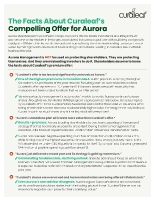
STAMFORD, Conn., Sept. 8, 2026 /PRNewswire/ -- Curaleaf Holdings, Inc. (TSX: CURA) (OTCQX: CURLF) ("Curaleaf" or the "Company"), a leading international provider of consumer and medical cannabis products, today released a fact sheet addressing a number of inaccurate and misleading statements made by Aurora Cannabis Inc. ("Aurora") in connection with Curaleaf's proposal to acquire Aurora. Curaleaf believes shareholders deserve the facts. While Aurora has focused on criticizing Curaleaf's proposal, shareholders should focus on the fundamental question: which company has a clearer vision for the future and a stronger record of creating shareholder value? The fact sheet below helps shareholders evaluate the choice between Curaleaf's premium offer and Aurora's standalone plan. Read the fact sheet and learn more at grow.curaleaf.com. MYTH: "Curaleaf's offer is too low and significantly undervalues Aurora." FACT: One of the highest premiums in Canadian M&A. A 45% premium is among the higher Canadian M&A premiums of the past decade. Excluding cash on Aurora's balance sheet, Curaleaf's offer represents a 110% premium*. If Aurora's assets are worth more, why has management been unable to unlock that value after years? More importantly, management's actions don't match its words. Aurora continues to issue shares through its At-the-Market (ATM) program at prices materially below the value implied by Curaleaf's offer. Since Curaleaf's bid, Aurora has accelerated these dilutive issuances while telling shareholders not to tender to a substantially higher value. If management truly believes Aurora is worth so much more, why is it selling stock at lower prices? MYTH: "Aurora's standalone plan will create more value than Curaleaf's offer." FACT: Results > promises. Aurora is asking shareholders to continue supporting a "turnaround" strategy that has had nearly six years to prove itself. During this time, management has recorded ~C$5 billion of impairments and ~C$130 million of business transformation costs. Aurora has overseen negative operating cash flow of more than C$480 million since FY21A, while having one of the highest executive compensation plans among industry peers. ACB's 97% share decline under CEO Miguel Martin speaks for itself. By comparison, Curaleaf generated $447 million of positive operating cash flow since F21. MYTH: "Aurora just delivered a record year and its strategy is gaining momentum." FACT: Deteriorating fundamentals, declining outlook. Shareholders should focus on where the business is headed, not where it has been. Management's own guidance says fiscal 2027 revenue is expected to decline to fiscal 2025 levels and adjusted EBITDA is expected to be lower than the prior year. MYTH: "Curaleaf's shares are overvalued and Aurora shareholders are being offered inflated stock." FACT: Even Aurora's own advisor disagrees. Aurora argues Curaleaf's shares are overvalued, yet its own financial advisor states that "the trading price of those [Curaleaf] shares can be reasonably regarded as a proxy for their underlying value." Curaleaf consistently commands a premium because it is the largest publicly traded cannabis company in the world and a leader in profitability and cash flow generation. Aurora can't have it both ways: if Curaleaf's valuation is too high, why is it not high enough for Aurora? MYTH: "Curaleaf's leverage presents a risk to future equity holders." FACT: Debt can be repaid; dilution is forever. Curaleaf is the largest cannabis operator by revenue and market cap, among the most profitable by adjusted EBITDA, and is a cash flow leader. Curaleaf's balance sheet compares favorably to peers, and the company's profitability and cash flows support its debt load. In contrast, Aurora promotes a "debt-free" balance sheet but ignores how that balance sheet was and is being financed. Aurora has raised more than US$400 million since September 2020 through equity issuances at the expense of shareholders and continues to rely on dilutive ATM programs that permanently reduce existing shareholders' ownership. MYTH: "ACB had substantive discussions with Curaleaf before rejecting our offer." FACT: They never even discussed price. Aurora never entered into a confidentiality agreement with Curaleaf and never once discussed price. Rather than testing whether additional value could be secured for shareholders, Aurora simply rejected the proposal without even discussing a counteroffer. MYTH: "The US$5.00 cap imposes a cap on any upside." FACT: If the cap is the issue, the Board can fix it. Aurora's criticism of the cap structure is a distraction from the significant premium represented by the US$5.00 cap. The US$5.00 cap price represents an implied premium within the 92nd percentile of Canadian M&A premiums over the last 10 years. The proposed structure encourages ACB shareholders to complete a transaction as soon as possible to lock in the exchange ratio and participate in potential upside and is the same structure that Aurora used in prior M&A transactions. If Aurora's Board was truly concerned about the cap, they can choose to shorten the 105-day bid period to 35 days and engage constructively with Curaleaf on the particulars of a deal. MYTH: "Aurora shareholders would trade independent ownership for a minority stake in a company controlled by one individual through multi-voting shares." FACT: This is about scale, not governance. Aurora shareholders would retain a minority stake in the combined company because Curaleaf is substantially larger than Aurora (>13x market cap prior to the offer). CURA insiders have nearly US$500 million of their own money invested alongside shareholders, significantly more than Aurora's insider ownership (~20% versus ~1%), and ensuring Curaleaf's management incentives are strongly aligned with shareholders. On the other hand, Aurora insiders have ~10% of the transaction value payable in the event of a change in control. Additionally, since Boris Jordan became CEO, Curaleaf has outperformed Aurora by approximately 57%. Multi-class voting structures are not a rarity. They are used by many of the largest founder-owned sector leaders, including Alphabet, Meta, Shopify, Palantir, DoorDash, and, among leading cannabis companies, Green Thumb, and Trulieve among others. MYTH: "Why should Aurora shareholders accept mostly Curaleaf stock?" FACT: Get paid today, participate in upside tomorrow. Cash consideration represents ~19% of the US$4.00 offer price, in line with precedent Canadian cannabis M&A transactions. Shareholders will receive immediate value while retaining ownership in the largest cannabis company in the sector with broader market exposure, stronger cash generation, and multiple future growth catalysts. MYTH: "Regulatory reform is already priced into Curaleaf's stock. There isn't much upside left." FACT: The biggest benefits are still ahead. Federal reform is not a one-time event. The value creation comes from what follows: immediately, materially lower cash taxes and improved free cash flow, and potentially broader institutional ownership, lower financing costs, greater M&A flexibility, access to credit cards, and uplisting to a major U.S. exchange. Those benefits compound over time and have only begun. MYTH: "Most of Curaleaf's business is Adult Use sales in the United States. That business is still federally illegal." FACT: Exposure to the world's largest cannabis market is an advantage, not a risk. Our U.S. medical business represents approximately 60%. What's more, U.S. cannabis regulation has been moving steadily in one direction: toward greater normalization, broader acceptance and reduced regulatory barriers. CURA's exposure to the world's largest cannabis market is a benefit and a competitive advantage. MYTH: "The transaction is not tax efficient for U.S. shareholders" FACT: Stay invested in the upside. A significant portion of the consideration consists of CURA shares, allowing shareholders to continue their investment in the combined company rather than fully liquidating their position. If tax structuring is a priority for Aurora, they should engage with Curaleaf to negotiate it. MYTH: "Why would Nasdaq-listed shareholders accept OTC paper?" FACT: It's about the business, not the exchange. Curaleaf trades on the TSX which is among the largest exchanges globally and is the leading exchange for cannabis issuers. On a 2026 YTD basis, CURA has traded meaningfully more value on the TSX relative to ACB on NASDAQ. Additionally, a Nasdaq listing has not prevented value destruction for ACB shareholders. Lastly, CURA is expected to also trade on a major U.S. exchange once the rescheduling process is completed. Cautionary Statement Regarding Forward-Looking Statements Cautionary Statement Respecting Aurora Information Notice to U.S. Holders It may be difficult for a securityholder in the United States to enforce his/her/its rights and any claim a securityholder may have arising under the U.S. federal securities laws, since the issuer is located in Canada, and some or all of its officers or directors may be residents of Canada or another country outside of the United States. A securityholder may not be able to sue a Canadian company or its officers or directors in a court in Canada or elsewhere outside of the United States for violations of U.S. securities laws. It may be difficult to compel a Canadian company and its affiliates to subject themselves to a U.S. court's judgment. Securityholders should be aware that the issuer may purchase securities otherwise than under the Offer, such as in open market or privately negotiated purchases. About Curaleaf Holdings Contacts Media Contact Investor Contact Shareholder Contact
SOURCE Curaleaf Holdings, Inc. | ||
Company Codes: CNSX:CURA,OTC-PINK:CURLF,OTC-BB:CURLF,OTC-QX:CURLF,Toronto:CURA |
 View original content to download multimedia: