



Equifax Second Quarter 2026 Market Pulse Index Report Sees First Pause in K-Shaped Economic Widening in Three Years
Equifax Second Quarter 2026 Market Pulse Index Report Sees First Pause in K-Shaped Economic Widening in Three Years |
| [28-September-2026] |
Measure of U.S. Consumer Financial Health Shows Modest Improvement In Consumer Financial Position Over Previous Quarter
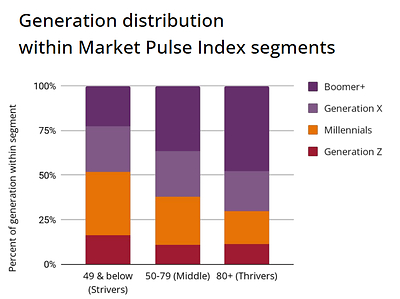
ATLANTA, Sept. 28, 2026 /PRNewswire/ -- Equifax® (NYSE: EFX) today released its second quarter 2026 Market Pulse Index, a measure of U.S. consumer financial health derived from anonymized credit, debt, income, and asset data along with VantageScore credit score insights. The Market Pulse Index rose slightly from 60.9 to 61.3, showing marginal improvement from the previous quarter, though the national average still sits just below where it stood a year ago. For the first time in three years, there was no observation of a widening gap in the K-shaped economy. The Index continues to track three consumer segments — Thrivers (those with an Index above 80), the Middle (those with an Index between 50 and 79), and Strivers (those with an Index of 49 and below) — each experiencing different financial realities. "We have closely observed the K-shaped economy since the COVID-19 pandemic. For the last three years, we have watched the gap between the top and the bottom of the 'K' widen, while the middle class shrank. In the second quarter of 2026, that pattern paused," said Emmaline Aliff, Advisory Leader at Equifax. "The Middle grew slightly, while the Striver population shrank and the Thriver population grew. One quarter does not make a trend, but this is the first quarter in some time where we have observed some improvement." The Economic Divide Paused Assets Remain the Clearest Dividing Line The Middle segment is where wealth is most mixed. About 32.4% of all U.S. consumers are Mass Affluent households, having between $100,000 and $1 million in assets, sitting in the Middle. Within that specific segment, the split between Mass Affluent and Mass Market is close to even at 46.8% and 42.9%, respectively. Households at similar asset levels can sit on either side of the Middle depending on their credit, debt, and income. Every Generation Improves Across The Board
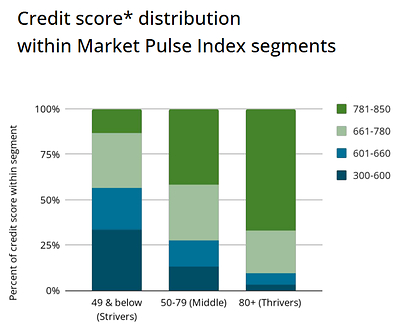
Sentiment vs. Reality: Feelings Didn't Match Financial Changes Credit Behavior Is Not the Same as Financial Capacity At the same time, 9.3% of Thrivers hold scores below 660, and 43.5% of Strivers carry prime or super-prime (scores of 781-850) credit. Excellent payment history is widespread across the country, with super-prime representing 38.4% of the entire U.S. population.
What separates Strivers are tight budgets and a lack of assets rather than difficulty meeting credit obligations: 81% of Strivers earn under $65,000 per year, making them highly sensitive to price changes, while nearly 88% of Thrivers earn more than $100,000. The Equifax Market Pulse Index provides a comprehensive view of U.S. consumer financial health by synthesizing anonymized credit, debt, income, and asset data with VantageScore credit score insights. The Index is designed to capture the combined effects of multiple economic forces rather than focusing on a single variable. Measured on a scale of 1 to 100 — where 100 represents the greatest financial strength — the Index delivers a holistic picture of consumer economic well-being, allowing for precise comparisons across diverse demographics and generations. The Equifax Market Pulse Index was built using AI and machine learning methods leveraging proprietary Equifax wealth and asset data along with data from the Equifax credit file and VantageScore 4.0 credit scores to provide a comprehensive view of consumer financial health. It distills the credit, debt, income, capacity, and assets of U.S. consumers into one benchmark number to reflect the cumulative index of both positive and negative financial factors. To learn more, read the full Market Pulse Index here. ABOUT EQUIFAX INC. FOR MORE INFORMATION:
SOURCE Equifax Inc. | ||
Company Codes: NYSE:EFX |

 View original content to download multimedia: