


ACLARA UPDATES PENCO MODULE PRELIMINARY ECONOMIC ASSESSMENT
ACLARA UPDATES PENCO MODULE PRELIMINARY ECONOMIC ASSESSMENT |
| [19-October-2026] |
After-tax NPV8 of US$344 Million based on Mineral Resources TORONTO, Oct. 19, 2026 /CNW/ -- Aclara Resources Inc. ("Aclara" or the "Company") (TSX: ARA) is pleased to announce the results of the updated preliminary economic assessment for its ion adsorption clay project located in the Biobío region, Chile, known as the Penco Module ("Penco" or the "Project"). The Project is being developed in partnership with CAP S.A. ("Grupo CAP"), a leading Chilean mining and industrial group holding a 20% ownership interest in the Project. The technical report titled "NI 43-101 Technical Report & Preliminary Economic Assessment on the Penco Module, Biobío, Chile" (the "PEA"), with an effective date of September 18, 2026 was prepared in accordance with National Instrument 43-101 – Standards of Disclosure for Mineral Projects ("NI 43-101") for Aclara with contributions from L&M Geociencias SpA, Promet 101 Consulting Pty Ltd, Abelco Consulting SpA, LOM Consultoria em Mineração Ltda, ERM Consultants Canada Ltd, Argus Media Ltd ("Argus Media") and William van Breugel as independent mining consultant. The PEA has been filed and can be found under the Company's profile on SEDAR+ (www.sedarplus.ca) and on Aclara's website (www.aclara-re.com). Highlights Strong Production of Heavy Rare Earth Elements within a Super Pure Rare Earth Carbonate ("SPREC") for a 17-year Life of Mine ("LOM")
Robust Economics
High Confidence in the Production Forecast
Very High-Quality SPREC
First Stage Environmental Approval Secured, with Low-Impact Project Design
Vertical Integration with Aclara's Processing Hub in Louisiana ("Project Dynamo")
Strong Financial Backing
Accelerated Development Pathway Targeting Construction Completion in H2 2028
Aclara COO, Hugh Broadhurst, commented: "The Penco Module stands out for its significant heavy rare earth content, particularly dysprosium, terbium and yttrium, and its strategic location in one of Chile's leading industrial regions. The Project benefits from a well-developed infrastructure network, with energy and recycled industrial water available nearby, direct access to major highways, and convenient connections to ports and an international airport. Its proximity to Concepción also provides access to a substantial pool of skilled workers while eliminating the need for a dedicated mining camp. These competitive advantages, combined with the support of Grupo CAP, our strategic partner in Chile, provide a strong foundation to accelerate the Project toward construction and production. Looking ahead, the potential integration of Penco with our separation and metals and alloys facilities in Louisiana offers a compelling opportunity to capture synergies across the value chain and strengthen Aclara's position as a vertically integrated supplier of critical rare earth materials to global markets." Key Project Parameters Table 2 and Table 3 summarize the relevant parameters associated with the PEA operating and financial metrics:
Table 1: Forecasted average price (US$/kg)
Table 2: Key Project Operating Parameters
Table 3: Key Project Financial Parameters
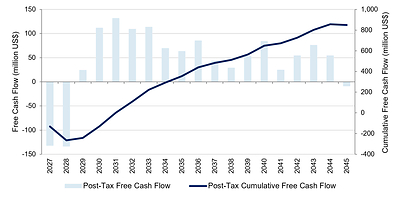
Post-Tax Free Cash Flow Figure 1 demonstrates the yearly and cumulative post-tax free cash flow generated through the LOM. Figure 1: Projected LOM, post-tax, unleveraged free cash flow. Source: Aclara Resources Inc. (2026)
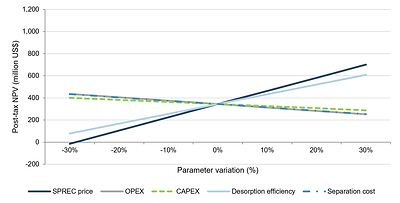
Sensitivity Analysis A sensitivity analysis was undertaken to evaluate the impact on post-tax NPV, considering a variation of ±30.0% for five key input variables: SPREC sale price, Separation Cost, Desorption Efficiency, OPEX and CAPEX (Figure 2). Figure 2: Sensitivity analysis testing the impact on NPV. Source: Aclara Resources Inc. (2026)
The economic analysis of the estimated cashflows for the Project indicates the potential for an economic project across a broad range of input assumptions. The NPV calculated at an 8.0% discount rate is positive, and the IRR calculated for the Project is within a favourable range. The primary commercial risks include:
The preliminary economic assessment is preliminary in nature. It includes Inferred Mineral Resources that are considered too speculative geologically to have the economic considerations applied to them that would enable them to be categorized as Mineral Reserves. There is no certainty that the preliminary economic assessment will be realized. Mineral Resources that are not Mineral Reserves do not have demonstrated economic viability. Mineral Resource Estimate The updated Mineral Resource Estimate ("MRE"), effective September 18, 2026, was prepared in accordance with NI 43-101 and the CIM Definition Standards. It is supported by 618 sonic drill holes totaling 17,397 meters and a composited estimation dataset of 7,981 nominal 2-m intervals. At an NSR cut-off of US$14.62/t, Measured and Indicated Mineral Resources total 35.8 Mt grading 2,095 ppm total rare earth oxides ("TREO"), comprising 26.4 Mt Measured and 9.4 Mt Indicated. An additional 2.2 Mt are classified as Inferred, grading 1,768 ppm TREO. Nearly 74% of the Measured and Indicated tonnage is classified as Measured, the highest-confidence Mineral Resource category. The updated classification applies a refined Three-Hole Rule methodology to the previously estimated geological blocks, producing more spatially coherent resource categories. The underlying drill database and estimated block grades remain unchanged relative to the 2022 MRE; the study should not be described as a new drilling-led resource discovery. Table 4: Mineral Resource Estimate – Oxide Grades (ppm)
Table 5: Mineral Resource Estimate – Contained Oxides (tonnes)
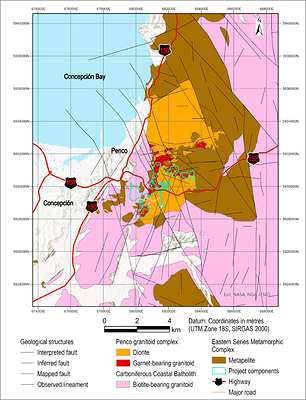
Geology & Geological Interpretation The Project is hosted within a geological environment comprising intrusive granitoid units and metamorphic country rocks that control the distribution of REE mineralization (Figure 1-3). Geological investigations have defined the lithological, structural, and weathering characteristics that govern REE enrichment and support the current geological and mineral resource models. Figure 3: Regional geology of the Penco area, Biobío Region, Chile. Source: Aclara Resources Inc. (2026)
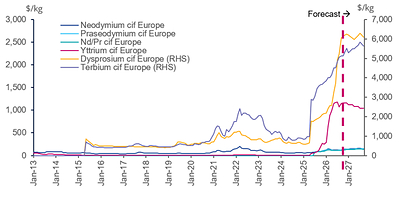
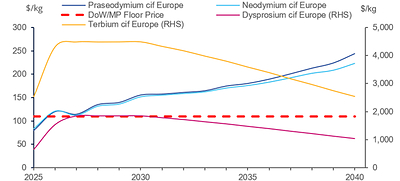
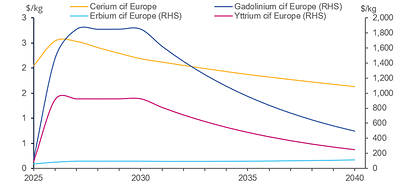
The Project is located within the Chilean Coastal Range and is characterized by the Eastern Series Metamorphic Complex, the Carboniferous Coastal Batholith, and the Penco granitoid complex ("PGC"). These units define the regional geological framework and geological evolution of the Project area, with the PGC hosting the majority of the REE mineralization. The area is dominated by granitoid units affected by weathering processes that generated clay-rich regolith profiles hosting exchangeable REEs. Mineralization is primarily associated with monazite-bearing granitoids and is concentrated within the completely and semi-weathered horizons. Although the host rocks exhibit propylitic alteration, REE enrichment is mainly controlled by weathering, regolith development, and local structural conditions that influence profile preservation. The Project hosts several REE-bearing deposits, referred to as Victoria (Victoria Norte and Victoria Sur), Maite, Luna, and Alexandra. Mineralization is associated with weathered granitoid units and concentrated within regolith horizons enriched in exchangeable REEs. Sampling, Assay & QA/QC Protocols Samples collected during the Project drilling campaigns were prepared, handled, and analyzed following established industry protocols, including chain-of-custody procedures, laboratory sample preparation, and geochemical analyses for REEs and bulk chemistry. The analytical database incorporates data from the 2021 PEA and subsequent drilling campaigns completed across the Project deposits. A comprehensive quality assurance/quality control (QA/QC) program was implemented to evaluate analytical accuracy, precision, and contamination through the routine insertion of certified reference materials, blanks, and duplicate samples. The results demonstrate a high level of analytical quality, with acceptable accuracy, strong precision, limited contamination, and no material issues that would affect the reliability of the database. Based on the QA/QC review, the sampling, preparation, analytical, and security procedures are considered adequate to support Mineral Resource estimation and geological interpretation. Estimation Methodology & Reporting Rare earth element Mineral Resources at the Project were estimated for the Victoria, Luna, Maite, and Alexandra deposits using geological and geostatistical models that incorporated lithological controls, weathering horizons, and mineralization domains. Estimation zones were defined based on geological continuity, regolith profiles, and grade distributions, providing the framework for grade interpolation and resource classification. The resource models were constrained within economically optimized open-pit shells and supported by updated drilling, geological interpretation, and statistical analyses. Project Description Mining The Project is designed as a shallow, conventional open-pit operation using mechanical excavation. The Project extraction zones will be mined using conventional open pit techniques with small-size equipment. Mining will be undertaken by hydraulic excavator with a backhoe configuration and an operating weight of 75 t and equipped with a 5.1 m3 bucket. All haulage will be performed by 23-t road trucks. The trucks will haul mined materials to processing facilities, the run of mine stockpile, and the washed clay/waste storage facility. Grade control will be conducted on a daily basis to delineate the mineralized zones, obtain samples for testing, and update and correlate the geological database to improve prediction of head grades. Samples will be collected primarily via auger drilling. Given the friable nature of the ionic clays, no blasting, crushing or milling is required. SPREC Production The processing plant is designed to recover REEs from ionic clay feed and produce SPREC product. The plant is designed to treat approximately 320 t/h of solids and achieve an equivalent average rare earth oxide production rate of approximately 732 t/year, excluding the ramp-up and ramp-down periods. The process begins with ore conditioning into a slurry through the addition of a low‑pH solution, enabling the ion exchange process to transfer REEs into solution. This ore conditioning stage will include two feeders, a washing drum, screening, thickening, and filtration, and concludes with the recovery of a pregnant solution containing the REEs. This stream will be directed to a primary precipitation stage, from which the washed clays will be transported to the deposition zone. The primary precipitate will be redissolved, and the resulting REE-rich solution will undergo successive chemical stages to remove impurities before producing the final SPREC product. Impurity removal will be carried out in a primary precipitation stage. The resulting product will be fed through a polishing filtration stage to remove solids impurities. A similar process will then be used to precipitate REEs from the resulting filtrate solution. A final selective separation stage is then used to reduce light rare earth elements, such as lanthanum and cerium. Final SPREC will be filtered in tube press filters and bagged for client distribution. Water generated during processing is treated in a dedicated water treatment plant and recycled back into the process, enabling recovery of approximately 97% of fresh water and 99% of ammonium sulphate. Project Infrastructure The Project infrastructure will include five extraction zones (Victoria Norte, Victoria Sur, Luna, Maite, and Alexandra), a processing plant, a stockpile area, the Neptuno deposition zone, internal access roads, and a dedicated electrical power connection. Electrical power will be supplied through a connection to the existing 15 kV distribution network, including a dedicated power line along the Route 152 transportation corridor that will be connected to Chile's National Electric System. The average demand is calculated to be 4.0 MW. Total electrical loads have been estimated using the Project's processing plant mechanical equipment list and other building power requirements. Communication services will be supported by a dedicated telecommunications infrastructure. Subject to final service agreements, regional telecommunication providers may also offer public mobile telephone services. Essbio S.A. will supply potable water through the Planta Biobío system. Industrial water will come from the existing Essbio Biobío Wastewater Treatment Plant, which will supply treated effluent for the processing plant. Water tank trucks will transport all water to the Project site and offload it into two dedicated receiving tanks that serve as the primary storage and supply buffer. Service water will be pumped from a tank into a closed‑loop distribution network that delivers water continuously to all designated consumption points throughout the facility. Drinking water will be separately pumped from a tank to all areas where it is required for human use and consumption, including the processing plant safety showers. A centralized diesel fuel storage and distribution facility will be located adjacent to the processing plant and mine operations. Permitting and Social In June 2026, the Project received a favourable Environmental Qualification Resolution ("RCA") for the first stage of the Project. Environmental management plans include monitoring of surface water, groundwater, air quality, soils, vegetation, wildlife, and social commitments throughout the Project life cycle. Indigenous consultation was completed with local Mapuche communities, resulting in agreements that support ongoing engagement and project implementation while addressing environmental and social obligations. Aclara has established Casa Aclara as a permanent community information and engagement centre to engage with community members, local governments and Indigenous peoples in the implementation of environmental, social and economic project commitments. The RCA was issued on June 19, 2026 and published on June 22, 2026, paving the way for the acquisition of sectoral permits for the construction and operation of the mine. The Project is being permitted in two stages through separate EIAs, as permitted under Chilean environmental regulations. The first-stage EIA, submitted in June 2024, covers the Victoria Norte, Luna and Maite extraction zones, the Neptuno deposition zone, the processing plant and associated infrastructure, which together support approximately the first six years of operations under the PEA mine plan. It was approved by the Biobío Regional Environmental Evaluation Commission on June 8, 2026, and the resulting RCA is the only environmental approval currently held for the Project. A second-stage EIA, expected to cover the Victoria Sur and Alexandra extraction zones, the Júpiter deposition zone and the expansion of the Neptuno deposition zone, has not yet been prepared or submitted. The portion of the PEA production schedule and economic analysis that depends on those components is subject to obtaining a favourable environmental approval for the second-stage EIA, which cannot be assured. Rare Earth Market Outlook The market study in Chapters 19.1–19.6 of the PEA was provided by Argus Media (2026), an independent market expert in REEs. The qualified person responsible for Chapter 19 has reviewed these studies and confirms that the results support the assumptions in the PEA. Vehicle electrification and the transition to renewable energy will continue to drive the REE market in terms of volume and (especially) value. Demand will increase for the REEs used in permanent magnets (REE PMs): neodymium, praseodymium, dysprosium, and terbium oxides. When growth in the electric vehicle and renewable energy industries begins to plateau, the industrial and humanoid robotics sector and drone technology are likely to keep boosting REE PM demand in the long term. The supply of the light REE PMs, neodymium (primarily) and praseodymium (to a lesser extent), from existing producers and new projects appears to be sufficient to satisfy demand until at least the end of the decade, although balances are tightening, particularly for praseodymium. However, the supply of the heavy REE PMs, dysprosium and terbium, as well as the heavy REEs gadolinium and yttrium is more problematic because far fewer projects target heavy REE deposits. The market will likely have to rely on China and Myanmar/Laos in the short to medium term for supply of heavy REE feedstocks, although production of ion-adsorption REE ores in southern China is declining. Chinese free on board ("FOB") prices for neodymium, praseodymium, and didymium oxide (NdPr, a mixture of praseodymium oxide and neodymium oxide) strengthened through 2025, increasing from the mid US$50/kg to the low US$100/kg range, owing to rumours of a decrease in product quotas for ion adsorption ores, enhanced efforts to curb smuggling of critical materials, and uncertainty of supply. Prices maintained their momentum through Q1 2026, exceeding the US$150/kg threshold before returning to the US$120/kg vicinity through Q3 2026. In early April 2025, China extended its export control scheme to include dysprosium, terbium, gadolinium, yttrium, lutetium, samarium, and scandium, likely in retaliation against the reciprocal tariffs announced by the United States (US) president. The effect on European REE prices was immediate: Argus's European assessments for dysprosium, terbium, and yttrium prices rose to nearly 3 to 7 times higher than Chinese prices. The disconnect has persisted through 2026, with dysprosium in Europe trading well over US$2,000/kg (compared to US$300/kg in China). Terbium has exceeded US$5,000/kg in Europe (compared to US$1,200/kg in China). Yttrium prices sit above US$1,100/kg, nearly 30 times higher than domestic Chinese prices. Europe and North America have made only marginal progress in regaining access to the REEs brought under China's export license system. Beijing began granting some REE export licenses in June 2025, but licensing remains restrictive in 2026, with approvals limited in number and scope. In the absence of sufficient replacement material, inventories outside China are becoming depleted, contributing to higher prices in the prompt spot market. Figure 5 shows current and forecasted prices currently being traded in Europe. Figures 5 and 6 show forecasted prices by Argus Media based European REE prices. Figure 4: Monthly European Cost, Insurance and Freight (CIF) permanent magnet rare earth oxide prices for 2013–2027. Abbreviations: Nd/Pr, didymium oxide; RHS, right-hand side. Source: Argus Media (2026)
Figure 5: European Cost, Insurance and Freight (CIF) and US delivery duty paid permanent magnet REO forecast prices for 2025-2040, including the MP Materials-Department of War (DOW) didymium oxide floor price (real, 2025). Abbreviations: RHS, right-hand side. Source: Argus Media (2026)
Figure 6: European Cost, Insurance and Freight (CIF) non-permanent magnet rare earth oxide forecast prices for 2025–2040 (real, 2025). Abbreviations: RHS, right-hand side. Source: Argus Media (2026)
Proposed Next Steps
Qualified Persons The scientific and technical information included in this news release and pertaining to the following chapters and sections of the PEA has been reviewed and approved by the following qualified persons, each of whom are independent of Aclara:
About Aclara Aclara Resources Inc. (TSX: ARA), a Toronto Stock Exchange listed company, is focused on building a vertically integrated supply chain for rare earth alloys used in permanent magnets, as well as high-purity rare earth oxides, including yttrium and gadolinium, for power generation, aerospace and other high-performance applications. This strategy is supported by Aclara's development of rare earth mineral resources hosted in ionic clay deposits, which contain high concentrations of the scarce heavy rare earths, providing the Company with a long-term, reliable source of these critical materials. The Company's rare earth mineral resource development projects include the Carina Project in the State of Goiás, Brazil as its flagship project and the Penco Module in the Biobío Region of Chile. Both projects feature Aclara's patented technology named Circular Mineral Harvesting, which offers a sustainable and energy-efficient extraction process for rare earths from ionic clay deposits. The Circular Mineral Harvesting process has been designed to minimize the water consumption and overall environmental impact through recycling and circular economy principles. Through its wholly-owned subsidiary, Aclara Technologies Inc., the Company is further enhancing its product value by developing a rare earth separation plant in the United States. This facility will process mixed rare earth carbonates sourced from Aclara's mineral resource projects, separating them into pure individual rare earth oxides. Additionally, Aclara through a joint venture with Grupo CAP, is advancing its alloy-making capabilities to convert these refined oxides into the alloys needed for fabricating permanent magnets. This joint venture leverages Grupo CAP's extensive expertise in metal refining and special ferro-alloyed steels. Beyond the Carina Project and the Penco Module, Aclara is committed to expanding its mineral resource portfolio by exploring greenfield opportunities and further developing projects within its existing concessions in Brazil, Chile, and Peru, aiming to increase future production of heavy rare earths. Forward-Looking Statements This news release contains "forward-looking information" within the meaning of applicable securities legislation, which reflects the Company's current expectations regarding future events, including statements with regard to: the results of the updated PEA for the Project, including the estimated Mineral Resources, projected mine life, mining and processing rates, anticipated production volumes and composition of SPREC, and expected metallurgical recoveries and product purity; the Project's estimated capital and operating costs, net smelter return, revenues, EBITDA, after-tax net present value, internal rate of return, payback period and other economic projections, including the alternative economic scenario based on uncapped Argus Media price forecasts ; the assumptions underlying the PEA, including rare earth oxide prices, processing costs, commercial discounts, transportation and separation costs; the anticipated completion of the Project's Feasibility Study in Q1 2027, commencement of engineering, site preparation and construction activities in 2027, and targeted completion of construction in H2 2028, subject to financing; the receipt of remaining sectoral permits and approvals following the Project's environmental approval and the outcome of any administrative or judicial challenges thereto; the preparation, submission and approval of the second-stage EIA; the expected environmental performance of the Project, including water and reagent recirculation rates, the use of recycled industrial water, land restoration and revegetation activities; the expected quality and regulatory classification of SPREC, including its anticipated qualification as non-regulated, non-radioactive material for transportation and processing; the integration of the Penco Module with the Company's downstream separation and metals and alloys production strategy, including Project Dynamo in Louisiana; the anticipated development and production of separated rare earth oxides, metals and alloys, and the expected achievements and timelines of the Company's demonstration plants at Virginia Tech and through Aclara Metals; the expected availability and pricing of rare earth products, future market demand and supply conditions, including the impact of Chinese export restrictions and the development of rare earth supply chains outside China; the availability of financing and strategic support for the Project; the potential exercise by Grupo CAP of its option to increase its ownership in REE UNO from 20% to 40% through a US$50 million investment upon the Project's final investment decision; the anticipated processing of SPREC at, and payment of separation charges to, the Company's planned separation facility in Louisiana; the Company's community and Indigenous engagement commitments; and statements in the quotations attributed to the Company's management. Forward-looking information can generally be identified by the use of words such as "plans", "expects", "estimates", "targets", "anticipates", "intends", "potential", "projected", "designed", "on track" or variations of such words, or statements that certain actions, events or results "may", "could", "would", "will" or "are expected to" occur or be achieved. The economic results of the PEA, including NPV, IRR, payback period, net revenue, EBITDA, NSR and capital and operating cost estimates, are forward-looking information and may constitute a "financial outlook" within the meaning of applicable securities laws. They are provided solely to present the potential economics of the Project as assessed in the PEA and may not be appropriate for other purposes. Forward-looking information is based on a number of assumptions and is subject to a number of risks and uncertainties, many of which are beyond the Company's control. Material assumptions include, among others: the accuracy of the Mineral Resource estimates, geological models, mining schedules, processing rates, metallurgical recoveries and production forecasts contemplated in the PEA; the accuracy of the estimated capital and operating costs, including mining, processing, deposition, transportation and commercial separation costs; the rare earth oxide price forecasts provided by Argus Media, including the Company's assumed prices for yttrium and gadolinium and the continued relevance of European market prices outside China; the discount rates, exchange rates, tax assumptions, project life, production schedule and other economic parameters underlying the PEA; the availability of financing on acceptable terms and the timely completion of the Feasibility Study, detailed engineering, site preparation and construction; the receipt of all remaining permits and approvals on a timely basis and the continued validity of the Project's environmental approval, including the absence of successful administrative or judicial challenges thereto, and the timely receipt of environmental approval for the second-stage EIA; the successful implementation and scale-up of the Circular Mineral Harvesting process and the ability to achieve targeted SPREC purity, recovery rates and environmental performance; the availability of industrial water, power, reagents, equipment, personnel and contractors at anticipated costs; the successful development and operation of Project Dynamo and the availability of downstream separation capacity for the Project's SPREC production on the commercial terms contemplated in the PEA; the continued regulatory classification of SPREC as anticipated; the continued support of the Company's strategic shareholders and the potential exercise of CAP's investment option; market demand and prices for rare earth products, including the continued development of supply chains outside China; and the absence of material adverse changes in trade policy, export controls, geopolitical conditions or other market circumstances; the absence of material changes to Chilean mining, tax, royalty or environmental laws; currency exchange rates and inflation consistent with the PEA assumptions; and the maintenance of positive relations with local communities and Indigenous peoples. Such risks and uncertainties include, but are not limited to: the preliminary nature of the PEA, which includes Inferred Mineral Resources that are considered too speculative geologically to have economic considerations applied to them that would enable them to be categorized as Mineral Reserves, and the absence of certainty that the PEA results will be realized; the accuracy range inherent in an AACE Class 5 capital cost estimate, and the possibility that the Feasibility Study may produce results that differ materially from the PEA or may not support a construction decision; Mineral Resources that are not Mineral Reserves do not have demonstrated economic viability; risks related to the accuracy of Mineral Resource estimates, geological interpretation, mine planning, processing assumptions, metallurgical recoveries and production forecasts; actual capital expenditures, operating costs, production volumes, revenues and economic results differing materially from those anticipated; changes in rare earth oxide prices, including the risk that prices realized for SPREC-derived products may be closer to Chinese domestic prices than to the European price forecasts underlying the PEA base case, and the limited liquidity and transparency of rare earth markets outside China, including the potential narrowing of price differentials between China and markets outside China and the impact of Chinese government intervention, trade restrictions or changes in supply and demand; the availability and cost of financing, including the possibility that the Company may be unable to secure sufficient funding to complete construction within the anticipated schedule; delays in completing the Feasibility Study, engineering, permitting, procurement, construction, commissioning or start-up of the Project; risks associated with operating in Chile, including political, economic, regulatory, environmental and social conditions; changes to mining laws and regulations, the termination or non-renewal of mining rights, or the failure to obtain or maintain required permits and approvals, including administrative appeals, judicial proceedings or other challenges to the Project's environmental approval; community opposition and the maintenance of community and Indigenous relations; the failure to obtain, or delays in obtaining, environmental approval for the second-stage EIA; environmental compliance obligations, including water management, reagent recirculation, deposition, land restoration and community commitments; risks related to technology development, process optimization and scale-up from pilot operations to commercial production, and the Company's ability to protect its intellectual property; the availability and reliability of water, energy, reagents, equipment, contractors and qualified personnel; risks associated with transportation, product quality, regulatory classification and downstream processing of SPREC; dependence on the successful development and operation of Project Dynamo for the Company's planned vertically integrated processing strategy, including potential changes in separation costs or the availability of alternative processing arrangements; risks related to CAP's investment option, including the possibility that the option may not be exercised; reliance on technical consultants, engineering contractors, suppliers, strategic partners and other third parties; inflation and cost escalation; currency exchange rate fluctuations; dilution resulting from future equity financings; and risks associated with international trade, tariffs, export controls and geopolitical developments. Aclara cautions that the foregoing list of factors is not exhaustive. For a detailed discussion of the foregoing factors, among others, please refer to the risk factors discussed under "Risk Factors" in the Company's annual information form dated March 18, 2026, filed on the Company's SEDAR+ profile. Actual results and timing could differ materially from those projected herein. Readers are cautioned not to place undue reliance on forward-looking information. Unless otherwise noted or the context otherwise indicates, the forward-looking information contained in this news release is provided as of the date of this news release, and the Company does not undertake any obligation to update such forward-looking information, whether as a result of new information, future events or otherwise, except as expressly required under applicable securities laws.
SOURCE Aclara Resources Inc. | ||||||||||||||||||||||||||||||||||||||||||||||||||||||||||||||||||||||||||||||||||||||||||||||||||||||||||||||||||||||||||||||||||||||||||||||||||||||||||||||||||||||||||||||||||||||||||||||||||||||||||||||||||||||||||||||||||||||||||||||||||||||||||||||||||||||||||||||||||||||||||||||||||||||||||||||||||||||||||||||||||||
Company Codes: Toronto:ARA | ||||||||||||||||||||||||||||||||||||||||||||||||||||||||||||||||||||||||||||||||||||||||||||||||||||||||||||||||||||||||||||||||||||||||||||||||||||||||||||||||||||||||||||||||||||||||||||||||||||||||||||||||||||||||||||||||||||||||||||||||||||||||||||||||||||||||||||||||||||||||||||||||||||||||||||||||||||||||||||||||||||