


Whoscall, GASA and Mastercard Release the 2026 Asia Scam Report: Hong Kong
Whoscall, GASA and Mastercard Release the 2026 Asia Scam Report: Hong Kong |
| [27-October-2026] |
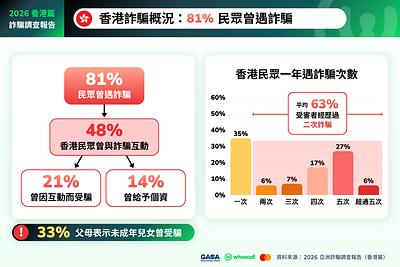
More Than 80% of Hong Kong Respondents Encountered Scams; Phone Calls and SMS Remain the Leading Channels and bank account transfers by scammers is significantly above the Asia average at 43% Impersonation Scams Are the Most Common, While More Than 60% of Victims Have Been Scammed More Than Once HONG KONG, Oct. 28, 2026 /PRNewswire/ -- The Global Anti-Scam Alliance (GASA), Whoscall, the anti-scam app developed by TrustTech company Gogolook, and Mastercard have jointly released the 2026 Asia Scam Report: Hong Kong. The report examines how people in Hong Kong encounter scams, the tactics scammers use, how victims are asked to pay, and the effects of being scammed. It finds that 81% of respondents encountered a scam in the past year, while 48% interacted with a scammer. Phone calls and SMS remain the most common points of contact, and WhatsApp leads among individual digital platforms. 81% Encountered Scams; 27% of Victims Were Scammed Five Times According to the report, 81% of Hong Kong respondents encountered a scam in the past year. Nearly half (48%) interacted with a scammer; 21% lost money following an interaction, and 14% provided personal information. The risk also extends to younger people: 33% of parents surveyed said their underage children had been scammed. Among respondents who had been scammed, approximately 63% had been victimized more than once. More than a quarter (27%) said they had been scammed five times, while another 6% reported more than five incidents. These findings point to the need for continued support after an initial scam, including guidance that helps victims recognize and avoid subsequent attempts.
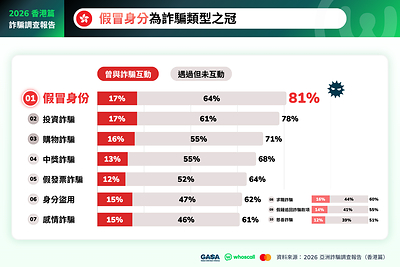
"One of the most striking findings in Hong Kong is the gap between confidence and vulnerability. While 76% of adults believe they can recognize a scam, nearly half of those exposed still interacted with one. Awareness is important, but consumers cannot be expected to carry the burden alone. Stronger prevention and intervention across the scam journey are essential," said Brian D. Hanley, Chapter Director Asia-Pacific, Global Anti-Scam Alliance (GASA). Jeff Kuo, Co-founder and CEO of Gogolook, said: "Scams now reach people through everyday channels, from phone calls and texts to messaging apps. More than 60% of scam victims in Hong Kong have been scammed more than once, highlighting the need for continued scam prevention education. Through our work with GASA, we hope to turn these findings into greater awareness and stronger protection. Gogolook will keep improving its technology to help people identify scams." Rajat Maheshwari, GASA Inaugural Chapter Chair and Senior Vice President, Strategic Growth (AP), Mastercard shared, "Hong Kong has put in place a strong range of measures to combat scams, offering valuable learnings for markets around the world. As scams continue to evolve, the GASA report highlights the opportunity to build on this progress through deeper collaboration across the wider ecosystem, supported by technology and a greater focus on preventive and behavior-based measures. Continued public-private partnership will be essential to staying ahead of emerging threats and helping protect people from scam-related losses." Top Three Scam Channels Revealed; WhatsApp Leads Digital Platforms at Nearly 70% Phone calls (59%) and SMS (52%) were the channels through which Hong Kong respondents most commonly encountered scams, followed by messaging apps (47%) and email (41%). Compared with 2025, the share reporting scam contact by phone was unchanged, SMS fell by two percentage points, and messaging apps rose by four percentage points. The report also found that around 80% of scam contact occurred on platforms with private messaging capabilities, underscoring the need to scrutinize suspicious requests that move from calls or texts into private conversations. Among individual digital platforms, WhatsApp ranked first at 68%. Hong Kong Police recently reported receiving around 50 cases of WhatsApp account hijacking in the first week of October, with losses totaling nearly HK$20 million. Many of the cases involved cryptocurrency or investment pretexts. Gmail (32%) and Facebook (28%) followed WhatsApp, while Instagram (22%) and Telegram (17%) also featured prominently. Whoscall advises people to verify a contact through a separate, trusted channel, even when a message arrives on a familiar platform or appears to come from a friend, business or public agency. Impersonation Encountered by Over 80% of Respondents, Followed by Investment and Shopping Scams Impersonation was the most widely encountered scam type, reported by 81% of Hong Kong respondents; 17% had interacted with someone carrying out such a scam. Scammers may pose as Hong Kong Police, the Department of Health or mainland law enforcement officials, claim that a person is implicated in a crime, and demand passwords or access to assets for a purported investigation. Others may impersonate banks, major telecommunications providers or online shopping platforms, using claims of account problems or order cancellations to obtain personal information, passwords or remote access to a device. Investment scams followed at 78%, while shopping scams reached 71%. Respectively, 17% and 16% of respondents had interacted with scammers using these approaches. Other commonly encountered schemes included prize scams (68%), fake invoice scams (64%), identity theft (62%) and romance scams (61%). In addition, 55% had encountered offers claiming to help recover money lost to a scam. Such approaches warrant particular caution from people who have already suffered a loss.
Bank Transfers Are the Most Common Payment Method; Harm Extends Beyond Financial Loss Among respondents who paid a scammer, 43% did so by bank transfer, above the Asia-wide average of 36%. Mobile payment apps and credit cards each accounted for 25%, followed by e-wallets at 24%. Physical or digital gift cards, cash, and payment tools within websites each accounted for 21%. The trend shows scammers favor immediate and irrevocable payment methods that increase in abuse rates in Hong Kong. This will require more advance interventions to secure these immediate payment rails in Hong Kong. The report also examined the broader effects of scams on people in Hong Kong. Beyond financial loss, 33% said the experience had damaged their confidence and caused them to question themselves, 28% worried about being scammed again, and 23% had become less trusting of the internet or digital tools. The effects reached into daily life: 23% needed financial help from friends or family, and another 23% reported a greater need to borrow money. Both figures exceeded the Asia-wide averages. When faced with a suspicious message or request, Whoscall recommends pausing before taking action and checking the sender's identity using information from an official website. Anti-scam tools can also help assess unfamiliar numbers, links and messages. Anyone who has been scammed should seek help from the relevant authorities or organizations promptly and remain alert to subsequent offers to recover their money, which may be another scam attempt. To help people navigate changing scam tactics, Whoscall offers more than caller identification. Its Check feature lets users assess suspicious phone numbers, URLs and screenshots in one place. Whether they receive an unfamiliar message or a promotional email, users can upload a screenshot or photograph a physical flyer for an AI-powered assessment of potential risks. They can also share the results with friends and family, helping others recognize suspicious content before they engage with it. The full 2026 Asia Scam Report – Hong Kong is available on the GASA website: For more information about the Global Anti-Scam Summit Asia 2026, visit: About Whoscall The Whoscall app, a digital anti-scam tool, is designed to protect users across various scenarios from scams and spams, including phone calls, text messages, and links. With over 100 million downloads worldwide, it boasts the most comprehensive database in East and Southeast Asia, encompassing over 2.6 billion phone numbers, and collects data from partner ScamAdviser to form a leading digital anti-scam database. The Whoscall team has been dedicated to developing anti-scam technology for over a decade, employing AI to analyze and simulate the patterns of scam groups, proactively preventing the spread of scams. At the same time, Whoscall actively engages in building a community collaboration mechanism with its users, playing a role with societal impact in digital anti-scam services from educational initiatives, cross-sector collaboration to product innovation. Recognized and chosen for partnerships by the Taiwan National Police Agency, Thai Royal Police and NCSA, Royal Malaysia Police and CyberSecurity Malaysia, the Philippines Cybercrime Investigation and Coordinating Center, Financial Supervisory Service of South Korea, and local governments in Japan. For more information, please refer to: https://whoscall.com/en
SOURCE Whoscall; Gogolook | ||
Company Codes: Taiwan:6902 |
 View original content to download multimedia: